
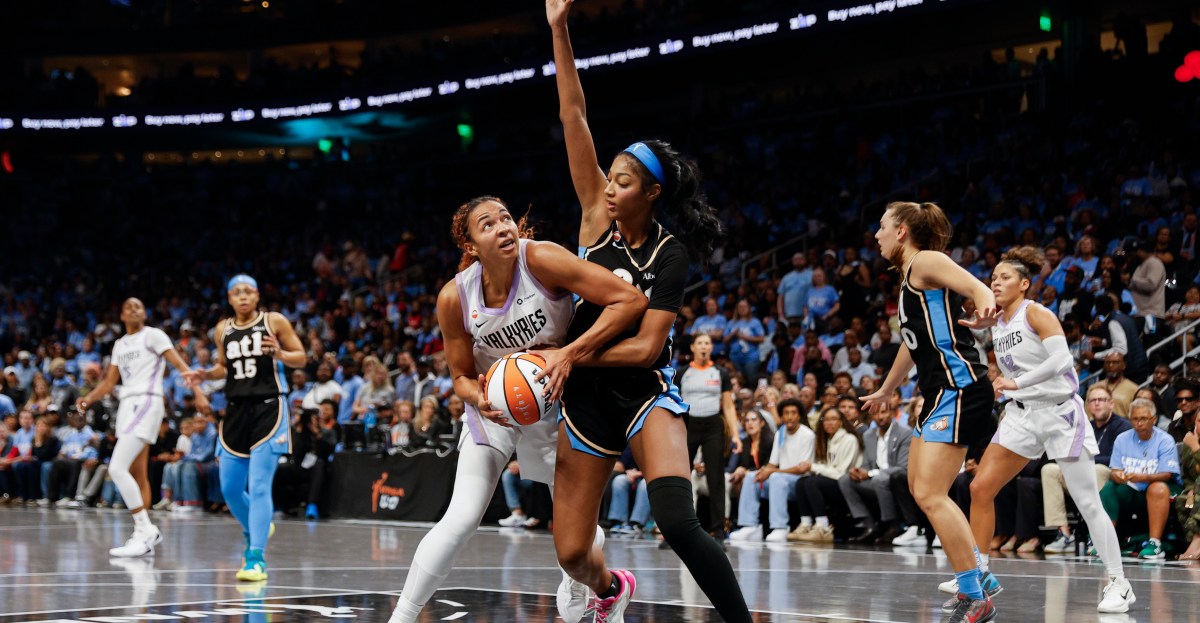
The Atlanta Dream lead the 2026 WNBA Finals 2-1, and Saturday’s Game 4 (1 p.m. ET, NBC) may be the game that decides it.
A Dream win sends them back to San Francisco up 3-1 and one victory from the first championship in franchise history. A Valkyries win levels the series, returns homecourt advantage to Golden State and puts a second-year franchise back on track for a title of its own.
Underneath it all sits an underlying question that has defined the first three games of this series: Who is your weakest link?
What is “weak link” theory?

Tip off of Game 3 of the WNBA Finals. Icon Sportswire via Getty Images
Basketball has always been widely considered to be a strong-link sport. That perspective essentially boils down to, “As long as X is on your team, you have a chance.”
Conventional wisdom has been that your best player set your ceiling, and the supporting cast mostly needed to avoid disaster. However, with the influx of matchup hunting and pace we’re seeing in the W, it has tilted toward the weak link being the determining factor that can cap a team’s ceiling.
Every possession is a search for the defender who can’t hold up or the offensive player who can’t punish an ignored closeout, and one hole can sink a lineup no matter how good its stars are.
These Finals may be the cleanest illustration in years. Both teams pair a defining strength with a singular matchup to exploit on the other end, and both coaching staffs are hunting for it on every trip down the floor.
Atlanta has exposed Golden State’s weak link

Kiah Stokes and Angel Reese. Getty Images
She has a double-double in all three games, including 30 points and 16 rebounds in Game 2 and 21 points and 12 rebounds on 7-for-12 shooting in Game 3—and she is the youngest player ever with three straight Finals double-doubles.
Golden State’s problem is that only one Valkyrie has consistently bothered her: Kiah Stokes.
Stokes has been spectacular, recording 11 rebounds and three blocks in back-to-back games and 23 blocks this postseason, which is tied forthe seventh-most in a single WNBA postseason. Put anyone else on Reese and she gets deeper seals, cleaner catches and easy shots at the rim.
The cost for Golden State shows up on the other end. Stokes is not a floor-spacer, so whoever guards her can ignore her and shrink every driving lane that comes available for Golden State . Her on-off data reflects that: The defense holds with her on the floor, but the offense gets capped. The Valkyries have scored 68, 65 and 71 points in this series, topping 70 exactly once—and that was in a 26-point loss. In Game 3 they missed their first eight shots and went nearly five minutes without a basket.
The Dream’s formula is to make Stokes’s defensive greatness expensive. She anchors the rim, so drag her away from it. Use Reese as a hub at the top of the key so Stokes must commit to guarding her, then let Rhyne Howard, Allisha Gray and Jordin Canada cut and drive into the vacated space.
On the other end, the Dream have treated the Stokes’ matchup as an opportunity to deploy a free safety. Assign a disruptive perimeter defender to guard her—the kind Howard was in Game 2 when she set a Finals record with six steals—to roam off Stokes and live in the passing lanes. Atlanta turned 15 Golden State turnovers into 22 points in Game 3, while the Valkyries managed seven points off eight Dream turnovers.
Does Golden State have a viable counter?

Golden State head coach Natalie Nakase. NBAE via Getty Images
The Valkyries can’t remove Stokes without Reese making them pay for it, so they must make due with her on the court.
But beyond Stokes, Golden State, a team that prides itself on strength in numbers, has the depth to pull a player who is getting exposed and pivot to another option. They are that deep.
Defensively, Golden State must move Reese’s touches away from the rim, picking her up before she touches the paint. Deny the catches on the block, front her when she seals and send the second defender intermittently so Stokes isn’t the only answer.
The risk is real. Atlanta had 26 assists and hit 9 of 22 threes in Game 3, so the rotations and closeouts must be crisp.
Unfortunately, Golden State lacks the creation on offense to really be a high-scoring attack unless they play weaker defenders like Janelle Salaün and Cecilia Zandalasini. It’s the price they have to pay for dealing with a force like the Dream, but they’ve gotten this far off their defense and amazing depth, which will need to come up huge for them if they want to take home court advantage back.
Four things to watch for in Game 4

Jordin Canada and Gabby Williams. Getty Images
How fast does either team start? How intentional is Atlanta with attacking Zandalasini? Do the Valks try to go after Jordin Canada due to her lack of size?
Gabby Williams and Tiffany Hayes
How aggressively is Gabby Williams looking for her shot? Does Golden State move Tiffany Hayes into the starting lineup in hopes of getting better offense and more paint touches?
She hit both of her 3s in Game 3 and it changed how the Valkyries guarded her. If she keeps hitting, it changes the equation for both teams.
It has swung in Atlanta’s favor the last two games.
Why the WNBA championship is at stake in Game 4
When the series is 2-1 in favor of the lower seed, Game 4 is what I consider to be desperation time.
Although the series isn’t technically over with a Valkyries loss, this game usually decides who wins the series. Reese and the Dream have forced Golden State into a difficult predicament with their matchups and rotations, but Golden State has the depth to pivot.
The question is who will show up and make the difference.