

Listen to this article
Estimated 4 minutes
The audio version of this article is generated by AI-based technology. Mispronunciations can occur. We are working with our partners to continually review and improve the results.
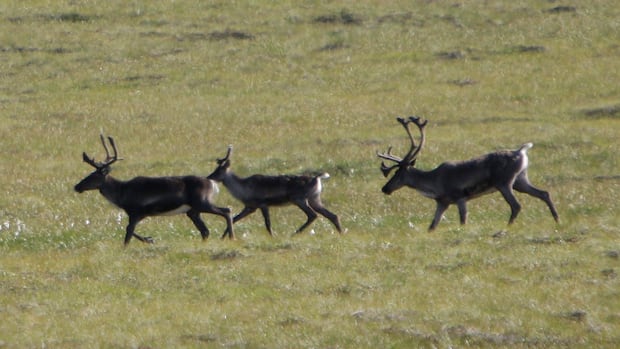
The Porcupine caribou herd might spend the winter in the Northwest Territories this year, according to the Porcupine Caribou Management Board.
The herd has a range spanning 250,000 square kilometres of northern tundra in Alaska, the Yukon and the N.W.T., and is known for its massive migrations.
Joe Tetlichi, the management board’s chair, said the herd appears to be moving into the Rat River and Timber Creek area. He said that area is about a one-day snowmobile ride from Fort McPherson, N.W.T.
It’s been about 10 years since the herd has overwintered there, he said.
Tetlichi said the main herd hasn’t migrated to the Dempster Highway — a separate location on the eastern side of its range — since 2013, though a limited number of caribou were in that area a few years ago.
“It’s especially a big deal for the Delta people because they haven’t gotten caribou for the last, for a number of years,” he said.
“It could be a winter where people are going to see caribou all winter, and because of that, that’s good justification for hunters to just hold off and let the caribou do what they need to do,” he said.
What the caribou need to do, according to Wanda Pascal, the former chief of the Tetlit Gwich’in Council in Fort McPherson, is graze and get comfortable on the land where they’ll spend the winter season.
“It doesn’t take long,” she said. “If you go after the first bunch, they’ll just turn around and head back where they come from. That’s what they’ve been doing.”
For Tetlichi, it’s a matter of teaching patience to young people looking to harvest the animals.
“Right now the rut is over and they’re going to start going into the trees for the winter … they’re going to start fattening up, and that’s when our people can harvest,” he said.
Mary Effie Snowshoe, an 88-year-old elder in Fort McPherson, said the caribou are the livelihood of the Gwich’in people.
“It’s the main food of our diet, for years that’s what the Gwich’in people survived on and that’s how they remain strong and healthy,” she said. “We are happy because people will get meat for their families.”
A map that relies on data from satellite collars on animals in the herd shows it spent last winter almost entirely in Alaska, and the winter before that it was spread across Alaska and the Yukon.
The management board’s latest count pegged the population of the herd at 134,000 animals at the start of the year, down 75,000 from 2017. According to the board’s harvest management plan, the herd is currently in the “green” zone, meaning licensed hunters can get tags for two male caribou, and there are no restrictions for Indigenous harvesters.
Other guidelines and restrictions would kick in if the population dropped below 115,000 animals.
Even so, Tetlichi is urging people to hunt responsibly.
“We’re trying to tell people, let’s be responsible and cut back on the number of caribou that you’re getting, and not going out every day for the sake of going out and getting caribou.”
Pascal said the prospect of the Porcupine caribou spending the winter in the Delta is “a good feeling.” She is reminding people to hunt responsibly as well, and wants harvesters to use every part of animal too.
“When you kill a caribou … you take everything,” she said. Even the blood from the caribou’s stomach, Pascal said, has a purpose.
“I even use that as medicine for the elders. Even that would be good to gather, for the elders. There’s lots you can do with the whole caribou.”