
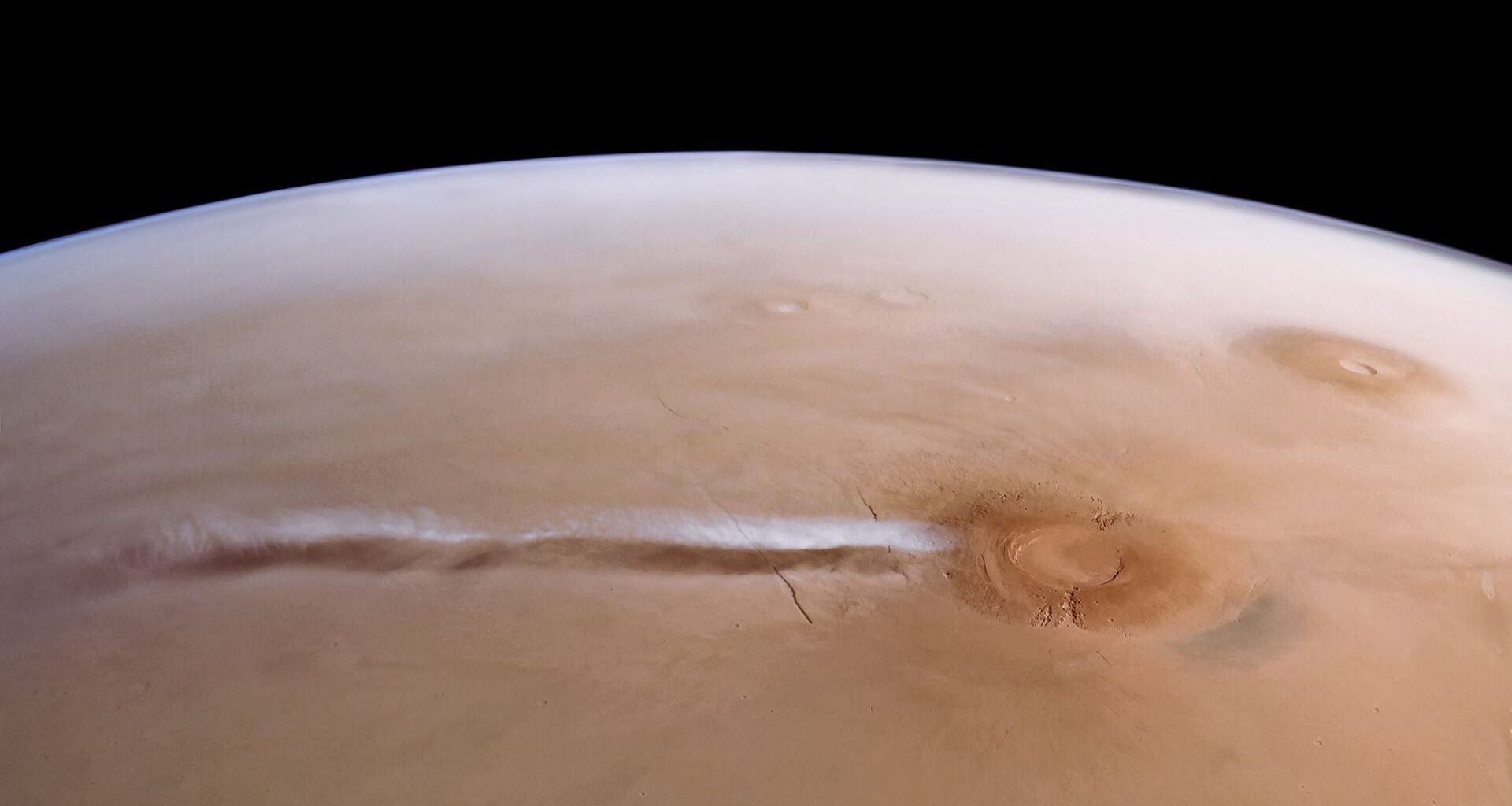
A giant cloud on Mars may form ice directly from water vapor without dust, revealing an atmospheric process never confirmed on another planet.
Clouds on Earth need something to grow on, and water vapor settles onto specks of dust, salt, or soot before it turns into droplets or ice.
Ice can theoretically form directly from water vapor without dust or other particles, but the conditions required are so extreme that scientists have never confirmed the process in a planetary atmosphere.
On Mars, one cloud appears to be the exception.
A white streak forms every morning beside a giant volcano, and its ice may have formed directly from water vapor with nothing to freeze onto, according to a new modeling study.
If the model is right, it’s the first time that process has been found in any planet’s atmosphere.
Jorge Hernández-Bernal of the Laboratoire de Météorologie Dynamique in Paris, a lab shared by CNRS and Sorbonne Université, led the work.
His team’s conclusion rests on a computer model of the Martian atmosphere checked against years of spacecraft images, not on a direct measurement of the ice itself.
“It certainly hasn’t been seen in action before,” Hernández-Bernal said.
The cloud returns daily
The cloud appears beside Arsia Mons, a volcano about 12 miles (20 kilometers) tall. For several months of the dusty southern spring and summer it comes back every morning.
It starts forming at sunrise, spreads sideways for about three hours, and then breaks away from the volcano and fades.
At its longest it stretches about 1,100 miles (1,800 kilometers), farther than the straight-line distance from Chicago to Houston. It forms roughly 28 miles (45 kilometers) above the surface.
The European Space Agency’s Mars Express orbiter first spotted the cloud in 2018. Few spacecraft at Mars can take pictures in the morning, when the cloud exists, and the mission’s cloud atlas holds two decades of such images.
Researchers already knew the cloud forms where wind flows over the volcano, as mountain clouds do on Earth. No simulation had managed to reproduce its long tail.
With ice allowed to grow only on dust grains, the standard rule, the simulated cloud never looked like the streak in the photos.
Ice forms without dust
Hernández-Bernal’s team ran a Mars weather model over the region around Arsia Mons, at a resolution of about six miles (10 kilometers).
In that model, wind hitting the volcano sets off a large atmospheric wave that lifts parcels of air a few miles (several kilometers) upward in minutes.
Air that rises that fast cools sharply, so a compact pocket on the volcano’s western slope ends up far colder than its surroundings.
In the model, the air at that height is normally near -172°F (-113°C). Inside the cold pocket it falls below -226°F (-143°C).
The vapor in that pocket is roughly 100,000 times more than the air can hold without it freezing, a level no instrument has yet measured on Mars.
Such extreme humidity is what lets ice form without a seed. In the team’s calculations, hundreds of ice crystals appear in each cubic centimeter of air, about a sugar cube’s worth.
Dust is scarce there, roughly one grain in every two teaspoons of air, so ice growing on dust can’t use up the excess vapor.
“Water vapor turns directly into icy cloud particles without any middle step. It’s akin to droplets of condensation appearing in the middle of a room, rather than on a window,” Hernández-Bernal said.
“We call this homogeneous nucleation, and we’ve never seen it before in a planetary atmosphere.”
The tail stays in balance
Once the simulated ice crystals form, westward winds carry them away from the volcano.
The crystals keep growing until the air around them holds exactly as much vapor as it can, and then they stop changing.
Ice in that balance neither grows nor evaporates, so the wind can carry it for hundreds of miles.
Later in the morning the cold pocket fades. New ice stops forming, the head of the cloud shrinks, and the tail detaches from the volcano, just as the real one does.
The simulated cloud’s brightness and crystal size are consistent with the spacecraft data. Like other water-ice clouds on Mars, it is made of crystals hundreds of times thinner than a human hair.
The model falls short
The modeled cloud is 30% to 50% narrower than the real one. It starts about an hour and a half late, and before it detaches it reaches only about a quarter of the observed length.
The late start, slower winds in the model, and a warm region where part of the cloud turns back to vapor probably explain the gap, the authors wrote.
The team also tested an alternative. Mars may carry very fine dust, grains less than a hundred nanometers across, and ice growing on those grains could have been an ordinary explanation.
In the model, the fine dust produced widespread hazes but never a sharply defined cloud like the one in the pictures.
“While clouds on Earth and Mars seem to be governed by the same ‘rules’, understanding this exotic martian cloud required exotic physics – and this may be true elsewhere in the cosmos,” said Colin Wilson, ESA’s project scientist for Mars Express.
Questions about the Martian cloud
The biggest uncertainty is in the physics itself. How readily ice forms from vapor depends on a property of water measured only down to about -24°F (-31°C), and the cloud forms about 200°F (110°C) colder than that.
The team had to extrapolate, and the cloud’s width, length, and start time all shift with how much ice the model lets form this way.
Whether this happens anywhere else on Mars is an open question.
The team plans to look for the same process in other clouds, and to ask whether it moves enough water to matter for the planet’s water cycle.
Study co-author Anni Määttänen of LATMOS calculated in 2005 how extreme the conditions would have to be.
Researchers have proposed the same process for the thin, cold air high in Earth’s own atmosphere, and nobody has confirmed it there either.
ESA’s Trace Gas Orbiter can also photograph Martian weather in the morning, and the authors wrote that sharper models and a careful reading of those images are what comes next.
The full study was published in the journal Nature Geoscience.
—–
Like what you read? Subscribe to our newsletter for engaging articles, exclusive content, and the latest updates.
Check us out on EarthSnap, a free app brought to you by Eric Ralls and Earth.com.
—–