
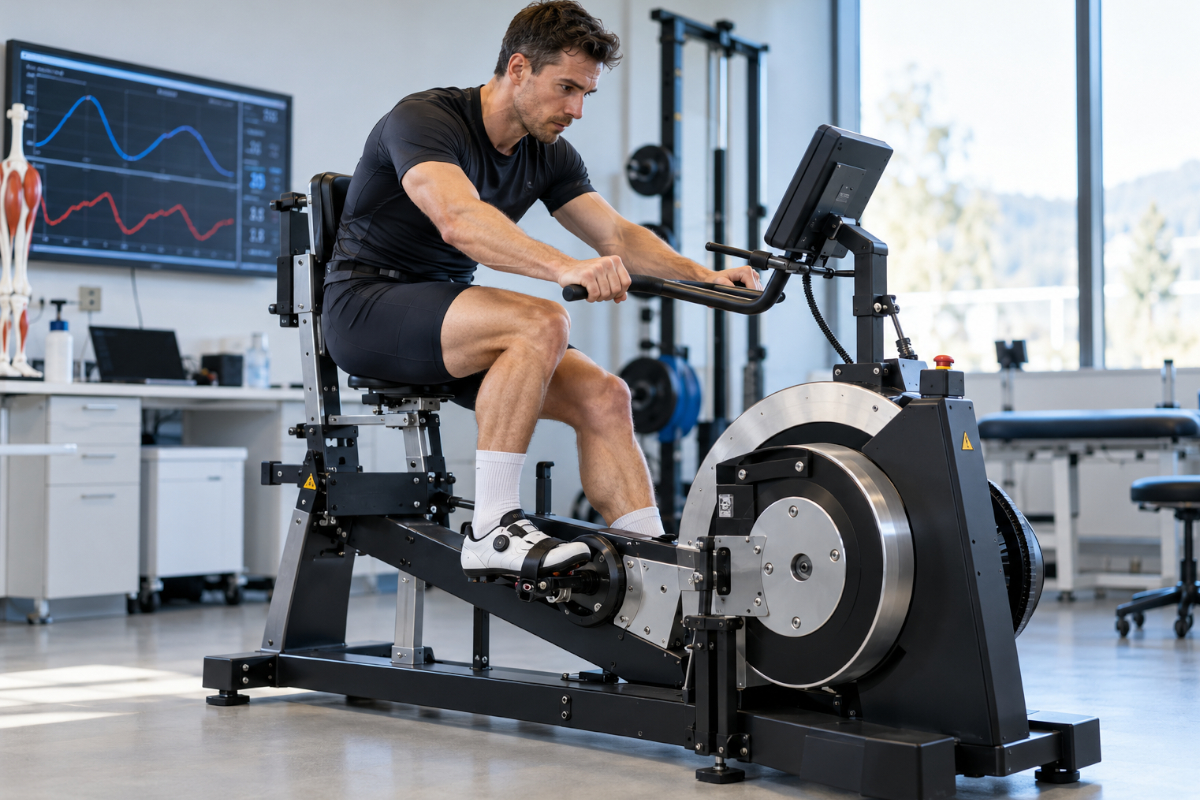
Building stronger legs usually means lifting weights, performing resistance exercises, or pushing harder on a bike. But researchers in Belgium have tested a different approach that challenges muscles while placing less demand on the cardiovascular system. Their findings suggest that a specialized form of cycling could help sedentary adults improve muscle strength and everyday physical function, potentially offering another option for people who struggle with conventional exercise.
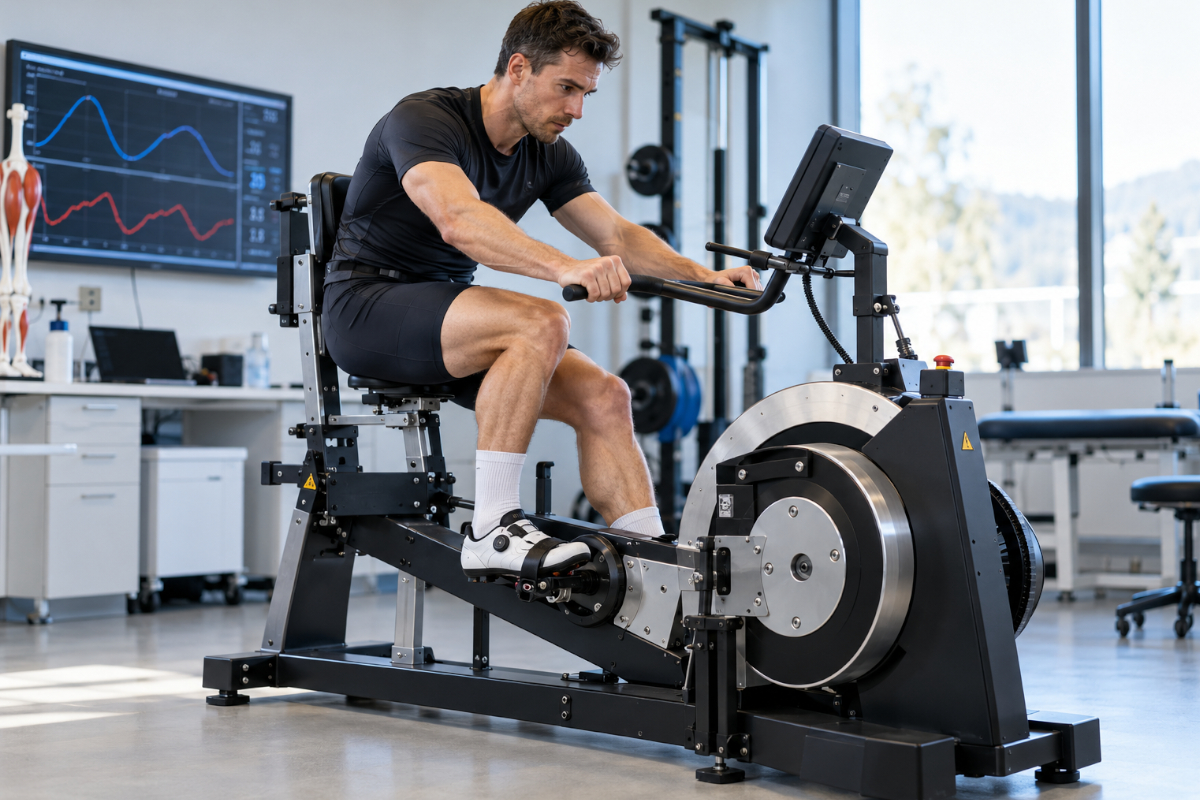 Man performing eccentric cycling on a specialized exercise machine. Imagen: TodoMountianBikeHow Eccentric Cycling Builds Muscle Strength Differently
Unlike a regular stationary bike, where riders generate power by pushing the pedals forward, an eccentric cycling machine uses a motor to drive the pedals. The person exercising must resist that movement, forcing the leg muscles to generate tension while lengthening rather than shortening.
This process is known as an eccentric muscle contraction. It occurs naturally when walking downstairs, lowering a dumbbell, or controlling the descent of a squat. In each case, muscles work to slow down an external force instead of producing the movement themselves.
The advantage of eccentric cycling for muscle strength comes from the relationship between muscular force and energy consumption. Eccentric contractions can generate substantial force with a relatively low metabolic cost, allowing muscles to experience significant mechanical loading without requiring an equally demanding cardiovascular effort.
However, this type of exercise requires specialized equipment. Simply pedaling backward on a conventional exercise bike does not reproduce eccentric cycling because the muscles must resist a motor-driven movement. The distinction is important for understanding why researchers are investigating these machines for rehabilitation and physical conditioning.
For older adults, this approach could be particularly relevant. Maintaining lower-body strength plays an important role in mobility and independence, while reduced physical activity can make it increasingly difficult to perform everyday tasks. A training method capable of improving muscle function without requiring intense cardiovascular effort could offer another option for certain individuals.
A 12-Week Study Found Leg Strength Improvements of Up to 17%
The research, conducted by scientists at the University of Liège in Belgium and published in the October 2026 issue of the European Journal of Applied Physiology, involved 43 sedentary adults with an average age of 61. The study originally appeared online in July and compared three different cycling programs over 12 weeks, with participants completing two supervised sessions per week.
Fifteen participants performed high-intensity interval training on an eccentric cycling machine, another 15 completed continuous eccentric cycling sessions, and 13 followed a conventional concentric cycling interval program. Researchers measured quadriceps strength, aerobic fitness, and functional performance before and after the intervention.
The results showed measurable improvements in leg strength after 60 among the participants, although the average age does not mean every volunteer was over 60. Maximum isometric quadriceps torque increased by 14% in the eccentric interval group and 17% in the continuous eccentric group. Interestingly, the conventional cycling group recorded a larger numerical improvement of 24%.
The researchers also found improvements in physical tasks associated with everyday mobility. The distance participants could walk in six minutes increased by 6% in both eccentric groups, compared with 4% in the conventional cycling group. Performance on a test requiring participants to stand up from and sit down in a chair ten times improved by 14%, 17%, and 11%, respectively.
These findings suggest that eccentric cycling can produce useful muscular and functional adaptations in previously sedentary adults. However, the percentages alone do not establish that one program was statistically superior to another for every outcome measured.
One of the most interesting differences appeared in the cardiovascular response during exercise. Average heart rate reached 63% and 65% of the reference maximum in the eccentric groups, compared with 85% in the conventional cycling group. Ratings of perceived exertion were also lower, averaging 12 and 11 points versus 14.
Participants did not develop muscle soreness during the supervised training programs, according to the researchers. That finding is particularly relevant because unfamiliar eccentric exercise can cause considerable muscle soreness when the initial workload is too high.
The study therefore supports an important possibility: low-impact strength training for older adults may be achievable through specialized cycling equipment while imposing a lower cardiovascular burden than the conventional interval cycling protocol used in the experiment.
But there was a significant trade-off.
While the eccentric programs improved muscle strength and functional performance, they produced little improvement in aerobic fitness. Maximum oxygen consumption, commonly measured as VO2 max, increased by just 1% in the eccentric interval group and decreased by 1% in the continuous eccentric group.
By comparison, conventional cycling improved VO2 max by 14%. Maximum aerobic power followed a similar pattern, increasing by 4% and 1% in the eccentric groups versus 18% among participants performing conventional cycling intervals.
These results indicate that eccentric cycling benefits are primarily associated with muscular and functional improvements in this study, rather than the cardiovascular adaptations typically sought through endurance training.
Could Eccentric Cycling Replace Weight Training or Regular Cycling?
The findings raise an interesting question for people looking to maintain or regain muscle strength without following a traditional gym program. Could a motor-driven exercise bike provide some of the benefits normally associated with resistance training?
The study suggests that eccentric cycling can improve quadriceps strength and everyday physical performance, but it does not establish that the method is equivalent or superior to lifting weights. Researchers did not include a conventional weight-training group, nor did they directly compare changes in muscle size, explosive power, or strength across different movement patterns.
The distinction matters because building muscle without lifting weights involves more than increasing force production in one particular muscle group. A comprehensive strength-training program can target multiple muscles and movement patterns, whereas the benefits demonstrated in this experiment were measured primarily through lower-body strength and functional tests.
The researchers’ findings may be especially useful for rehabilitation specialists working with individuals who have difficulty tolerating demanding exercise. Applying significant muscular resistance with a lower cardiovascular response could be advantageous in carefully selected patients, although the study itself involved sedentary adults rather than people with serious cardiovascular conditions or recent injuries.
The equipment also presents a practical limitation. Eccentric cycling requires motorized ergometers that can control pedal movement and resistance. These are not the exercise bikes typically found in homes or commercial gyms, and the study does not provide evidence that ordinary stationary cycling can reproduce the same eccentric stimulus.
Another consideration is the relatively small sample size. With only 13 to 15 participants per group and a 12-week intervention, the findings cannot establish long-term benefits or predict how trained cyclists, competitive athletes, or people with specific medical conditions would respond.
For cyclists interested in improving performance, the results should not be interpreted as evidence that eccentric cycling will increase speed, climbing ability, or sustainable power output. None of those outcomes were directly investigated.
The cardiovascular findings also reinforce the continuing value of conventional cycling. Among the three programs studied, traditional concentric interval training produced substantially greater improvements in aerobic capacity while also increasing quadriceps strength.
Eccentric cycling may therefore be most useful as a complementary training method, particularly when improving muscular function is a priority and cardiovascular exercise tolerance is limited. In this experiment, the ability to strengthen the legs with a lower heart rate was its most distinctive characteristic, but that advantage came with far smaller improvements in aerobic fitness.