
The Golden State Valkyries are in the WNBA Finals, a second-year team two wins from a championship. Yet by plenty of indicators, the rest of the league and everyone watching still seem a little unsure what to make of them.
They went 32-12 and are 7-3 in the playoffs. They did it without any of the league’s 10 best players, at least according to the first- and second-team All-WNBA honors.
The Valkyries are not merely succeeding despite the absence of conventional star power. They are succeeding in a way that makes conventional star power a strikingly inadequate explanation for their success. There’s no single thread to pull. And, to some, that can be disorienting.
If the Valkyries win the WNBA Finals, they will have done something no team in league history has done: win a title without an All-WNBA player on the roster.
To play deep into October is already a triumph. An improbable ascent. It’s a challenge to the league’s prevailing understanding of what a championship team is supposed to look like.
In the 28 seasons before the Valkyries’ 2025 arrival, the WNBA followed a blueprint for championship contention. The top teams had elite players who commanded the ball and piled up gaudy numbers. Those players were the unmistakable faces of their franchises. Then, they were rewarded with All-WNBA selections, All-Star appearances, and, eventually, championship parades.
The Las Vegas Aces dynasty had three or four of those players in each championship year. The New York Liberty built a Big Three. Breanna Stewart, Sue Bird, and Jewell Loyd shared the floor for Seattle’s 2018 and 2020 championship teams. The 2021 Chicago Sky, who won a title as the sixth seed with a .500 regular-season record, had a collection of established forces in Candace Parker, Kahleah Copper, Courtney Vandersloot, and Allie Quigley — so even when the champion was a surprise contender, individual excellence remained critical.
Golden State has arrived at the same destination, via a different route.
Three teams have reached the Finals without a first- or second-team All-WNBA player, and none won. Chicago did it most recently, in 2014, with a losing regular-season record. The 2001 Charlotte Sting and 2006 Sacramento Monarchs were the others. That Monarchs team, like the Valkyries, had only one All-Star selection — the Sting and Sky had multiple.
Gabby Williams, the Valkyries’ most recognizable star, who landed in Golden State with a lauded international career and a yearning for a team in the W to believe in her, played just 25 minutes per game during the regular season. She was named a starter in the All-Star Game and was later voted runner-up to Dream star Angel Reese for Defensive Player of the Year. But she wasn’t the kind of volume scorer who pressed to be the offense’s focal point every night.
The Valkyries’ second-leading scorer — Janelle Salaun — didn’t start a game this season and has played fewer than 10 minutes in seven of Golden State’s last eight playoff games.
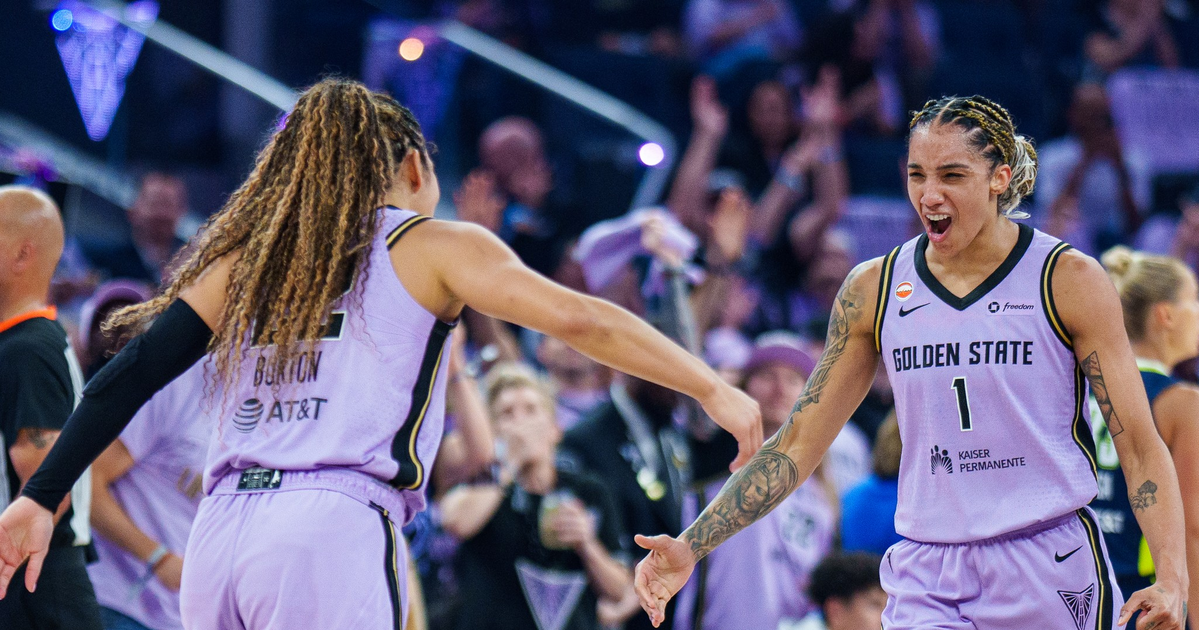
Their starting center, Kiah Stokes, averaged 3.6 points per game during the regular season. Their first-ever draft pick, 2025 No. 5 selection Juste Jocyte, barely saw the floor. Their lone 2025 All-Star, Kayla Thornton, a full-time starter, has seen her numbers decline across nearly every major statistical category from last season. Veronica Burton, the starting point guard and, in coach Natalie Nakase’s words, the team’s “heart and soul,” is shooting 31.9% in the playoffs.
It’s late October, and that’s a group that’s still kickin’.
 Janelle Salaun has scored in double figures just twice in the playoffs after ranking second on the Valkyries in points per game during the regular season. | Source: Ezra Shaw/Getty Images
It doesn’t matter that none of that sounds like the recipe for a Finals team. The Valkyries have built a program in which a player’s importance can’t be measured by points, or minutes, and certainly not by votes gathered on an awards ballot.
Burton’s percentages won’t show how much the team feeds off her direction and hustle, or how she continues to hit huge shots in huge moments. Thornton’s box-score production doesn’t convey her impact defensively, in boxing out, or in pushing the pace in transition. Stokes’ line won’t encapsulate the way she’s continually disrupted All-Star frontcourts. Williams’ modest regular-season minutes don’t capture the breadth of her influence — her anticipation, versatility, IQ. On and on.
2 days ago

5 days ago

Friday, Oct. 16

Salaun, who has been largely in and then mostly out of Nakase’s playoff rotation, took home the first unanimous Sixth Player of the Year award. Williams was named All-Defensive first team, with Stokes and Burton named to the second team. That’s what the records will show.
It’s worth pointing out there’s nothing blatantly wrong with the WNBA’s All-WNBA teams. All 10 players had tremendous seasons with plenty of numbers and highlight packages to back up their selections. The league’s top talents should be celebrated, and individual awards will always involve difficult decisions.
But awards are also a record of what the league — and in this case a panel of 74 national and local journalists, including me — chooses to value. Individual awards aren’t supposed to be statistics awards, but they often function that way. Do they adequately reflect the season that actually happened?
The Valkyries, well, their pieces were in the blind spots.
Nakase finished second in Coach of the Year voting, 20 votes behind Minnesota’s Cheryl Reeve, whose fifth win is historic. The Lynx went 33-11, earned the No. 1 seed, and navigated a season — mostly without Napheesa Collier, and with rookie Olivia Miles at the helm — that demanded a lot from their coach.
 Coach Natalie Nakase’s team has held the Atlanta Dream to fewer than 65 points in each of its WNBA Finals wins. | Source: Sean Fan/The Standard
Nakase won the award in 2025, her first season as a head coach. This year, she turned a 23-win team into a 32-win, second-place squad. She did it by preaching collective discipline and a full 40 minutes of defensive commitment, and by cultivating an unusually deep understanding of roles, all without the luxury of handing the ball to an MVP candidate to solve every problem.
If the players responsible for the Valkyries’ breakthrough are not worthy of All-WNBA nods, then Nakase — the type of coach players would run through a brick wall for, according to five-time MVP and Aces star A’ja Wilson — deserves greater recognition. And if not Nakase, then GM Ohemaa Nyanin, whose compressed offseason emphasized continuity and player development and secured the two free agents — Williams and Stokes — who are indispensable to the Valkyries’ run.
Golden State built its success in the gaps between what the league values and what wins. For a franchise still so young, it’s a statement. And for a league celebrating its 30th year, a warning to the established order.
A team can be more than the sum of its parts, just as a player can be integral without being a star. The individual honors on this Valkyries roster may be thin in the history books. What they’re doing together will be there forever.