
Pentagon clash may cause Anthropic “material revenue losses”
U.S. Secretary of War Pete Hegseth gives a State of the Force address at Marine Corps Base Quantico on Sept. 30, 2026 in Quantico, Virginia.
Alex Wong | Getty Images
In its IPO filing, Anthropic warned investors that ongoing issues with the Trump administration and U.S. Department of Defense could cause “material revenue losses or business disruptions.”
As CNBC previously reported, the department labeled Anthropic a “supply chain risk to national security,” and in February, President Donald Trump also ordered the U.S. government to stop using the company’s models.
In March, Anthropic filed a complaint in a federal court in the Northern District of California challenging that label as illegal, and at the same time, filed a petition for review in the U.S. Court of Appeals in D.C.
The California federal court ruled in Anthropic’s favor, finding that the Pentagon’s actions were “retaliatory acts meant to punish” the company. The court also found the actions violated the company’s First Amendment rights, and had violated the AI company’s Fifth Amendment rights to due process, the company noted in its IPO filing.
But the D.C. Circuit Court of Appeals ruled in favor of the DOD, saying the supply chain risk designation was allowed under the Federal Acquisition Supply Chain Security Act.
Anthropic said in its filing that it is “evaluating its next steps” with respect to the D.C. appeals court decision. The company has asked the full D.C. circuit to rehear its appeal.
Today, the U.S. filed a notice of appeal to try to invalidate the decision from the Northern California district court.
—Lora Kolodny
Anthropic investor Matt Witheiler says emphasis on enterprise key to lab’s success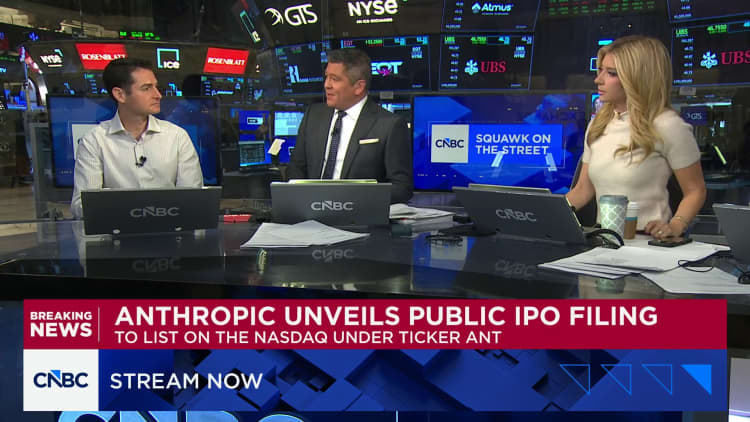
Matt Witheiler, head of late-stage growth for private markets at Wellington Management, said the AI lab’s focus on enterprise was ‘absolutely’ important in making it stand out.
“The scale at which they’ve been able to capitalize on the enterprise opportunity is really something that’s been impressive,” Witheiler told CNBC’s “Squawk on the Street.”
“I think what Dario [Amodei] and team are trying to build is really the next generation of great enterprise company,” with products like Claude Code and Claude Science, Witheiler added.
—Caleigh Keating
Anthropic uses AI chips from Nvidia, AMD, Amazon and Google
Jensen Huang, chief executive officer of Nvidia Corp., shows Vera Rubin computer modules during the keynote address at the Nvidia GTC in Berlin, Germany, on Wednesday, Oct. 21, 2026.
Alex Kraus | Bloomberg | Getty Images
Anthropic said its pool of computing power includes Nvidia’s GPUs, AMD’s GPUs, AWS Tranium, and Google TPUs.
Anthropic treats all AI chips as a “single fungible pool” and it has developed technology that routes its AI models to whatever chip is the most efficient at the time.
It’s a sign that Anthropic won’t tie itself to any one chip provider. OpenAI, which mostly uses Nvidia compute, has made similar moves to diversify the AI chips it uses.
“Our multi-chip compute approach provides us with substantially greater chip access than relying on one platform and enables us to opportunistically capture the price-performance benefits of each chip family and generation,” Anthropic said in its filing.
All four of Anthropic’s primary chip designers have large stakes or options to buy stakes in Anthropic, highlighting the strategic ties between chipmakers or hyperscalers and the AI labs.
Anthropic’s filing left the amount of total money it has committed to spending on compute blank, but the frontier lab signaled it will spend heavily.
Separately, Anthropic detailed long-term commitments with SpaceXAI, Nscale, and Lambda to secure access to Nvidia chips. The company also said it could buy more than $20 billion in AMD chips. It said it was committed to spending on Amazon’s Trainium chips at $110 billion through 2036, and $114.5 billion on Google TPUs through 2033.
“We anticipate making significant investments for the foreseeable future, including in compute and infrastructure, to ensure we have the technological resources to maintain and expand our position at the frontier of AI,” Anthropic said in the filing.
— Kif Leswing
Anthropic’s implied gross margins have exploded, but cost of compute may change that
Anthropic reported its cost of revenue as $2.38 billion as of June 30, 2026, booking $16.29 billion in revenue during the same period and implying a gross margin of 85%.
That’s an explosion from the implied 12% gross margin the company generated during the same period last year, on just over $1 billion in cost of revenue and $1.16 billion in revenue booked.
However, Anthropic’s S-1 states that operating margin and adjusted operating margin are expected to “fluctuate over time, particularly in periods when substantial incremental compute is delivered to us and we incur the associated expenses.”
The prospectus also reveals that “substantially all of cost of revenue” is associated with compute and infrastructure costs, adding that smaller personnel and overhead-related costs are also factored in.
—Isabel O’Brien
Amazon’s deepening ties to Anthropic
Amazon’s largest AI data center has seven completed buildings, with 30 total buildings planned on 1,200 acres in New Carlisle, Indiana, shown here on October 8, 2025.
Erin Black
Amazon remains one of Anthropic’s biggest backers and strategic partners. The company has poured $13 billion into Anthropic since 2023, with the potential to invest $20 billion more.
According to the filing, Amazon has separately agreed to provide up to $15 billion in financing, which will become available to Anthropic in $5 billion tranches. Each draw is tied to Anthropic hitting certain compute capacity milestones.
Amazon holds $6.2 billion in outstanding convertible notes that could be worth $1.84 billion once Anthropic goes public. Amazon’s stake is capped at 12% of the company, the filing states.
Amazon holds nonvoting shares and it doesn’t have a board or observer seat at the startup.
The companies have continued to deepen their partnership, with Anthropic becoming a key customer of Amazon’s cloud computing and chips businesses. Amazon last year opened an $11 billion AI data center campus dedicated to training and running models from Anthropic, called Rainier.
In April, Anthropic said it committed to spend at least $110 billion with Amazon for cloud services through April 2036, “regardless of actual usage.”
The agreement is “non-cancelable,” except for in the event of a “material breach” by Amazon, the filing says. If Anthropic’s actual spend falls short, it’s required to pay Amazon the difference as a true-up.
The filing doesn’t state how much Anthropic has spent on Amazon’s cloud services and Trainium AI chips to date.
— Annie Palmer
Anthropic H1 2026 overseas revenue tops $4.5 billion amid global expansion
Dario Amodei, chief executive officer of Anthropic, at the AI Impact Summit in New Delhi, India, on Thursday, Feb. 19, 2026.
Ruhani Kaur | Bloomberg | Getty Images
Anthropic made $4.5 billion in international revenue during the first half of 2026, more than 13 times the $343 million recorded during the same period a year earlier. That’s 27.8% of the company’s total revenue.
The company said it was expanding its ability to serve international customers through the growth of regional offices and partnerships in key markets. It added that it expects “international expansion to be a meaningful driver of revenue growth as global demand for AI accelerates.”
Anthropic is also expanding its computing infrastructure outside of the U.S. The filing states that the company has entered into leases for data center capacity in Australia and Canada and that it is “pursuing” data center capacity in additional jurisdictions outside the U.S.
Those moves are part of Anthropic’s efforts to reduce “concentration risks associated with operating a significant portion of our compute infrastructure in the United States,” the filing says, alongside supporting its international growth strategy.
Anthropic has sounded out data center deals for small deployments of 20-30 megawatts across the U.K. and the Nordics, CNBC reported in September, citing sources. Deals to secure smaller allocations of compute allow companies to deploy workloads faster.
— Kai Nicol-Schwarz
‘Channel partners’ drive 2,540% increase in sales and marketing costs
People walk by the exhibit for Amazon Web Services (AWS) at National Retail Federation (NRF) 2026: Retail’s Big Show, in New York City, U.S., Jan. 12, 2026.
Kylie Cooper | Reuters
Anthropic’s sales, marketing and partnership costs increased 2,540% in the first six months of this year to $3.17 billion, the second-biggest expense behind compute and infrastructure.
The vast majority — $2.7 billion — of those outlays are “fees paid to channel partners.” In the first half of last year, Anthropic’s entire sales and marketing costs were $120 million.
Anthropic sells Claude through the leading cloud service providers, Amazon Web Services, Google Cloud and Microsoft Azure. The company said 48% of its revenue in the first six months of 2026 came from those relationships.
“These platforms bill end customers, collect payments on our behalf, and remit such amounts to us, net of applicable platform and other fees,” Anthropic said in the filing. “Any change to, or termination of, one of our significant distribution relationships could adversely affect our business by disrupting customer access to our models, reducing usage, or increasing customer acquisition, onboarding, and migration costs.”
— Ari Levy
Anthropic warns of ‘legal liabilities’ if models used to develop weapons
The Anthropic logo is displayed on a smartphone screen placed on a reflective surface onto which a stock market chart is projected, in Creteil, France, on June 2, 2026.
Samuel Boivin | Nurphoto | Getty Images
Anthropic warned of potential “legal liabilities” if its models are used to develop weapons, including chemical and biological.
The company said its most capable models had demonstrated, and were expected to continue to demonstrate, the ability to help “malicious actors” develop weapons. While the company deploys safeguards, they are “incomplete,” the filing states. It added that safeguards have previously been “circumvented” and may be in the future.
“Any actual or perceived use of our models to contribute to the development of such weapons could result in harm, legal liability, regulatory or enforcement action, loss of government and enterprise relationships,” alongside damage to Anthropic’s brand, the filing reads.
Legal liability related to the misuse of AI models is under increasing scrutiny amid capability gains from frontier systems over the past year.
— Kai Nicol-Schwarz
Menlo’s Matt Murphy is optimistic about Anthropic’s growth trajectory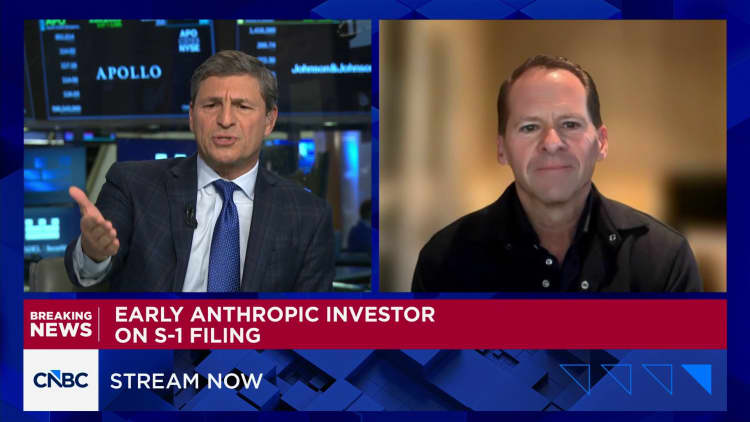
Matt Murphy, partner at Menlo Ventures and early Anthropic investor, expressed optimism about Anthropic’s growth, saying the AI lab is “the place to invest” for those wanting to get into the AI space.
Murphy said Menlo’s stake in Anthropic is the biggest investment ever for the firm and “by far the biggest return.” Menlo invested in Anthropic when the AI lab was valued at only $4 billion.
“You wait your entire 25-year career to find a technology wave like this,” Murphy told CNBC’s “Squawk on the Street.”
“It’s an exceptional story. It’s not the kind of growth, nor scale, you see in the 25 years I’ve been in the venture business,” he said.
— Caleigh Keating
Alphabet stands to become a larger Anthropic shareholder through IPO
Google CEO Sundar Pichai speaks during the 2026 Google I/O technology developer conference in Mountain View, California, on May 19, 2026.
Karl Mondon | AFP | Getty Images
Google parent Alphabet will have the option to become a more significant Anthropic shareholder.
In March, Anthropic agreed to give Google an option to buy up to $10 billion in Class N common stock in a private placement concurrent with the offering at the IPO price, according to the filing.
If Google exercises the option, that would lower by up to $10 billion the total in notes that are available for issuance to Google, which currently stands at $20 billion, the filing states.
— Jordan Novet
Anthropic’s asset-light model in numbers
Numbers have finally been put to Anthropic’s asset-light model.
The company stated $1.19 billion in net property and equipment on June 30, 2026, up from $19 million at year-end 2024 and $146 million at year-end 2025. That $1.19 billion includes $432 million of net property and equipment associated with finance leases.
It’s a sharp increase, but not as sharp as its off-balance-sheet obligations. The company’s active operating leases sat at $117 million at the end of 2025, but that number has sharply risen to $1.079 billion. The company also added an additional $443 million in financing leases during that time period.
Anthropic’s off-balance-sheet obligations are similarly large. At year-end 2025, the company had signed up for just $54.6 billion in noncancelable purchase commitments. By June 30, 2026, that number has ballooned to $265.6 billion. Similarly, at year-end 2025, Anthropic’s future undiscounted lease obligations were just $50.2 billion — halfway through 2026, that number sat at $321.4 billion.
The leases “will commence between 2026 and 2028, with lease terms ranging from less than one year to 20 years,” according to the S-1.
— Isabel O’Brien
Anthropic has $6.2 billion in debt, mainly tied to Amazon
At the end of June, Anthropic was sitting on $6.2 billion in debt, a small sum considering its nearly $81 billion in losses during the first half of this year.
The debt reflects the principal amount outstanding under convertible notes Anthropic issued to Amazon starting in 2023, according to the lab’s prospectus.
— Jordan Novet
Bessemer’s Byron Deeter says stake in Anthropic is largest investment in firm’s history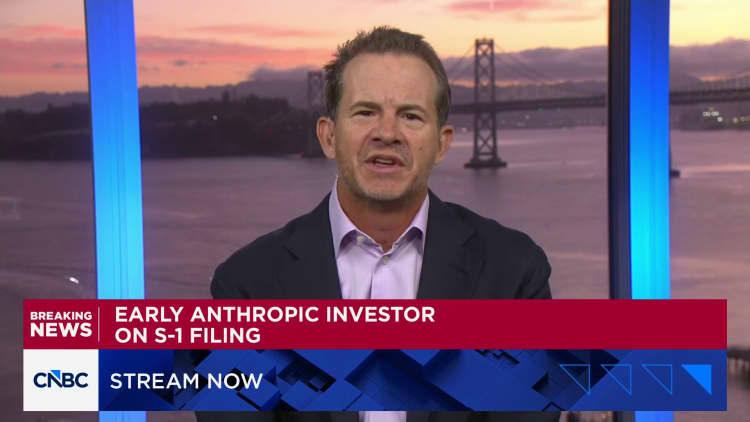
Byron Deeter of Bessemer Venture Partners said the firm’s stake in Anthropic is the largest investment by cost basis in Bessemer’s 100-plus-year history.
Deeter said the venture capital firm invested in Anthropic in a funding round “many years back,” calling Anthropic “close partners.”
“We were fortunate to partner early and aggressively,” Deeter said on CNBC’s “Squawk on the Street.”
— Caleigh Keating
Anthropic sees U.S. data center moratoriums as a key risk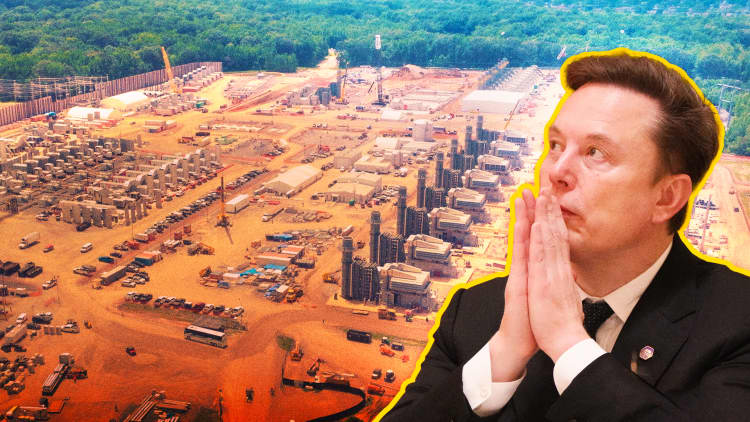
In its lengthy risk factors statement, Anthropic called out existing and proposed “moratoriums on new data center construction” by jurisdictions across the U.S., which it said pose a risk to its growth and operations.
As of last month, 16 states had formally weighed such moratoriums according to bills tracked by the National Conference of State Legislatures.
These moratoriums, ranging from narrow and temporary pauses to more sweeping bans, are meant to stop rapid construction of large data centers from causing pollution and other problems for neighbors, including higher electricity costs due to grid strain.
Anthropic wrote that moratoriums “could delay or prevent the construction or expansion of facilities on which we depend for compute.” It cautioned investors, “The loss of, or a significant disruption at, any major facility may not be readily absorbed by our remaining or future infrastructure.”
The company is seeking to build data centers overseas in order to diversify its “infrastructure footprint,” and “reduce concentration risks associated with operating a significant portion of our compute infrastructure in the United States.”
— Lora Kolodny
Anthropic’s S-1 includes more than 90 pages of risk factors
Anthropic’s S-1 includes more than 90 pages of risk factors, including its effort to balance safety and commercial objectives.
The company said that if it is unable to manage risks related to AI safety, its “brand, business, financial condition, and results of operations could be adversely affected.”
Anthropic said it regularly makes “judgement calls” about when it determines a model is safe enough to release. However, it said there can be “no assurance” that its safeguards will prove adequate, or that the company will correctly identify which capabilities should be restricted.
“These judgments are particularly consequential because, as AI systems become more capable, the potential severity of harm from misaligned or misused models increases correspondingly, and a wide range of stakeholders, including researchers and policymakers, have raised concerns that sufficiently advanced AI systems could pose catastrophic or existential risks to society if not developed and deployed responsibly,” the filing says.
“Our safety-focused approach is designed in part to mitigate such risks, but there can be no assurance that our efforts will be successful or that the broader AI industry will adopt similar safeguards,” Anthropic said.
— Ashley Capoot
Political risks are all over the filing
Across Anthropic’s growth plans, potential political headwinds stand in the way.
Access to critical supplies like memory can be affected by tensions between China and Taiwan. Getting the requisite power and water is subject to “shifting public and political views regarding climate change.” AI policies and regulations can and will change.
“The development, deployment, and use of AI technologies are subject to rapidly evolving and increasingly complex laws, regulations, and governmental scrutiny across multiple jurisdictions,” the filing said.
Anthropic also said that “war, terrorist attacks, and other acts of political violence” can impact operations.
“Further, we may experience backlash from customers, government entities, advocacy groups, employees, or other stakeholders who disagree with our actual or perceived positions, or with our lack of position on social, environmental, governance, political, public policy, economic, geopolitical, or other sensitive issues,” the filing said.
— Ari Levy
Anthropic co-founder Daniela Amodei’s husband, Holden Karnofsky, works at the AI lab
Daniela Amodei, president and co-founder of Anthropic, during the Bloomberg Tech conference in San Francisco, California, US, on Thursday, June 4, 2026.
David Paul Morris | Bloomberg | Getty Images
At Anthropic, business is all in the family.
Co-founders Dario Amodei and Daniela Amodei are siblings. Holden Karnofsky, the spouse of Daniela Amodei, has worked at Anthropic since January 2025, receiving just over $430,000 in total compensation, excluding options and restricted stock units.
Earlier in his career, Karnofsky was co-founder of GiveWell, a nonprofit “dedicated to helping people in need as much as we can by researching the most cost‑effective ways to save and improve lives.”
More recently, Karnofsky was co-CEO of Open Philanthropy, which has since rebranded to Coefficient Giving. The nonprofit serves as an advisor to Good Ventures, a charity established by Facebook co-founder Dustin Moskovitz and his wife, Cari Tuna.
Both GiveWell and Coefficient Giving have been closely associated with the effective altruism movement, which seeks to achieve the greatest good through the use of capital and other resources. Sam Bankman-Fried of bankrupt cryptocurrency exchange operator FTX contributed to effective altruism causes.
— Jordan Novet
Anthropic breaks down its enterprise customer base
Anthropic said that as of Sept. 30, its enterprise customer base includes more than 11,900 customers with $100,000 or more of revenue during the trailing twelve-month, or TTM, period.
It also includes more than 1,900 customers with $1 million or more of revenue on a TTM basis, and roughly 250 customers with $10 million or more of revenue on a TTM basis.
“The speed and depth of our enterprise customer adoption are powerful evidence of Claude’s position at the frontier of AI,” the filing says.
Anthropic said a growing number of its enterprise customers agree to “non-cancelable annual or multi-year contracts,” which primarily result in consumption-based revenue.
Consumption-based revenue made up $13.1 billion, or 80% of total revenue, for the six months ended June 30, 2026, according to the filing. Anthropic reported subscription-based revenue of $3.2 billion, or 20% of total revenue, over the same period.
“We expect consumption-based revenue to continue to represent the substantial majority of total revenue for the foreseeable future,” the filing says.
— Ashley Capoot
Anthropic has 5,300 employees, referred to internally as ‘Ants’
An Anthropic logo is displayed at Moscone Center during the Dreamforce 2026 technology summit in San Francisco, California, US, September 17, 2026.
Carlos Barria | Reuters
Anthropic said it had 5,300 employees as of the end of Sept. 30, compared with 940 staffers as of the end of Dec. 31, 2024.
The company said it logged $6.6 million in revenue per employee for the trailing 12 months, which it said is a “reflection of what we believe is the deepest concentration of AI research talent in the world.”
The filing also touches on Anthropic’s corporate culture. The company said it refers to its employees internally as “Ants,” a nickname that “captures the collaborative, ego-light culture of the team.”
“Claude compounds that impact further: Ants use Claude across every function to take on work that would otherwise require substantially larger teams — allowing us to remain remarkably lean relative to our output,” according to the filing.
Anthropic said it’s “one of the most intensive users of our own technology.” More than 90% of contributions to its codebase in September “were written by Claude,” the company said.
— Annie Palmer
OpenAI and Google only named competitors
Alphabet CEO Sundar Pichai, left, and OpenAI CEO Sam Altman arrive to the White House for a meeting with Vice President Kamala Harris on artificial intelligence, Thursday, May 4, 2023, in Washington.
Evan Vucci | AP
The only two companies Anthropic named as competitors in its prospectus are OpenAI and Google.
“We face direct competition from companies building frontier models for third-party software developers and enterprises, including OpenAI and Google, and large, well-capitalized technology companies investing to reach the frontier,” Anthropic said.
Additionally, the company said it faces competition from a “broader set of model providers,” including open-weight or open-source models.
— Ari Levy
Anthropic says dependence on TSMC for chip manufacturing is a risk
A motorcycle is seen near a building of the Taiwan Semiconductor Manufacturing Company (TSMC), which is a Taiwanese multinational semiconductor contract manufacturing and design company, in Hsinchu, Taiwan, on April 16, 2025.
Daniel Ceng | Anadolu | Getty Images
Anthropic said the geographic concentration of advanced chip manufacturing in Taiwan, particularly at Taiwan Semiconductor Manufacturing Co., is a risk to its business.
The company said it could be impacted by natural disasters in Taiwan, potential disruption from geopolitical tensions with China, disruptions to its power grid or other critical infrastructure as well as trade regulations or restrictions.
“Accordingly, any restrictions or delays on the supply of advanced chips out of Taiwan or TSMC would adversely affect our business, financial condition, and results of operations.”
— Ashley Capoot
What is Founder LLC?
The Amodei siblings — Dario and Daniela — along with Anthropic’s five other co-founders will be the “sole members of” Founder LLC, which will hold 50.1% of the voting power of outstanding shares, the filing said.
The other members of the LLC are:
Tom Brown, chief compute officer Jack Clark, head of Anthropic InstituteJared Kaplan, chief science officerSam McCandlish, chief architectChristopher Olah, head of interpretability research efforts
The group owns in total about 1.7 billion Class A shares.
— Ari Levy
Correction: Sam McCandlish is chief architect of Anthropic. An earlier version misspelled his name.
Anthropic agreed to pay SpaceX $3.1 billion per month for compute
Anthropic will pay SpaceX around $3.1 billion per month to “access compute powered by NVIDIA GPUs,” once all promised capacity is delivered, the filing said. The company has agreed to spend up to $120.5 billion over a period extending into 2029.
Anthropic’s filing said the company has other agreements with Microsoft, Nscale, Lambda and other cloud providers to provide “compute capacity powered by Nvidia GPUS.”
SpaceX said in its third-quarter financial filing last week that a customer, which is Anthropic, paid the company just over $5 billion, or 34.5% of its total $14.58 billion in revenue for the quarter.
SpaceX previously said Anthropic would spend up to $1.25 billion per month on cloud compute capacity at the company’s Colossus data centers in the area around Memphis, Tennessee.
— Lora Kolodny
Anthropic could use net proceeds to ‘acquire or invest in businesses, products, services, or technologies’
Anthropic said it intends to use the net proceeds from the offering for “general corporate purposes,” including capital expenditures, working capital, operating expenses, and hiring and retention of “highly skilled personnel.”
The company said it may also use a portion of the net proceeds to “acquire or invest in businesses, products, services, or technologies.”
“However, we do not have agreements or commitments for any material acquisitions or investments at this time,” the filing says.
— Ashley Capoot
How much Anthropic’s top brass gets paid
According to Monday’s filing, Amodei’s compensation totaled $17.96 million in 2025, with the vast majority coming from stock and options awards. His base salary was $654,167.
His sister, Daniela Amodei, was the second-highest paid executive at $16.4 million for 2025. Her base salary is the same as her brother’s.
Both Dario Amodei and Daniela Amodei received raises in 2025 and two pay bumps this year. Both executives’ base salary was increased to $1.38 million, effective July 1, according to the release.
Anthropic CFO Krishna Rao earned a base salary of $706,250 in 2025, and following several salary increases, his base salary now reaches $1.25 million, effective July 1.
— Annie Palmer
Anthropic has nearly $45 billion in commitments with Microsoft, which is also a rival
Microsoft CEO Satya Nadella speaks at a Microsoft Frontier Tour event in the CNIT building at La Defense business district in Puteaux, near Paris, on October 20, 2026.
Dimitar Dilkoff | Afp | Getty Images
Microsoft announced plans to invest $5 billion in Anthropic last November in a funding round valuing the lab in the range of $350 billion. In May, Anthropic said it had raised funds at a $965 billion valuation, and weeks later, Microsoft disclosed a $3.2 billion gain on its stake.
At the time of its investment announcement last year, Microsoft said Anthropic would bring its Claude large language models to the Microsoft Azure cloud, widening access to software developers. Plus, Anthropic signed on to spend $30 billion on Azure and contracting as much as a gigawatt worth of additional computing power.
Anthropic and Microsoft have modified the November 2025 agreement such that Anthropic now intends to spend with Microsoft at least $44.9 billion between November 2026 and May 2033. The deal can’t be canceled unless Microsoft has an uncured material breach or an undelivered tranche.
Anthropic said in Monday’s prospectus that it pays fees to Microsoft — plus Amazon and Google — in a joint go-to-market arrangement to gain a direct relationship with customers.
Plus, Anthropic counts on Microsoft, as well as Amazon, Google and Broadcom, for computing power in relationships that “create dependencies and potential vulnerabilities.”
Microsoft has integrated Claude models into the GitHub Copilot coding tool, the Foundry model garden and Copilot Cowork, a product that takes on complex productivity tasks. At the same time, Microsoft has been advertising the capabilities of models it has built in house, at times touting advantages over Anthropic alternatives.
“Amazon, Google, and Microsoft each offer AI services and develop and deploy competing AI models through their respective cloud platforms,” Anthropic said.
Additionally, Christopher Liddell, a former Microsoft finance chief, joined Anthropic’s board in February, according to the filing.
“To the extent these CSPs promote, integrate, prioritize, or provide customer access to our models, platform, and applications on terms that are less favorable than those applicable to their own competing offerings or to the offerings of other companies, including with respect to pricing, commercial terms, product placement, integration, or access to compute or sales incentives, our competitive position, customer adoption, and business results could be adversely affected,” Anthropic said.
— Jordan Novet
Anthropic says its capital and governance structure has ‘no direct public company precedent’
Dario Amodei, co-founder and chief executive officer of Anthropic, during the World Economic Forum (WEF) in Davos, Switzerland, on Tuesday, Jan. 20, 2026.
Krisztian Bocsi | Bloomberg | Getty Images
Anthropic said it has a novel capital and corporate governance structure that “has no direct public company precedent.”
“Our governance structure is likely to have the effect of limiting the likelihood of an unsolicited merger proposal, unsolicited tender offer, or proxy contest for the removal of directors,” the filing said. “As a result, our governance structure may make it more difficult to replace our directors and management and may have the effect of depriving our stockholders of an opportunity to sell their shares at a premium over prevailing market prices.”
— Ashley Capoot
MIT professor Sinan Aral says enterprise is key to Anthropic’s success in the market
Sinan Aral, MIT Sloan professor and AI investor, said on CNBC’s “Squawk Box” that Anthropic’s ability to be profitable in the enterprise space will determine whether it’s an attractive prospect for investors.
“If you think about the $1.5 to $2 trillion valuation, that’s approximately from the low to high end a 22 times to 30 times revenue multiple. So the future growth and the profit of this company are being priced in that kind of valuation,” Aral said.
“The question is, where is the enduring value? And I think the enduring value is going to come from companies that can demonstrate enterprise profitability, productivity, and actual value add, rather than just providing intelligence. I think Anthropic is on the way to doing that … and I think that is where it will succeed and fail.”
— Caleigh Keating
No single customer represents more than a tenth of Anthropic’s revenue
Anthropic logo and a keyboard in this illustration taken October 19, 2026.
Dado Ruvic | Reuters
With so many firms relying on Anthropic, the company can say that its business has greater diversification than top artificial intelligence chipmaker Nvidia.
“No single customer represented more than 10% of our revenue for the nine months ended September 30, 2026,” Anthropic said in its IPO prospectus.
Nvidia, by comparison, had five clients that were contributing at least 10% of accounts receivable as of July, according to a filing.
Anthropic, for its part, reported that five customers accounted for about a quarter of its revenue for the first nine months of 2026.
“We anticipate that we will continue to derive a significant portion of our revenue from a limited number of customers for the foreseeable future, and in some cases, the portion of our revenue attributable to certain customers may increase in the future,” the AI lab said in the prospectus.
At the end of 2025, revenue from customers that buy through cloud marketplaces represented 48% of revenue, the filing shows.
— Jordan Novet
Anthropic lost $80.7 billion in the first half of this year
Anthropic said it lost a staggering $80.7 billion in the first six months of this year, after losing $12.9 billion over the same stretch in 2025.
The vast majority of its net loss in the first half of the year, about $72 billion, comes from accounting charges related to changes in the value of convertible notes, “resulting from an increase in our enterprise valuation during each of the respective periods,” Anthropic said.
For all of 2025, the company lost about $41.9 billion, widening from a loss of $8.3 billion in 2024.
— Annie Palmer
Anthropic reported $16.29 billion in revenue for first half of the year
Anthropic said revenue increased 1,304% to $16.29 billion in the six months ended June 30, up from $1.16 billion during the same period a year earlier. Revenue for all of last year jumped 1,089% to $4.59 billion.
— Ashley Capoot
Goldman Sachs and Morgan Stanley are Anthropic’s top IPO underwriters
Morgan Stanley and Goldman Sachs signage on the floor of the New York Stock Exchange (NYSE) in New York, US, on Friday, April 10, 2026.
Michael Nagle | Bloomberg | Getty Images
At the top of the prospectus for Anthropic’s historic initial public offering, the two biggest investment banks for technology IPOs receive the largest billing. The lead left, as the term is called for the underwriter listed first, is Goldman Sachs. On the right is Morgan Stanley.
Others banks participating in the share float include JPMorgan, Citigroup, Barclays, Wells Fargo, Bank of America, Deutsche Bank, RBC Capital Markets, UBS Investment Bank, BMO Capital Markets, BNP Paribas, Credit Agricole CIB, Jefferies, Mizuho, MUFG, Societe Generale, TD Securities, BTIG, Cantor, Capital One Securities and Macquarie Capital.
— Jordan Novet
Who is Anthropic CEO Dario Amodei?
Dario Amodei, co-founder and chief executive officer of Anthropic, during a Bloomberg Television interview in San Francisco, California, US, on Tuesday, Dec. 9, 2025.
David Paul Morris | Bloomberg | Getty Images
Amodei grew up in San Francisco and earned his doctorate degree in biophysics from Princeton University.
Before starting Anthropic, Amodei, now 43, worked as a senior research scientist at Google Brain, which is now part of AI unit Google DeepMind. Amodei also spent more than four years at OpenAI, where he led the development of models including GPT-2 and GPT-3.
His sister, Daniela Amodei, is another Anthropic co-founder and serves as the company’s president.
— Ashley Capoot
Anthropic’s most recent funding round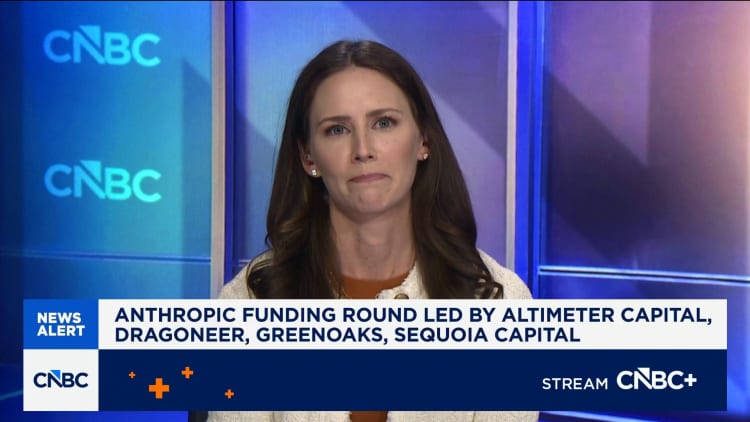
Anthropic closed its last funding round in May, when it raised $65 billion at a $965 billion valuation. The financing was led by Altimeter Capital, Dragoneer, Greenoaks and Sequoia Capital, and nearly tripled Anthropic’s valuation from February, when the company was worth $380 billion.
The round was particularly notable because it pushed Anthropic’s valuation above OpenAI’s for the first time. OpenAI was valued at $852 billion in late March after closing a record-breaking $122 billion funding round.
— Ashley Capoot