
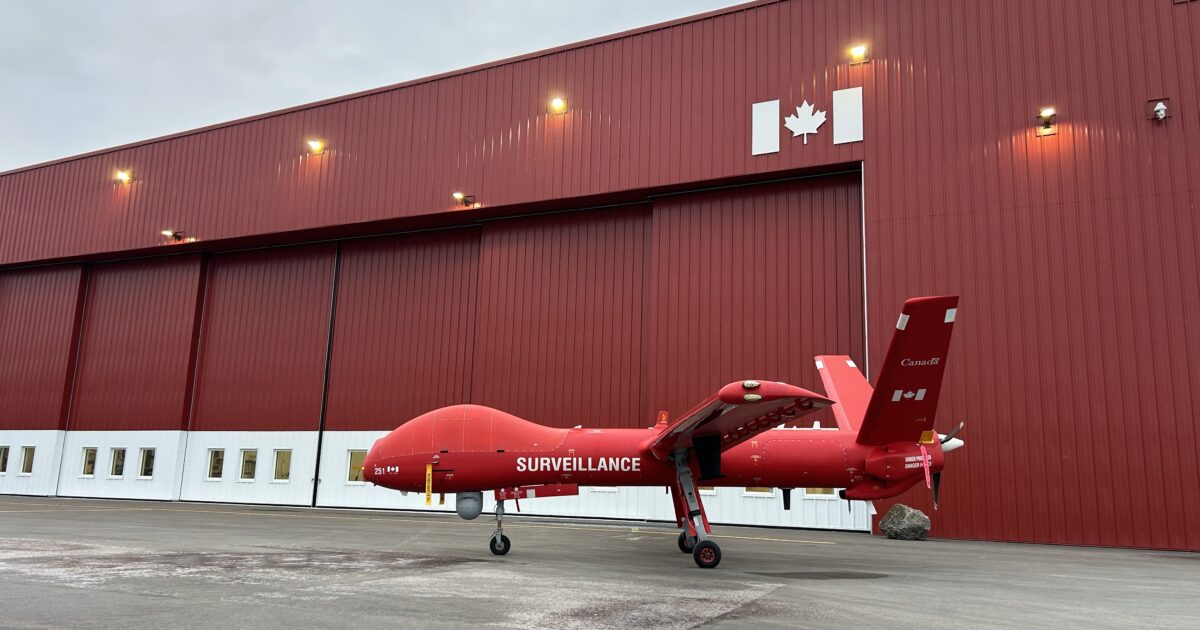
The Hermes 900 StarLiner was shipped to Iqaluit on Oct. 1
The Canadian Coast Guard is preparing to test the Arctic surveillance capacity of a large Israeli-manufactured drone.
Coast guard staff began testing the Hermes 900 Starliner earlier this year at the Canadian Forces Base in Greenwood, N.S., before it was disassembled and shipped from there to Iqaluit on Oct. 1.
The testing will part of an effort to study whether the drone can fit well into the coast guard’s fleet of smaller drones, said Mark McKeeman, the director of the coast guard’s remotely piloted aircraft program.
“Were still in the contract delivery stages with the manufacturer, so they have to prove that the aircraft is capable of operating in some of the conditions in the Arctic,” he said.
One of the things the Hermes 900 Starliner will be tested for is its ability to operate at 72 degrees north, which is about the same latitude as Pond Inlet.
Canada signed a contract to obtain the drone from the Israeli arms dealer Elbit Systems in 2020, at a cost of $36 million.
Transport Canada was initially assigned to manage its use as part of Canada’s National Aerial Surveillance Program, which was transferred over to the coast guard on April 1.

The program now has a mandate to assert Canada’s presence and sovereignty in the Arctic, McKeeman said.
Climate change is bringing an extended shipping season to the Arctic, he noted, and more shipping traffic demands more monitoring.
Should the drone join the government’s fleet, it would monitor shipping and ice cover, respond to pollution events such as oil spills, and patrol for foreign actors attempting to illegally enter Canadian waters, McKeeman said.
The drone, which is red, has a 15-metre wingspan and is about 8.3 metres long, is stationed at a hanger in Iqaluit’s airport.
He said his team had initially hoped to get the drone airborne early this month, but the mission was called off because of low cloud cover. Now testing should begin in May or June.
McKeeman said if everything goes well, the Department of National Defence could explore purchasing more of the drones.

Canada’s Department of National Defence has awarded Elbit Systems contracts for many years. As recently as 2025, the department awarded a $1.9 million sole-source contract to a Elbit Systems Deutschland, a German subsidy of the company, for the purchase of networking equipment.
Meanwhile, a 2025 UN report named the company in a report investigating how the private sector profits from and is complicit in Israel’s genocide in Palestine.
The Hermes 900 Starliner is among drones long-used by the Israeli military since at least 2014. The Israeli military has also used it during the Israeli-Hamas war, which started in October 2023.
NDP Edmonton MP Heather McPherson, also the party’s critic for foreign affairs and international trade, said the federal government has a moral obligation to cut its ties with the company.
“The Canadian government has a responsibility to live up to the same standards that they have set for other companies in this countries, and that means they should not be engaging with companies who are complicit in human rights abuses in the West Bank and Gaza,” she said in an interview.

In 2024, Canada paused the approval of new direct export permits for military goods to Israel.
Jad Eleid, a Montreal-based organizer with the Palestinian Youth Movement, said that the federal government should instead implement a two-way arms embargo, which would end the awarding of contracts to Israeli companies.
“Complicity with genocide is not always about sending bombs and bullets: it’s about purchasing from companies that use the same surveillance technology that allows the bombing of our people,” said Eleid, who is from Lebanon.
The Hermes 900 StarLiner was alleged to have been used in 2024 to target civilians in Lebanon, according to media reports from the time.
Eleid said a loophole in Canada’s export regime also still allows for the export of parts as long as they get to the United States first before being shipped to Israel.
In March, Jenny Kwan, another NDP MP from Vancouver, attempted to pass a bill to close that loophole. It was rejected then, with 295 MP voting against it and 22 voting in favour.
Nunatsiaq News asked Liberal Nunavut MP Lori Idlout for her thoughts on Canada conducting business with an Israeli defence contractor but did not receive a response.