
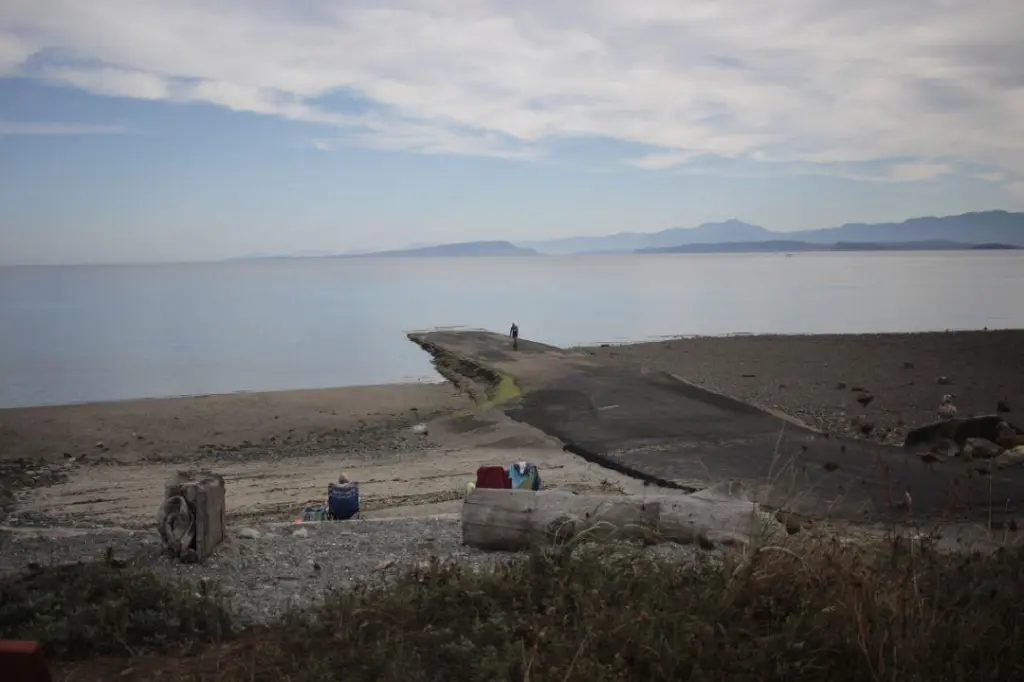
What’s in a wave? How a Kelvin wave could impact Vancouver Island’s east coast
Published 1:42 pm Tuesday, October 27, 2026
Vancouver Island residents have probably heard about the Kelvin wave by now — the ocean phenomenon impacting coastlines this fall — but have they wondered what it means for the sheltered shores of the Salish Sea?
It all starts with it being a potent El Niño year across the globe, part of the El Niño Southern Oscillation (ENSO) pattern that leads to warmer surface water temperature in the Pacific Ocean, which occurs approximately every two to seven years.
El Niño causes a weakening or reversal of the typically east-to-west trade winds blowing across the equator, which creates a Kelvin wave.
“All that warm water that would normally blow westward across the equator comes sloshing—very slowly—back to South America,” explained Jordan Watson, acting director of science at Ocean Networks Canada.
“The warm equatorial water rises on top of any cold water. As this warm water ‘sloshes’ into the continent, some of it hits land and turns north, while some turns south. That water that turns north moves up the coastline as what’s called a Kelvin wave,” said Watson.
Watson said that there is some discussion on whether this slosh of warm water is still a Kelvin wave by the time it reaches Vancouver Island; so, for clarity, he calls it the “ENSO impact.”
Watson also says that while this impact is often referred to as a Kelvin wave, it does not behave like a traditional wave, such as those that surfers ride. Nor is it a wall of water, like a tsunami. The ENSO impact doesn’t create higher tides (that’s due to the moon and solar gravity); it layers on top of high tides, sometimes adding up to 30 cm of water.
“Just like warm air rising because it’s less dense than cold air, warm water also sits on top of cold water because it’s less dense. That warm water also expands relative to colder water. When that water expands, it leads to higher sea levels,” he said. “The impact of El Niño — whether we call it a Kelvin wave or something else — will bring warmer waters and higher sea levels via a mass of slow-moving water or several masses of slow-moving water over the course of several months.”
However, the ENSO impact will manifest differently on Vancouver Island’s east coast compared to its shores on the open ocean. Watson says that while Tofino and Nanaimo are at about the same latitude, their tides differ in terms of time of day and magnitude because of geography, weather, ocean bottom features, and Fraser River discharge, just to name a few features.
So, when one thinks about the characteristically big waves on the west coast of the island, the ENSO impact could lead to higher water levels on their shores. However, areas like the Comox Valley don’t typically get the “Tofino-style” waves.
For the Comox Valley, the ENSO impact will mean warmer temperatures in Baynes Sound, which may cause increased bacteria outbreaks in shellfish. Watson says that changing water temperatures could also lead to shifts in the composition and distribution of ocean species.
“Another way that ENSO more broadly — beyond the ‘Kelvin wave’ strictly — affects the region is through altered weather patterns,” said Watson. “A southward shift in winter storm systems often leaves BC with milder and drier winters, leading to lower snowpacks, which can lead to changes in lake and river systems where salmon eggs and juveniles are incubating or rearing, respectively.”
Watson says any risks associated with the ENSO impact depend on where people live on the island and says coastal residents should stay tuned to local advisories and emergency management authorities. In areas where people harvest shellfish, they should be extra vigilant about shellfish harvest advisories.
“Industry is always watching water quality, so they are likely already paying extra attention and doubling down on their monitoring,” said Watson.
ENSO impacts are likely to affect water levels the most in early winter; however, warmer water temperatures on the east coast could persist longer than that. Predicting the exact timing and duration of these effects is challenging due to other factors, said Watson.