
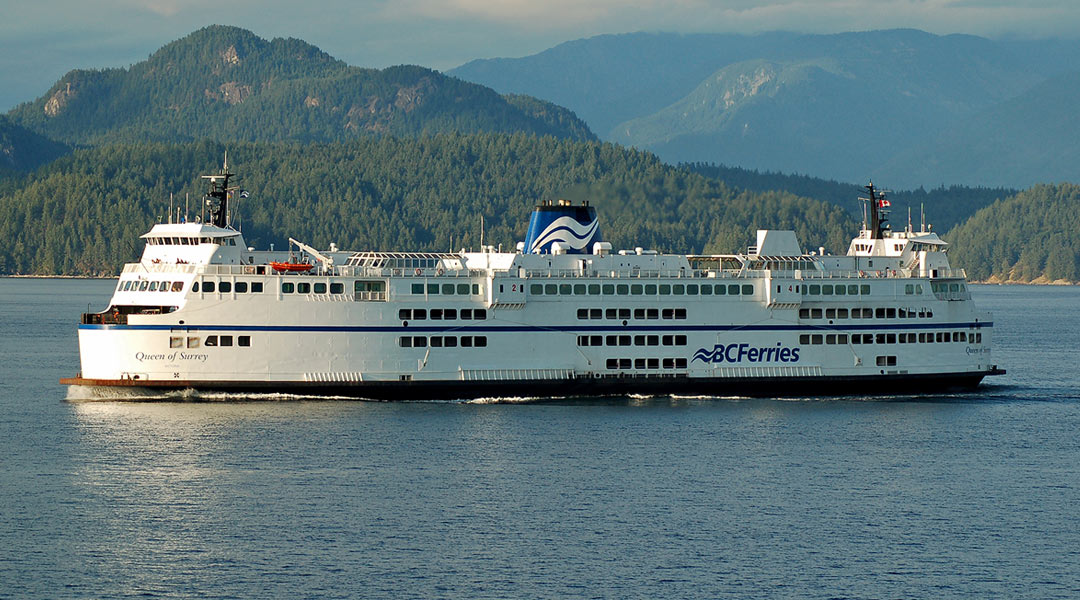
A dead humpback whale has been found near where a BC Ferries’ vessel hit a whale earlier this month.
On Oct. 19, the Marine Education and Resource Society (MERS) shared that BC Ferries had reported to Fisheries and Oceans Canada (DFO) that the Queen of Surrey hit a whale between Gambier and Keats islands.
“According to witness accounts from passengers on the ferry, the whale surfaced in front of the bow, travelling from right to left,” MERS said in the Oct. 19 post.
“The whale then surfaced behind the ferry, thrashing, with red visible in the water. Passenger accounts indicate that the ferry did not slow after the collision and that there was no communication to passengers about the impact they felt or what follow-up actions might be taken.”
Now, MERS has updated that a dead humpback whale has been found by the Grace Islands, which is just south of Gambier Island.
Caitlin Birdsall, executive director of MERS, says DFO is responding to the report of the deceased humpback whale.
“A deceased humpback whale we are learning has been found in the same general area where that strike happened,” Birdsall said in a Zoom interview with CHEK News on Oct. 27.
“It sounds like the whale was first detected last night, and that there are some recovery efforts by Fisheries and Oceans Canada to find and retrieve that carcass today.”
CHEK News has reached out to DFO for more information.
BC Ferries says it is aware of the reports of the deceased humpback whale, and one of its crews spotted the whale and reported it to DFO.
“This is a very sad development, particularly following the collision involving the Queen of Surrey on October 18. We recognize the concern this raises,” BC Ferries says.
“At this point, we don’t know whether this is the same whale involved in the collision or what caused its death. We continue to cooperate fully with DFO and will provide whatever information we can to support their assessment.”
At the time of the collision, BC Ferries said it was concerned about the incident.
“We are deeply concerned about this incident and the potential impact on the whale,” BC Ferries said in a statement to CHEK News on Oct. 19.
“Based on initial reports, the whale surfaced directly in front of the vessel, leaving the crew with very little time to react.”
The company also said it recognizes “how upsetting this is, particularly for those who witnessed the collision, including our crews.”
“They work on these waters every day and care deeply about protecting the marine life around them,” BC Ferries said in the Oct. 19 statement.
At the time, MERS said it feared the collision was fatal.
READ PREVIOUS: Humpback whale struck by BC Ferries vessel near Sunshine Coast, researchers fear collision was fatal
MERS also noted this collision is in the same area that a Prince of Whales boat hit a humpback in October 2025.
READ PREVIOUS: Prince of Whales boat hits humpback whale in ‘surprise encounter’
‘Nobody wants to hit a whale’ MERS offers tips to help avoid whale strikes
Birdsall says that humpback whales come to the water around Vancouver Island to feed and bulk up before making their migration journeys to Hawaii, Mexico and Central America.
“So this is the time of year they have to be focused on feeding,” she said.
“And because they’re very focused on feeding, it may mean that they’re not exactly as aware to other things in their environment because of that sort of hyper focus on bulking up as much as possible before these enormous migrations to places where they’re not going to get any food.”
Birdsall says this can make the whales “oblivious” to their environment, so it’s important for boaters to take steps to avoid strikes.
“It’s really important to say that we recognise that nobody wants to hit a whale,” she said.
“Nobody does, and that it is really hard on those that are involved in these types types of incidents. And so we do have great empathy for that. However, there are multiple tools available right now and developing that can be implemented to give large vessel operators more situational awareness.”
One of those tools that MERS would like to see BC Ferries and other large vessels incorporate is using the Whale Report Alert System. Birdsall says there had been reports using the system of a humpback whale in the area prior to the whale strike.
In addition to that system, Birdsall says large boats could use tools to detect whales acoustically or using infrared cameras.
“Implementing slowdowns is also a really important one, both situationally, dynamically, or static slowdowns as well,” she said.
“And so, I think that certainly there can be situations where nothing more could be done, but we’re not at that place yet.”
MERS also launched a free whale safe boating course that Birdsall encourages “anyone who spends time on or near the water” to take to learn about rules, regulations and best practices for being around whales.
With files from CHEK’s Jeff Lawrence