
‘It was an experience like nothing I’ve had,’ legally blind rider says of Main Stream Therapy
Carley Davis has managed to combine her passion and experience with horses with her desire to help people.
While working on her degree in counselling psychology at Georgian College, Davis began researching equine therapy. Soon after, she earned a certificate in equine-assisted learning.
She began working at Main Stream Therapy in Barrie as a student where she now does counselling and administration. There, in addition to focusing on athlete mental performance, she has carved out a niche as an equine-assisted learning practitioner.

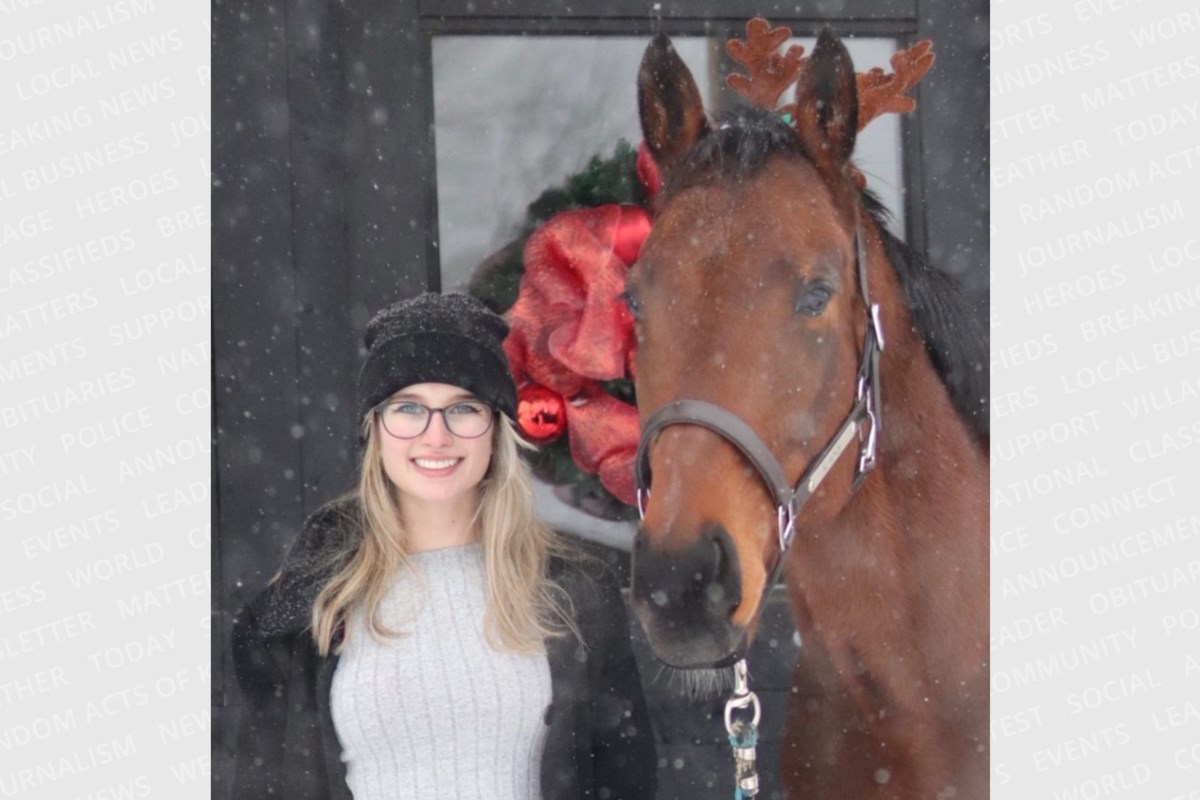
Carley Davis runs an equine therapy program through a local counselling service. | Image supplied
“It felt like it was the most perfect thing I could do,” says Davis, who formerly was a competitive rider.
“I always felt a connection with horses. Horses were always where I always felt myself.”
Through equine therapy, she’s able to share that comfort with people interested in taking the therapy out of the office and into the horse arena.
Davis helps clients interact with horses to work on human physical and mental health.
Main Stream has developed its own program, working from the base Davis had developed.
It began at a farm in the Big Bay Point area where Davis started her own journey with horses as a child.
But when the owner retired, the program was moved to a new location in Springwater Township.
Stuart Matan-Lithwick, who is legally blind, came to the equine program though a recommendation from the farm.
His young daughter had enjoyed horse riding camp and he became intrigued. He quickly connected with both Davis and the horse.
“It was an experience like nothing I’ve had,” says Matan-Lithwick, who closed his eyes to block out what vision he does have while riding.
Sitting on the horse was initially anxiety-provoking, he says. But then he learned to relax and connect with the horse. He learned to communicate with the horse, directing her to go left or right with a pull on the reins and a pinch of the heels to start going.
At first, he followed Davis’s instructions. Then she set up speakers in the periphery of the arena and, as he approached one speaker, it would fade out and then he followed the sound coming from another speaker.
By working with the horse and through the help of the speakers, he learned to ride the horse with control independent of the intervention of others.
“It was an incredible meditating experience,” he says. “I could actually ride a horse completely blind … I could imagine this therapy being an incredible, empowering experience.”
Davis began by leading him around the arena and giving him instructions on when to go right and left.
Adding the speakers then allowed Matan-Lithwick to ride independently, but while sharing trust with the horse.
“It really shows that horses really can be for everyone,” adds Davis.
Now one year in, Davis says the year-round program has exceeded her expectations. She works with clients on the farm on Sundays and Tuesday evenings, mostly in individual sessions, but with some group sessions available. And she’s at the point of making more times available.
“When people show up, I usually have the horse ready for them … They’ll learn about the horse a little bit first,” she explains. “Most of it is on the ground, but there can be some riding.
“Horses, they respond to body language and emotional energy … they’re constantly giving people honest and immediate feedback.”
There are ground exercises, such as problem solving and verbal and non-verbal communication.
By communicating with the horse, she says the clients build confidence while learning how to build the relationship and trust with the horse – real life skills that can be used outside the arena.