
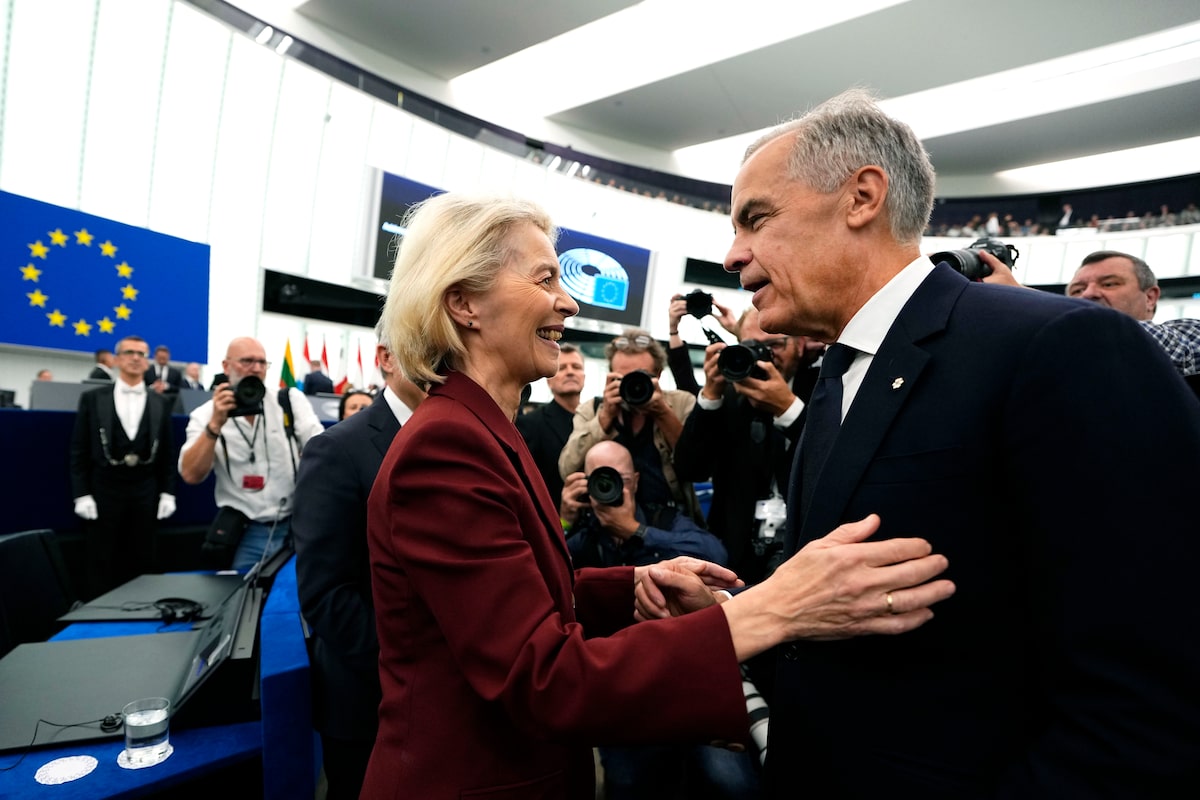
Prime Minister Mark Carney is greeted by European Commission President Ursula von der Leyen in September. Mr. Carney was in Strasbourg, France, to address the European Parliament.Justin Tang/The Canadian Press
The European Union has dropped the idea of designating Canada an “associate member” of the 27-member economic bloc after objections from major players, including Germany and France, two sources familiar with deliberations said.
Instead, a new draft of a joint statement to be issued during the two-day Canada-EU summit that starts Thursday talks of “ever closer association” between Ottawa and Brussels.
This doesn’t change the thrust of efforts to deepen economic and security ties but shelves a term that captured the imagination and also prompted friction between EU members.
The Globe and Mail is not identifying the sources who detailed plans for the summit Wednesday because they were not authorized to speak publicly on the matter. They called the new text a compromise.
A second source said the term “associate member” had become a distraction that threatened to overshadow the summit to deepen economic and defence ties. They said EU states that objected are not opposed to closer association, but felt it would be a confusing term for a country that has no intention of becoming a member.
The label was proposed by European Commission President Ursula von der Leyen in September, but it has no legal basis in the EU treaties that bind the 27 member states together.
Carney, von der Leyen urged to draft ‘middle power’ charter at Canada-EU summit
Also, German Chancellor Friedrich Merz floated the idea of designating Ukraine as an “associate member” earlier this year in a letter to EU leaders, the second source noted. His proposal would let Ukrainian officials take part in EU summits and ministerial meetings but not vote in them. There’s no indication this idea gained traction.
The bloc and Canada are trying to boost two-way trade and investment in order to reduce economic and strategic reliance on the increasingly protectionist and unpredictable United States under President Donald Trump.
The EU bought about $43-billion of Canadian goods in 2025, roughly 1 per cent of what it imports, according to a new report from TD Economics. Exports to the EU amount to 5 to 6 per cent of Canada’s merchandise exports, roughly the same share as shipments to the United Kingdom or China, the bank said.
Canada’s exports of $22-billion in services to the EU in 2025 is “barely a blip considering the EU’s more than $2-trillion in services imports from non-EU countries,” TD Economics said in a report.
Prime Minister Mark Carney this week played down the question of whether Canada is designated “associate member” in public comments, saying the title is irrelevant. “What matters is the difference that it will make to the lives of Canadians, young Canadians in terms of opportunities to study, work and travel, our Canadian businesses in terms of new opportunities, Canadian researchers in terms of depths of opportunity, and Canada as a whole becoming a more independent, more sovereign nation, so we can live our lives as we choose,” he said Tuesday.
The Prime Minister said the Montreal summit is only a beginning and will “launch further formal discussions, negotiations, over the course of the next year.”
EU officials told journalists earlier this week Ottawa and Brussels are working toward a digital trade agreement that will cement rules for online trade, including e-signatures and e-contracts, paperless trade, secure cross-border data flows, duties on electronic transmissions and e-commerce. This agreement would effectively expand the Canada-EU trade agreement into digital trade, officials said.
Mr. Carney has said Canada has no intention of formally joining the EU, which would require this country to bring its laws and regulations into alignment with those of the economic bloc.
This new partnership includes opening Europe’s supercomputing infrastructure to Canada, giving researchers and businesses more opportunities to use the quantum power from these machines to further research into areas such as artificial intelligence and Alzheimer’s, EU officials have said.
Prosperity’s Path: Canada must stand with Europe against U.S. Big Tech
Canada is also looking at greater reliance on EU satellite systems to reduce dependence on the U.S. Mr. Carney recently told The New York Times he plans to “diversify away from” billionaire Elon Musk’s Starlink satellite-internet network, indirectly citing instances where Ukraine’s access to Starlink services was “turned on and off in a way that was not sovereign to the actors in the conflict,” without naming the country.
Canada and the EU are also talking about deepening co-operation on secure satellite connections, including Galileo, the EU’s satellite navigation system, which is the equivalent of GPS, as well as Iris2, the EU’s planned secure satellite network that would give governments and businesses a communication option that doesn’t depend on U.S. or Chinese systems.
Ottawa and Brussels are talking about Canada participating in GovSatCom, which pools satellite communications capacity from member states for government and military use, officials said.
A recent version of the joint statement for this summit also said deepening ties will mean “connecting instant payment systems to facilitate faster, lower-cost and more seamless cross-border transactions,” making it easier for Canadians and Europeans to conduct business, invest and transfer funds internationally.
Canada and the EU will also co-operate on building telecommunications cables connecting them to Asia as well, a recent draft of the summit joint statement says, as capitals in both jurisdictions grow concerned about sending digital traffic through the United States.
“We will launch joint initiatives to improve secure international connectivity between Europe, Canada and Asia through new subsea cable infrastructure,” the draft joint statement said. “As part of these efforts, we will assess cable routes, points of interconnection, and engage with industry. Our goal is to develop new infrastructure to enhance economic growth, route diversity, and resiliency.”