
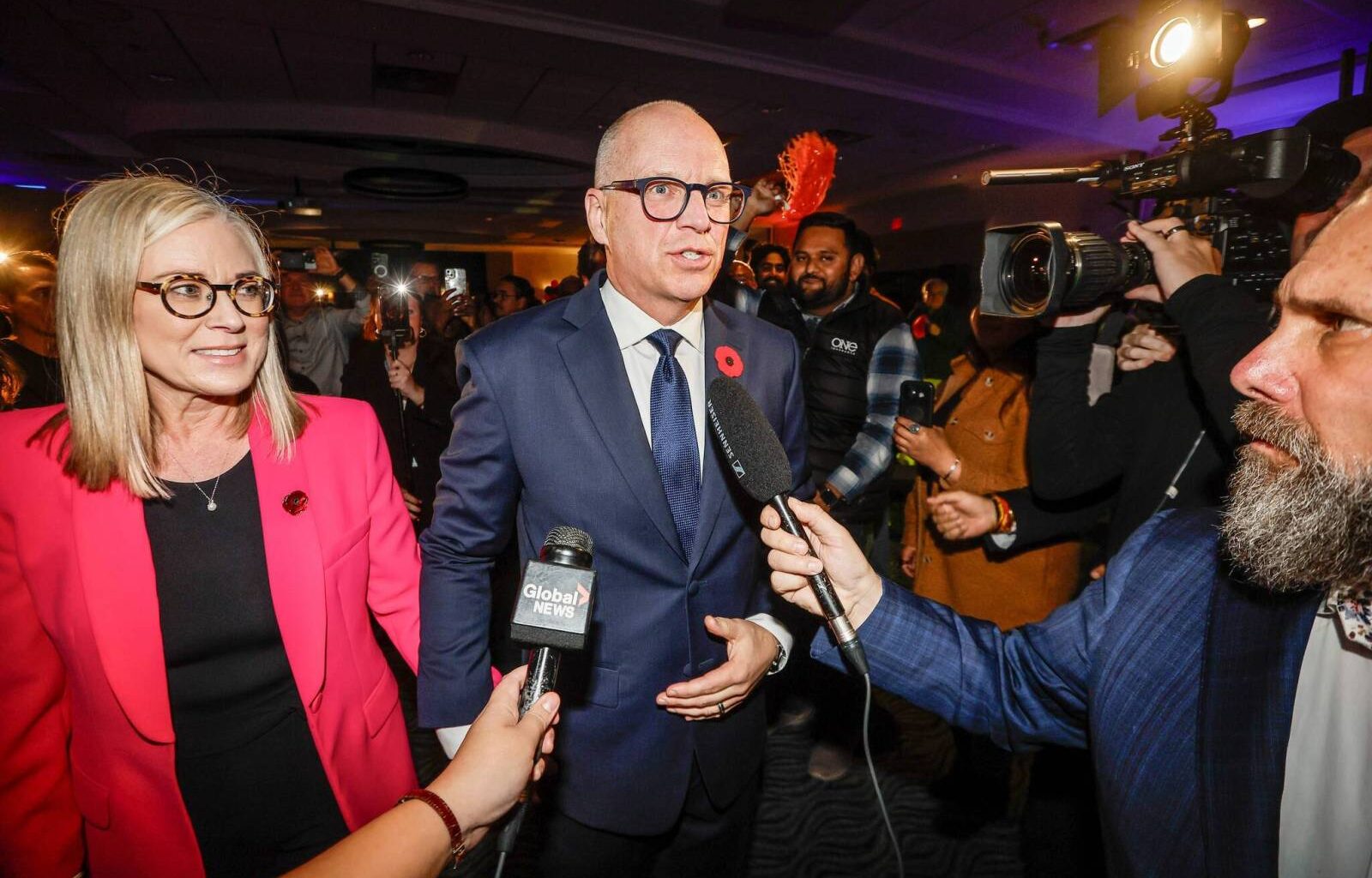
Congratulations, Scott Gillingham, you’ve won another four years leading Winnipeg’s civic government! Johnny… tell him what he gets!
Daunting, chronic problems and not enough money to fix them. Oh, and a city full of people who were unsure about whether they wanted you to have another four years.
Civic politics is a cruel and cynical business, to be sure. Every four years, you have to audition for your job in a contest that has the lowest voter turnout of any level of government. You get blamed for everything, even the stuff you don’t have any control over, and hardly ever get credit for anything.
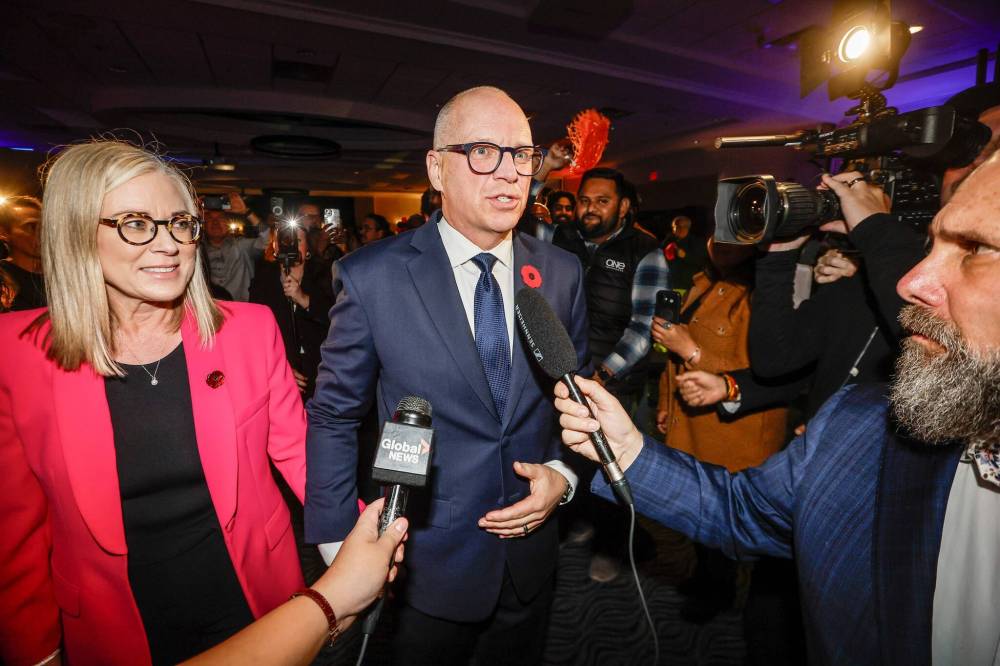
JOHN WOODS / FREE PRESS
Scott Gillingham won the Winnipeg mayoral race receiving just under 40 per cent of the votes cast with roughly 37 per cent voter turnout.
Even so, this edition of the Winnipeg mayoral election seemed to be particularly cruel and cynical.
While Gillingham was victorious, his level of support — he garnered just under 40 per cent of votes cast with roughly 37 per cent turnout — was modest. This was the exact scenario predicted by Free Press-Abacus Data opinion polls taken over the course of the campaign.
The polls found that while Gillingham had the most support of any candidate in the election, a majority of respondents felt that someone else should take the helm at city hall. Poll respondents were concerned about the state of municipal amenities, enraged about changes to Winnipeg Transit and dubious that any of the candidates — Gillingham included — could do anything to make the city safer.
It’s hard to feel bad for Gillingham, who has won an election where he was considered the best of a bad lot of candidates. Still, it’s equally hard not to have a modicum of sympathy about the difficult challenges he and council will face over the next four years.
Every big city in this country, Winnipeg included, is being crushed under the weight of too many demands for services and infrastructure, too many social problems and too little money to provide real solutions.
Even with a steep hill to climb on a go-forward basis, what expectations should we have about Gillingham 2.0?
“Making existing things a wee bit better” could have been his campaign slogan, and a fair description of the job he did over the last four years. New ideas or bold initiatives were largely absent from this re-election campaign.
To be fair, in that first term, there were moments of innovation and bold decision-making.
The reopening of Portage and Main to pedestrian traffic has been a triumph, providing a new attraction downtown and freeing the city from years of additional dithering and debate.
Gillingham has done a solid job managing city finances. Levying a 5.95 per cent property tax pledge the year before this election was both politically risky and fiscally justified.
The city has also played its part in supporting the redevelopment of Portage Place mall by True North Real Estate Development, arguably the most expensive multi-use project the downtown has ever seen.
These accomplishments demonstrated Gillingham’s capacity to think big and make tough decisions when needed.
Other initiatives he highlighted on his website, such as the Neighbourhood Action Teams and Community Safety Teams, showed the mayor’s ability to conjure small but meaningful gestures that no doubt resonated with Winnipeggers.
However, his first term in office left the overwhelming sense he is trying too hard to ensure things don’t get worse, rather than trying to make things better.
The problems he and council are faced with are enormous, systemic and deeply embedded in the very structure of local government. The awful truth is that Winnipeg has too many needs and not nearly enough money.
Gillingham must find a way to crack this fiscal nut. Either by finding new revenue sources or by convincing senior levels of government to pony up more cash and more long-term funding commitments for major civic services.
Both of those are easier said than done.
Successive provincial governments have consistently used their legal authority to stop municipal governments from introducing new taxes. And senior levels of government love short-term funding deals with municipalities so they don’t get backed into a fiscal corner if their own finances tank.
This is particularly problematic for things such as transit. The former Progressive Conservative government cut funding to Winnipeg Transit, and the current NDP government has continued that position, for reasons that are not entirely clear.
Given that the botched reboot of Winnipeg Transit routes and schedules was a complete disaster, Gillingham should be highly motivated to seek some sort of additional support to turn things around. The transit system overhaul debacle remains the biggest failure of Gillingham’s first term.
It would also be highly advisable for Gillingham to rethink his support for the widening of Kenaston Boulevard and the extension of Chief Peguis Trail.
The Kenaston proposal is a bad and expensive project that will only invite more vehicles to use the route. The Chief Peguis Trail extension is allegedly needed to trigger the construction of 15,000 new homes. On that basis, perhaps Gillingham could revisit development fees?
Without some sort of new funding arrangement, Gillingham and the city are doomed to spend the next four years trying not to make things worse, but falling well short of making things better.
dan.lett@winnipegfreepress.com

Dan Lett is a columnist for the Free Press, providing opinion and commentary on politics in Winnipeg and beyond. Born and raised in Toronto, Dan joined the Free Press in 1986. Read more about Dan.
Dan’s columns are built on facts and reactions, but offer his personal views through arguments and analysis. The Free Press’ editing team reviews Dan’s columns before they are posted online or published in print — part of the our tradition, since 1872, of producing reliable independent journalism. Read more about Free Press’s history and mandate, and learn how our newsroom operates.
Our newsroom depends on a growing audience of readers to power our journalism. If you are not a paid reader, please consider becoming a subscriber.
Our newsroom depends on its audience of readers to power our journalism. Thank you for your support.