
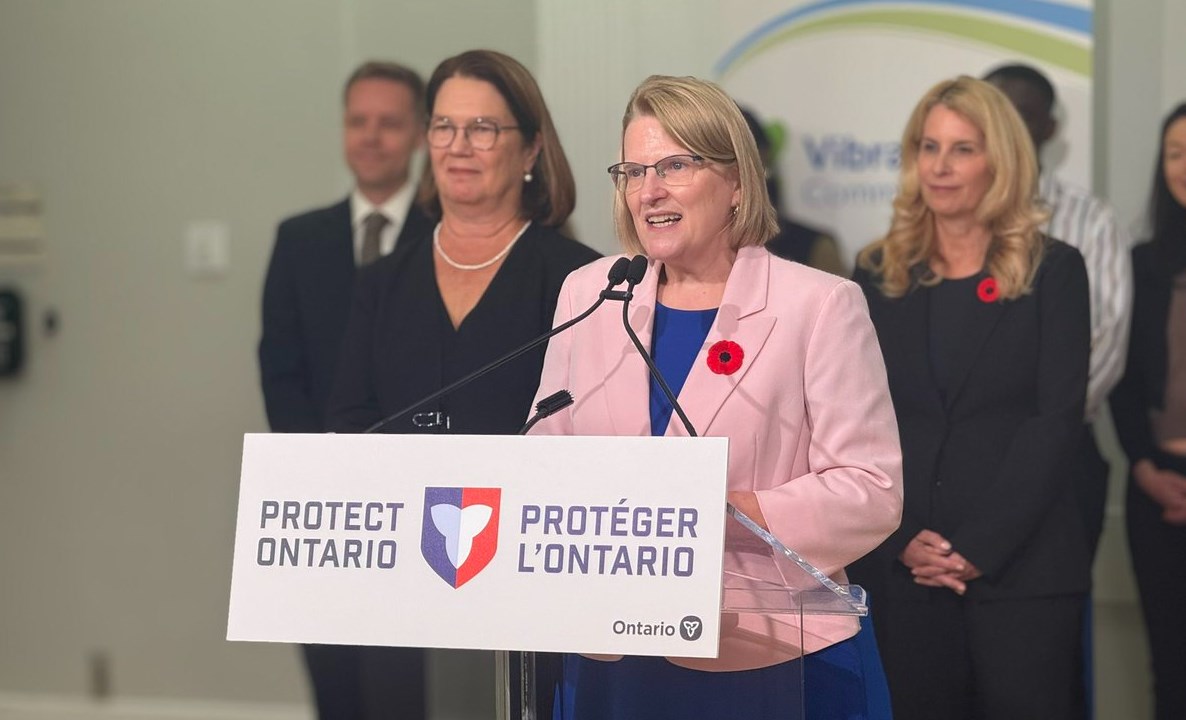
Sylvia Jones says new rules simply codify existing policy; patients say they’ve fundamentally altered who qualifies for life-saving treatments abroad
EDITOR’S NOTE: This article originally appeared on The Trillium, a Village Media website devoted exclusively to covering provincial politics at Queen’s Park.
As cancer patients fight to access potentially life-saving treatments abroad, Ontario Health Minister Sylvia Jones is defending the province’s decision to tighten its rules for funding out-of-country drug treatments, saying the changes formalize a policy that’s been in place for years.
“There’s no doubt as we hear and experience what patients and their families are going through that we all have a lot of empathy and concern,” Jones said. “The regulation change was really codifying something that has been in place since 2011.”
The health minister was responding on Monday to a question about patients like Sabrina Apitz-Grossman, a 31-year-old Ontario woman with stage-four synovial sarcoma who is taking the Ford government to court after it refused to fund a potentially life-saving treatment available in the United States.
The province made regulatory changes to limit who qualifies for out-of-country treatments on the same day Apitz-Grossman filed an application for judicial review challenging Ontario’s refusal to pay for Tecelra, a specialized T-cell receptor therapy that her doctors consider her an excellent candidate for.
The government’s changes limit public funding for out-of-country drug treatments to circumstances where the drug and its administration are already publicly funded in Ontario, but access is temporarily unavailable, and travelling abroad is necessary to avoid death.
“Trying to frame this as ‘codifying an existing position’ is truly counter to reality, when the criteria themselves have switched from not available in Ontario, to already available in Ontario,” Apitz-Grossman told The Trillium.
“The circumstances wherein a treatment is ordinarily available in Ontario, regularly funded, but is temporarily unavailable for whatever reason are just so impossibly narrow that it’s hard to see when they would ever apply,” Apitz-Grossman added. “These changes are taking a last-resort safety net program and limiting the scope so severely that it basically will never apply to anyone.”
The change is retroactive to Oct. 1, 2011, and could affect applications and appeals already underway.
It was made shortly after another Ontario cancer patient, Alex Shved, won a judicial review challenge similar to Apitz-Grossman’s over an out-of-country treatment funding decision.
The government has argued the change protects Ontario’s ability to negotiate lower drug prices and could prevent billions of dollars in additional annual costs to the health-care system. Jones said the province has increased access to “new and emerging technologies and drug therapies” through programs like Funding Accelerated for Specific Treatments (FAST) — which fast-tracks public coverage for high-priority cancer drugs.
When asked how the province helps patients with rare diseases, like Apitz-Grossman, who cannot access FAST, and how the government weighs cost savings against someone’s life, Jones said “these are very challenging decisions — and they are made by clinicians, surgeons, ethicists and not by politicians.”
More families say they’re being left behind
Since first publishing Apitz-Grossman’s story, The Trillium has heard from several other families struggling to access treatment for rare diseases, including those seeking experimental therapies that are not covered by Ontario’s existing programs.
Azeddine Labiad and Wisal Lahkimi say they have been left to find a way forward themselves after their three-year-old son, Samy, was diagnosed with a rare pediatric neuromuscular disease.
The disease weakens muscles over time, and without treatment, Samy could lose the ability to walk and use his arms as it progresses. The family told The Trillium their greatest hope lies in an experimental gene therapy trial in the U.S.
“We asked for the out-of-country program, like the one Sabrina is asking for. We got the answer that it does not cover clinical trials,” Labiad said. “I was expecting more from the government. My thinking was, ‘Once I will find something that will help my son, the officials will be happy and will try to work with me on that.’ But it was not the case, so that was really disappointing and surprising.”
The family has been travelling to the U.S. to meet with doctors on their own dime, and launched a fundraising campaign to help cover costs.
Apitz-Grossman is also now relying on a fundraising campaign to help her get the treatment she needs.
Liberal health critic Adil Shamji said Jones has “gutted a program that helps people with rare diseases get care when it’s not available in Ontario.”
“People have died from this. More will if she doesn’t change course,” he said.
In a statement last week, a spokesperson for Jones said, “A drug that has not been approved by Health Canada is not authorized for use in Canada and therefore cannot be made available through the public drug programs of any Canadian province or territory.
“This process is unchanged by the action we have taken to ensure life-changing drug treatments remain available to Ontario families,” Lily Barnes added. “Should the manufacturer wish to make a submission to Health Canada and the established national process, funding for the treatment could be considered in the future,” she added.
In Apitz-Grossman’s case, the manufacturer said it has no plans to seek Canadian approval.