
It’s been a busy year in Ottawa’s defence industry, with companies bidding on new contracts, adapting their operations or starting from scratch to meet the anticipated demand for domestic suppliers.
That activity was spurred by last fall’s federal budget with its $80 billion in defence spending, and the government’s goal, laid out in February’s defence industrial strategy, to award 70 per cent of military contracts in the next decade to Canadian companies..
Now, the industry is watching for a new federal budget to arrive on Nov. 5 to see what’s next.
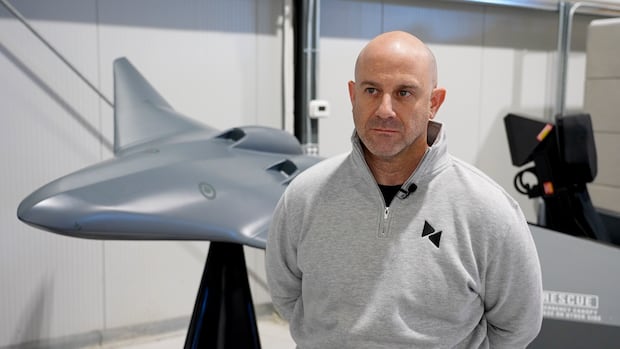
Dominion Dynamics launched last October and is now headquartered in a 30,000-square-foot factory in Kanata North.
Eliot Pence, the company’s CEO, says the company’s mission is aligned with the government’s: to build up Canada’s ability to build the tech needed for its own defence.
Dominion is developing hardware such as a drone meant to fly alongside crewed aircraft, and software such as control systems to support Arctic surveillance.
“I have seen dramatic changes in how we approach defence procurement, both in speed and velocity and … size of deals,” Pence said. “What I’m looking for next is, how does that affect the [small- and medium- size enterprises]?”
Pence noted recent developments like the Defence Drone Initiative, BOREALIS defence innovation incubators, and plans for the Defence Investment Agency to become a Crown corporation are signals procurement is changing for the better.
Pence said the company started in Ottawa to be close to his main government customers. Dominion Dynamics chose Kanata North specifically to benefit from the region’s expertise in telecommunications, which stretches back to the days of Nortel.
In its pre-budget submission, Dominion Dynamics said the government’s traditional procurement style favours big, established multi-national players. Dominion wants rules changed to help smaller Canadian-owned and controlled companies win smaller contracts that are nimble in a world of fast-changing technologies like drones and artificial intelligence.
“Transformation really happens lower down on the economic ladder with companies my size, 50 to 500 people, and frankly even lower,” Pence said.
WATCH | Dominion Dynamics CEO discusses partnering with Ukrainian drone company: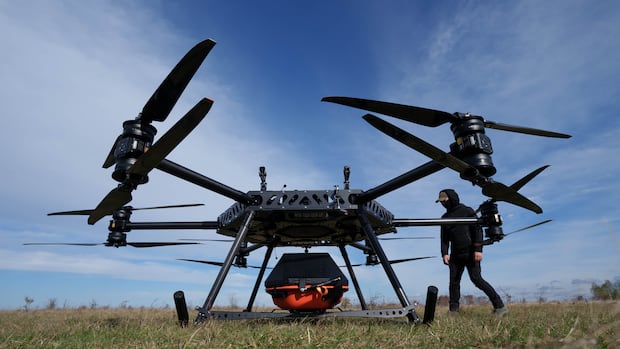
What can Canadian defence firms learn from Ukraine’s drone expertise?
Host of CBC Morning Live David Common speaks with Eliot Pence, CEO and founder of Dominion Dynamics, about his company partnering with Ukrainian robotics company Tencore and what this partnership could mean for the drone industry in Canada.
Dominion has some small Canadian contracts and a recent deal to build 500,000 ground drones in Canada for a Ukrainian company. It also raised $139 million in private investment over the summer, cementing its position as one of the fastest-growing companies in the space.
Pence has also co-founded the Alliance of Canadian Defence Companies, which now has almost 200 members, to advocate for Canadian-owned defence companies.
“I’m seeing green shoots. It would be a failure if we were the only ones that raised a lot of money,” he said.
Some local companies are tapping into a new $241-million program at the National Research Council aimed at helping small businesses in the defence sector, and another $4-billion program at the Business Development Bank of Canada, both launched in the past 10 months.
Ottawa-based One9, a venture capital firm focused on defence, said it is hearing more from both startups and commercial companies that are trying to position themselves in the sector.
CEO Michael Smith said there used to be stigma and risk associated with the defence industry, adding some new entrants weren’t able to get bank accounts 18 months ago.
But now that the geopolitical environment has changed, the federal government is pushing billions into building up its homegrown defence supply chain so it is less dependent on the United States.
There’s new interest from businesses looking to raise money, and from investors looking to back them.

Michael Smith is CEO of One9, an Ottawa-based venture capital firm specializing in defence-first technology companies and companies with technologies that have both defence and commercial applications. (Francis Ferland/CBC)
“There are these net-new, pure-play defence companies who are unabashed that say, ‘I am going to sell to the government and any other government that’s willing to buy my defence tech,'” Smith said.
He said those companies are setting up in Ottawa to be close to the Department of National Defence, plug into the tech capabilities of the city and benefit from demonstration opportunities like the Area X.O testing site operated by Invest Ottawa near Woodroffe Avenue and West Hunt Club Road.
Smith said the next federal budget is about the government putting “its money where its mouth is,” when it comes to the Defence Industrial Strategy’s maxim of build-partner-buy.
“The build only happens when you actually start buying your Canadian products, and when that happens — and at a scale that changes the Canadian landscape — remains to be seen,” Smith said.
WATCH | Ottawa drone builders anticipate more defence spending: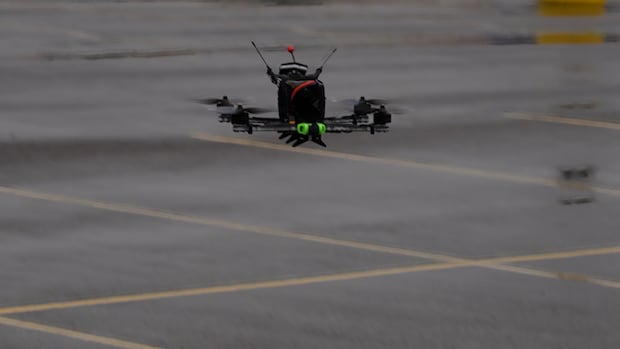
Ottawa drone makers tool up for increased defence budget
New and established drone companies in Ottawa are expanding their manufacturing base as the federal government signals it plans to rearm the Canadian Forces with domestic gear. Matthew Kupfer reports.
Invest Ottawa is waiting for updated numbers on how the sector has changed since it launched the Defence Innovation Hub a year ago. Back then, it pegged the number of National Capital Region companies in the sector at more than 330.
President and CEO Sonya Shorey said the number has grown and signals from the federal government have contributed to “doubling down” from companies in Ottawa.
At the same time, the government’s message is attracting foreign investment. Finnish airship company Kelluu, for instance, recently opened an Ottawa office and is working on uncrewed blimps that can surveil the Arctic or remote forest fires.
The Canadian Association of Defence and Security Industries (CADSI), which represents both domestic and multinational companies, says its membership grew by 70 per cent this year and now counts 254 companies in Ottawa-Gatineau.
The majority, 182, are in that small- and medium-size business category.
Christyn Cianfarani, CADSI’s president and CEO, said smaller firms are either trying to attract partners in the larger conventional defence supply chain, or win a niche contract with the Department of National Defence and Communications Security Establishment Canada.
She said some procurements are stating a preference for Canadian firms, but those will likely be on a case-by-case basis, in the areas where Canada wants to establish the ability to stand alone, such as cybersecurity and cryptography.
And Cianfarani notes defence is a highly regulated and scrutinized market to get into.
She said she’s already hearing from member companies that are either new or new to the sector running into hurdles that come with meeting controlled goods and national security regulations.
“There are some members that were very excited. They got some contracts and then they realized, ‘I need a security clearance and I cannot get it in the time frame that’s required for me to execute on my contract.'”

Christyn Cianfarani is president and CEO of the Canadian Association of Defence and Security Industries. (Matthew Kupfer/CBC)
Cianfarani, like Pence, said regulatory requirements and processes need to be clearer for companies that are coming into the sector and growing to respond to larger contracts — something the government’s strategy identified.
Smith, Shorey and Cianfarani all say that there is a boom going on in Ottawa’s defence sector.
Pence, however, is a little more cautious in his assessment at the end of his busy first year.
“I think there’s a recognition by the public that Canada needs to have a defence industry, that we need to invest more. For what it’s worth, I think the public recognized that long ago,” he said. “I’m waiting for the boom. I’m hopeful for the boom.”