
Cohere CEO Aidan Gomez speaks at the Milken Institute’s Global Dialogues Toronto summit last month.Sammy Kogan/The Globe and Mail
Cohere Inc. has secured most of a planned $7-billion financing, including backing from the federal government, in a deal that would value the Toronto-based AI company at $35.7-billion.
The financing is the largest by a Canadian startup in history and, once completed, would make Cohere the country’s most valuable privately held technology company.
The round was led by German retail giant Schwarz Group and includes funding from Bell Canada’s venture arm and Luxembourg-based Bullhound Capital, Cohere said in a news release on Thursday.
The Canadian government is putting $1.6-billion into the deal and taking an equity stake in the firm – a direct investment of unprecedented size in a technology company, as part of Ottawa’s strategy to build out and secure the country’s AI strengths and economic sovereignty.
Returning backers that have committed to the financing include chip giant Nvidia Corp., Montreal’s Inovia Capital, and Prosperity7 Ventures, an arm of Saudi Aramco.
AI personal assistants force Canadian companies to weigh customer access against security
Cohere chief financial officer Francois Chadwick said in an interview that the financing is necessary for the company to invest in compute infrastructure, develop its AI models and expand globally.
“Canada needs to be there at the forefront,” Mr. Chadwick said. “Instead of having two global leaders – China and the U.S. – Canada becomes a global leader in the AI world.”
To secure Ottawa’s investment, Cohere has committed to spend $1.7-billion on the buildout of compute infrastructure in Canada by 2030. It has also promised to remain headquartered in the country.
“Under this agreement, Cohere will stay Canadian,” Prime Minister Mark Carney said at a press conference announcing the investment on Thursday, calling the new round a “vote of confidence” in both Cohere and Canada.
Mr. Carney appears at Thursday’s press conference with Cohere CEO Aiden Gomez, left, and AI Minister Evan Solomon. The government is putting $1.6-billion into the deal and taking an equity stake in the firm.Christinne Muschi/The Canadian Press
The Globe and Mail first reported last month that Cohere had told investors it was in advanced talks to raise as much as US$3-billion, including financing from the Canadian and German governments, at a valuation of US$20-billion.
Mr. Chadwick declined to comment on those numbers and on any talks with the German government.
“We started with some original figures on what we were looking to raise,” he said. “Because we were oversubscribed on our original thinking, we’ve kept the investment open, and we will be looking to close soon.”
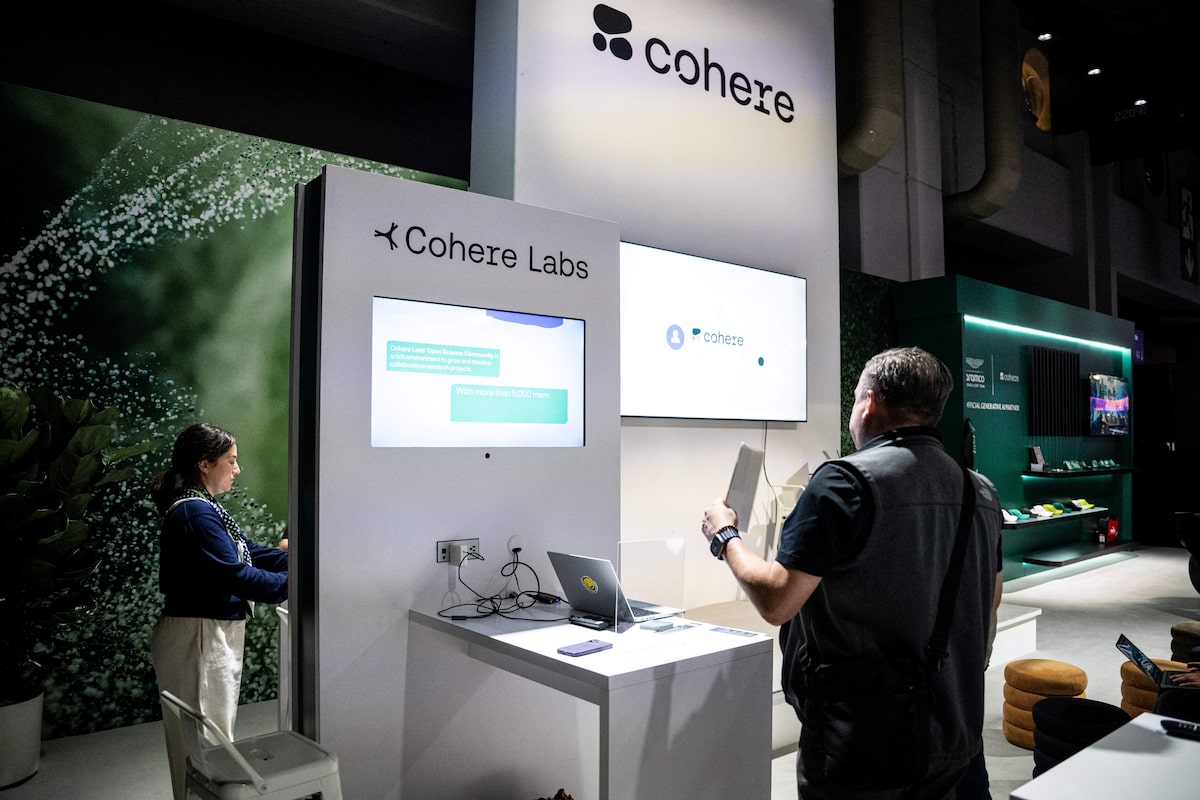
People visit the Cohere booth on day one of the Al In 2026 conference at the Palais des Congres de Montreal on Sept. 26.ANDREJ IVANOV/AFP/Getty Images
Cohere announced in September it had agreed on final terms on its proposed merger with Aleph Alpha GmbH, a German AI company backed by Schwarz. Earlier this month, Cohere reached a deal to acquire Aisle, a Prague-based cybersecurity startup. It also launched a new version of its flagship software platform North, which lets workers at its corporate and business clients set up AI agents to automate tasks such as financial analysis and coding.
The new financing would significantly boost Cohere’s valuation, which was set at roughly US$7-billion in a round last September.
Cohere, which develops large language models and software systems powered by them, faces significant competition in its chosen market of AI tools for large organizations in the private and public sectors. OpenAI and Anthropic are already generating billions of dollars in revenue from such customers. Meanwhile, many businesses are switching some AI tasks to cheaper models, often from Chinese developers, in a bid to contain rising technology costs.
Anthropic sets stage for blockbuster IPO, highlighting AI’s benefits and risks for humanity
Cohere remains much smaller than the leaders of the field in Silicon Valley. Annualized revenues were growing at 165 per cent as of the end of September, and its customer base has increased 20-fold to 300 clients over the last year, the company has said. In February, Cohere told investors it had reached an annualized revenue rate of US$240-million in 2025. (Mr. Chadwick declined to comment on Cohere’s current revenue run rate.)
The company sells its technology as a sovereign alternative to that of U.S. and Chinese developers. Cohere has made many of its recent AI models open source, meaning that users can download and run them on their own hardware. It also touts the control and privacy features of its technology.
Cohere is developing customized tools for highly regulated and sensitive industries such as financial services, telecommunications, health care and energy. It has struck partnerships with defence contractors, including Canadian Armed Forces supplier Thales.
Ottawa has championed Cohere as a strategic asset in its bid to make Canada into a significant AI power. Mr. Carney has repeatedly said Canada is one of only four countries in the world that has its own developer of LLMs. The updated national AI strategy, launched in June, pledges to “anchor” Cohere and other homegrown makers of “foundation models” in Canada, and help them export in global markets.
The plan also includes $500-million for a new Canadian Tech Growth Fund, which will back later-stage startups and – unusually for a federal program – could take equity stakes in them. Ottawa has committed $1.75-billion to help seed venture-capital funds in a bid to boost the amount of investment available to growing firms.
Wealthsimple raises funds at $13.8-billion valuation as it seeks to rival banks
Last week, the federal government began the process of finding takers for its $1-billion Venture and Growth Capital Catalyst Initiative, which requires firms to raise $3 from private investors for every $1 from Ottawa.
Thursday’s equity investment is not the first financial support that Ottawa has provided the company. In 2024, a federal industrial fund awarded Cohere $240-million to help pay for the processing power to train its AI models on Canadian soil. Last year, Ottawa signed a non-binding agreement with the firm to test its technology for use in the public service, and federal departments have since awarded the company some small pilot contracts.
Founded in 2019, Cohere is led by chief executive Aidan Gomez, one of the authors on a much-cited research paper that provided a key building block for LLMs. The firm’s other investors include Radical Ventures, the Canada Pension Plan Investment Board, the Public Sector Pension Investment Board and the Healthcare of Ontario Pension Plan.
Cohere’s models significantly lag those of OpenAI and Anthropic on key capabilities such as coding and cybersecurity, according to industry technical rankings. Mr. Gomez has acknowledged the gap, and said the firm is racing to secure the compute and financing needed to close it.