
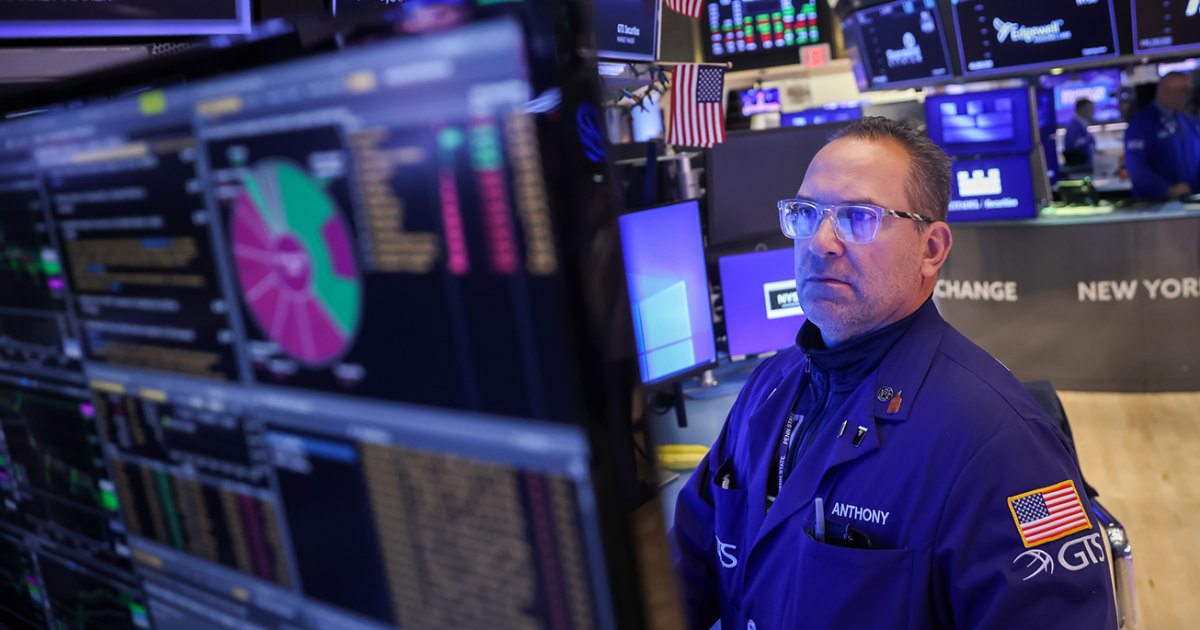
Tech stocks plunged Friday, putting the Nasdaq 100 index on course for a more than $1 trillion drop. The index fell 3.4% in early afternoon trading, on course for its worst one-day drop since mid-June.
Driving the declines were shares of Amazon, which fell 3%, and Intel, which plunged 30%. Both companies reported quarterly earnings this week that failed to reassure investors and analysts.
Amazon had already lost as much as 10% late Thursday.
The broader S&P 500 also dropped sharply, by more than 1.7%. The index’s tech sector was by far the worst performing on Friday, tumbling more than 4.1%.
As trillion-dollar tech companies raise and spend hundreds of billions of dollars to build massive artificial intelligence data centers and develop AI models, investors have been on edge as they look for clear signs that all this spending is actually delivering returns.

On Thursday, Amazon reported that its spending to build out AI had continued at a faster clip than expected last quarter, while growth in its core online shopping business had slowed.
The last time Amazon told investors it was upping its AI spending budget, the market rewarded the decision by sending shares up more than 15%.
But a lot has changed in the past three months. Some of the big companies that pay to use AI models have tightened their token budgets. Others have raised questions about exactly how much benefit they’re getting from all the time and resources they’re putting into AI adoption.
In response, some investors are now looking at Big Tech’s massive AI spending through a more skeptical lens.
Nonetheless, Amazon CEO Andy Jassy told shareholders Thursday to brace for even more spending.
“We still expect 2026 cash [capital expenditures] of approximately $220 billion, the majority for AWS, and expect to spend meaningfully more in 2027,” he said on the company’s earnings call. Amazon’s spending had already been set to double from 2025.
Intel, meanwhile, told investors that its profits and sales in the fourth quarter would be lower than expected, which sent the stock tanking.
Friday’s losses follow significant selling in shares of Alphabet on Thursday.
The Google parent company shed about $500 billion in market value — its worst day ever and the second-worst wipeout of value in market history. On Friday, the stock dropped another 1%.
 Intel CEO Lip-Bu Tan in Taipei, Taiwan, in June. Tan cited supply chain issues in the company’s lackluster performance.Cheng Chia Huang / Getty
The Philadelphia semiconductor index, of which Intel is a member, sank 7.8% on Friday. Other major chip shares followed Intel lower.
The “DRAM” ETF, which tracks companies linked to computer memory and storage, tumbled 7.2%.
The Nasdaq Composite, which tracks every company traded on that exchange, fell 2.7%.
Intel’s stock has surged in recent months as its management implements a sweeping overhaul of the long-ailing chip firm.
In the midst of that turnaround, the U.S. government took a stake in the company, making the federal government the company’s largest shareholder.
Even accounting for Friday’s expected drop, the value of the government’s stake in Intel has grown by 280%.
Analysts at Citigroup described the report as “two steps forward, one step back.”
A major issue highlighted by Intel CEO Lip-Bu Tan that contributed to the company’s lackluster performance in the quarter was supply chain issues.
“I’m disappointed that we were not able to meet strong customer demand in this quarter,” Tan told investors on the company’s earnings call. “We face near-term challenges, including manufacturing, supply shortage, the unprecedented memory crunch and the resulting softness in PC demand.”
Meanwhile, the sell-off in tech shares appeared to increase demand for U.S. Treasuries, which briefly sent government bond yields lower.
The big AI companies that are borrowing hundreds of billions for data center build-outs have tapped the debt markets for funds, which has in turn created more competition for capital.
As those companies increasingly offer better rates of return for lenders than the U.S. government does on bonds, Treasury yields have risen in recent months — partly to keep up with the private market.