
One full month of NHL action is behind us. With more than five months of regular-season play still ahead of us, there is still so much that can happen. What we think we may know about the season less than 20 per cent of the way in could change drastically by April — or, some early signs could stick and become season-long narratives.
At this one-month touchpoint, we take a look around the league at some key early takeaways:
At least three teams from the Atlantic — and maybe four! — will finish with crushing disappointment
We knew this would be a competitive division, but this start has been wild. Everybody in the Atlantic has a points percentage over .500 — Toronto currently ranks last with a .533 points percentage and the Maple Leafs have felt competitive with a 7-6-2 record. Only two teams — Detroit (minus-1) and Buffalo (minus-7) — have a negative goal differential.
All of these teams have playoff expectations — even Detroit, with all the drama around Dylan Larkin and Simon Edvinsson, has a 10-year playoff drought it is trying to squash this season.
We already see that at least three teams will head into the summer with some very difficult questions about firings and roster changes to answer — only because of the division they’re in.
Will the Connor Hellebuyck trade help shake the goalie market loose?
We know that multiple teams were in on Hellebuyck to some degree: Utah, Carolina, Florida, Buffalo, and New Jersey, who ultimately acquired him last week.
The goalie market is largely difficult to predict since so few stars at the position are ever traded and another one on Hellebuyck’s level may not come available for a while. But that’s not to say goalies are never available in trade: Florida, Toronto, Philadelphia and Winnipeg all acquired new starters last summer. Two years ago, the Avalanche made two in-season trades to change up their whole look in the crease.
So with the Hellebuyck business done, we wonder if it might shake loose another goaltender trade or two this season. If so, who may it involve?
Jordan Binnington: A regular on Kyper’s Trade Board going back to last season, his contract situation might increase the urgency. Binnington can become an unrestricted free agent in 2027 and he’s clearly been taken over by Joel Hofer (an RFA in 2027) as the No. 1. The catch is that Binnington has not been great this season, so he’ll need to string some good showings together to inspire confidence.
Filip Gustavsson: An interesting setting in Minnesota. Jesper Wallstedt is flying as the No. 1 goalie, one of the top players at his position so far. Meanwhile, Gustavsson is still on the sidelines recovering from off-season hip surgery with a bit of an unsure timeline — at least another month out. But while Wallstedt is taking over this crease, he’s an RFA at the end of this season while Gustavsson has another four years left paying $6.8 million against the cap. Just last season, Wallstedt was the trade candidate of the two.
“I could tell you this summer they were going to move him. I do not think Wallstedt would be on the Wild if Gustavsson was not hurt going into the off-season,” The Athletic’s Michael Russo said on the Worst Seats In The House podcast on Oct. 15.
The Wild are in search of a centre. And while goalies are tough to move, the Wild presumably have two starters on their roster now. There will also be the question of how quickly it takes Gustavsson to get back to his old self after returning from a hip operation. And he has no-movement protection in his contract right now. It’s hard to think the off-season calculation hasn’t changed here, but with Wild GM Bill Guerin, you just never know.
“Billy goes by his gut and if something came across his desk that he looked at, knowing Gus is still here, and it (Wallstedt) would get you that true No. 1 centre, I think he still would consider it,” Russo said.
John Gibson: On an expiring contract, 33-year-old Gibson may not fit Detroit’s window. Plus, free-agent pickup Daniil Tarasov is playing well and two high upside goalie prospects are on the way: 24-year-old Michal Postava has played two NHL games after a strong AHL season, and 21-year-old Trey Augustine is going through his first season in the minors. If someone needs help in net later this season, would veteran Gibson be a thought? He only has a 10-team no-trade list, per PuckPedia.
Sam Montembeault: Something will have to give in Montreal’s crease when Montembeault returns from injury. His value may not be all that high after he lost the crease a year ago, but the 29-year-old was Team Canada’s third-string goalie at the 4 Nations Face-Off less than two years ago.
 32 Thoughts: The Podcast
Hockey fans already know the name, but this is not the blog. From Sportsnet, 32 Thoughts: The Podcast with NHL Insider Elliotte Friedman and Kyle Bukauskas is a weekly deep dive into the biggest news and interviews from the hockey world.
The top line in the league may not be Edmonton’s fully loaded trio
Connor McDavid is absolutely on one right now (more on that later) playing with Leon Draisaitl, and Vasily Podkolzin on the other side is the beneficiary piling up points.
Still, Joel Eriksson Ek between Kirill Kaprizov and Matt Boldy has arguably been the NHL’s best line so far. Not only is Kaprizov the league’s goal-scoring leader, but this trio has played more than 154 minutes together so far and has not allowed a goal against. Only Edmonton and Winnipeg have top lines who’ve spent more on-ice time together so far, and each has allowed six goals against.
 Stats via MoneyPuck.com
Not only does Minnesota’s line do well to keep the puck out of the net, but they are the only line outpacing McDavid’s line in expected goals at 5-on-5, too.
A few other lines worth honourably mentioning here:
Arseny Gritstyuk-Jack Hughes-Jesper Bratt, NJ: In 97:25 together at 5-on-5, they have an expected goals percentage of 63.58. There may be more actual goals to come, too, when you consider they have twice as many high-danger chances than the opposition, but have so far been outscored in that area.
Zach Bolduc-Phillip Danault-Alexandre Texier, MTL: A defensive unit, there is just one 20-goal season between them (Danault five years ago) so no one will confuse this unit as an attacking one. But in just shy of 100 minutes at 5-on-5 together, they have outshot their competition 44-23 and have a 74.7 expected goals percentage, even if the actual on-ice goals are two for, and two against.
Anders Lee-Barrett Hayton-Kailer Yamamoto, UTA: Playing just shy of 78 5-on-5 minutes together so far, this is effectively Utah’s third line. So far they have only outscored the competition by one, but outshot them 49-23 and, get this: 29 high-danger looks for, just five against.
It’s crazy to think Connor McDavid could score 200 points but not that crazy
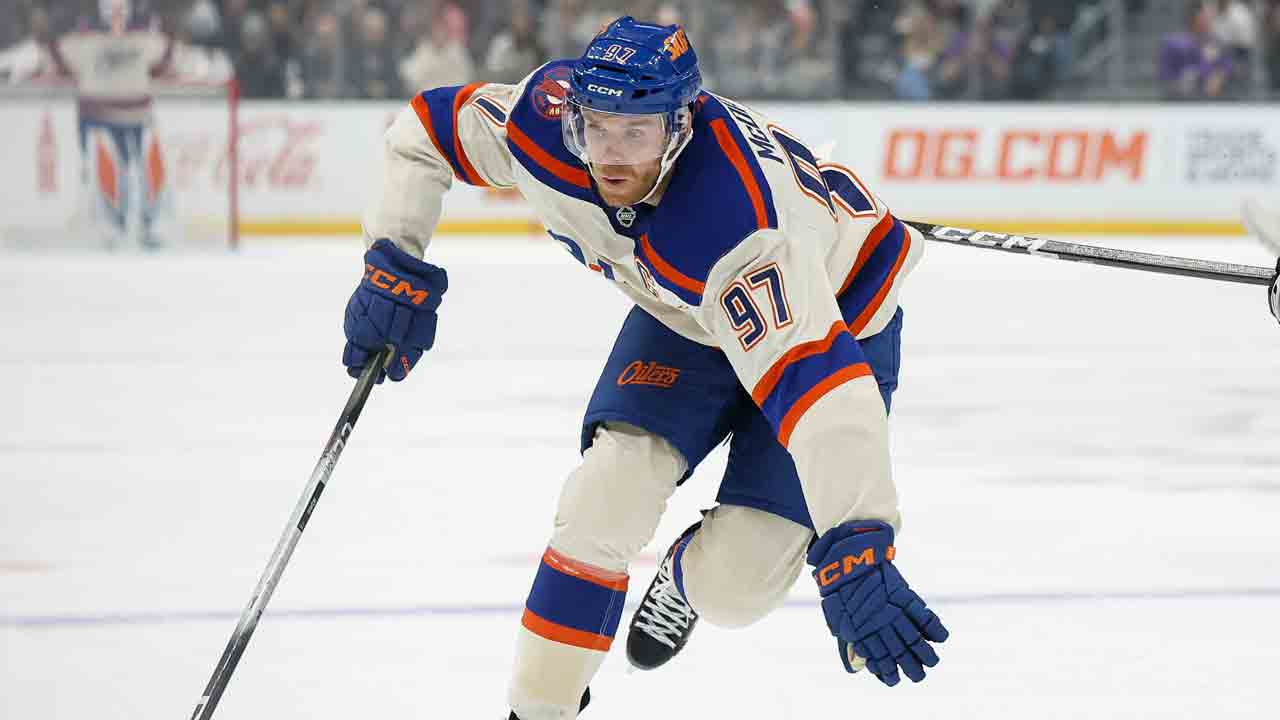
With 36 points in 13 games so far, there are many amazing things to say about McDavid’s start. He’s broken a Wayne Gretzky record for assist streak to start a season, another for most assists in the first 10 games, and he set a new Oilers record for most points before Nov. 1. McDavid has more assists than anyone else has points so far this NHL season — very Gretzky-esque itself.
So, naturally, the big ideas are coming out. Can McDavid also join Gretzky as the only players to ever hit 200 points in an NHL season?
For him to reach that mark, McDavid would need to still score at a 2.3 points per game rate the rest of the way — 164 over his next 71 games. The best season-long points per game McDavid has ever put up was 1.875 in 2020-21 when he incredibly registered 105 points in a 56-game season. He also had 1.86 points per game in 2022-23 when he set a salary-cap era record for points in a season with 153.
So getting to 200 seems like a stretch, but who’s saying McDavid can’t do it? Whatever happens, it’s a testament to how amazing his start is that this is even a conversation.
The Calder Trophy race is setting up to be a fascinating one
If you were to rank the Hart Trophy right now, McDavid would have to be at the top. The Norris? Evan Bouchard’s start has to give him a leg up. The Vezina would be tighter with Jake Oettinger, Jeremy Swayman, Jesper Wallstedt and Linus Ullmark making cases. All of these races will surely get more crowded with more time.
But how about this rookie class? Toronto’s Gavin McKenna leads them all with 11 points in 15 games, but is a minus-6. Boston’s James Hagens is one point behind with a plus-6 rating. Vegas’ Trevor Connelly and San Jose’s Ivar Stenberg are both at nine points. Washington’s Cole Huston leads all rookies in ice time.
And now here comes Jacob Fowler, currently leading the league in Goals Saved Above Expected, with six wins in a row and two shutouts already for Montreal.
The Seattle Kraken are the biggest regression candidate
Probably not a playoff pick for most people coming into the season, the Kraken are 8-4-1, sitting third in a crowded Central Division. How long can they keep it up, though?
The Kraken are second in the league in PDO (the sum of a team’s shooting and save percentage, aka the luck stat), with a league-leading 14.18 shooting percentage that is well above expectation. For context, last year’s shooting percentage leader finished at 11.30 and the year before was 10.64.
When you consider that they’ve been outshot 313-261, have scored 14 more goals than expected, and rank 18th in high-danger chances at 5-on-5 so far, this screams regression. Bet you can’t guess who their two leading goal scorers are without looking.