
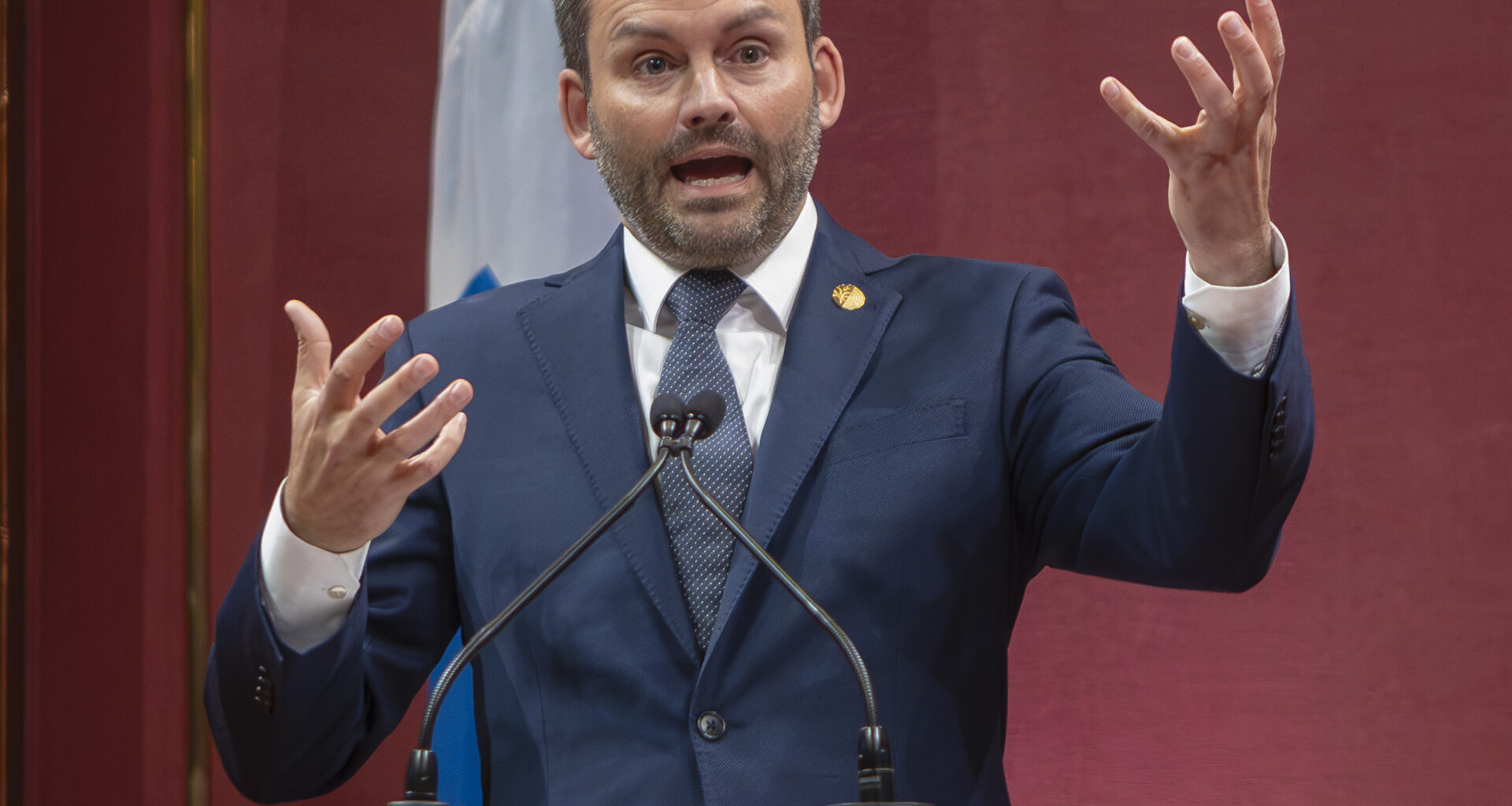
You may have read about Quebec Premier Paul St-Pierre Plamondon’s “new strategy” for sovereignty, and you might have thought, “Hang on, this sounds a lot like the old strategy” — namely, pick fights with Ottawa and pitch the slightest federal-government resistance as an intolerable affront to all Quebecers. But this time, as influential nationalist Quebec commentator Joseph Facal argued in an extraordinary encomium to PSPP (as St-Pierre Plamondon is nicknamed) in the Journal de Montréal, the approach is “uncompromising.”
So PSPP simply outright refused to attend this week’s Canada-EU meeting in Montreal. Because that would “compromise” Quebec’s sovereignty, in Facal’s view at least, and draw attention to the appalling reality: Quebec is part of Canada. To oversimplify: Hardcore sovereigntists tend to think nothing’s worth “sitting at the children’s table” of the federation along with all the other, lesser provinces. More strategic sovereigntists, and softer nationalists, tend to argue along the lines of, “if we’re not at the table, we’re on the menu.”
As always, there are some, um, peculiarities in the sovereigntist position. One: PSPP sent his lead trade negotiator to the summit in his stead. So it’s not his government boycotting this intolerable event, just him. A bit curious, no? There was plenty of Quebec on hand for Thursday evening’s gala Canada-EU dinner, including former PQ premier Lucien Bouchard.
Two: this new “uncompromising sovereignty” thing leaves the federal Bloc Québécois in an interesting position. Its job is to compromise. BQ members compromise from the moment they run for the “King of England’s” loyal Parliament (as PSPP often calls the Canadian monarch), then take their seats in Parliament having sworn oaths of allegiance to the King of Canada.
While Northern Ireland’s Sinn Féin MPs don’t take their seats at Westminster in part precisely because they would have to swear the same basic oath, the Bloc tries to make the best of federal legislation for Quebec’s purposes. It’s a perfectly defensible, sensible policy. Does PSPP support that?
The premier is certainly on a fascinating journey. He doesn’t lack for confidence, which I suppose is a positive, but it’s to the point that he seems to overestimate his and the sovereignty movement’s popularity. Twenty-eight per cent of the popular vote (the PQ’s haul on Oct. 5) is even lower than than 30-ish per cent support for sovereignty, which is where polls have been stalled for many years. The PQ’s vote efficiency, and the provincial Liberals’ lack thereof — they only finished four points behind the PQ — don’t matter in a referendum.
Already PSPP shows signs of Mark Carney-style overconfidence, just with much less voter support. He declined this week to attend a summit involving Prime Minister Carney, all the other provincial premiers and First Nations leaders. I can’t see how that decision left him and his movement any better off. He needs those First Nations leaders. Sovereigntists wish they didn’t have to deal with Indigenous Quebecers, their irksome nations and their backward insistence on their treaties with the “King of England” (as PSPP would put it), not to mention their near-total historic opposition to sovereignty.
Now the PQ has peeved a not-insignificant voting bloc — Indigenous people accounted for 2.5 per cent of the province’s population as of the 2021 Census; it will certainly be higher today. The press reaction I’ve seen has topped out at half-hearted support, and only in the context of “uncompromising” sovereignty. But successful uncompromising sovereignty would have to deal with First Nations along with everything else real live grown-up nations do. “Uncompromising sovereignty” cannot involve shirking these responsibilities.
Then there’s PSPP’s penchant for demagoguery. On Wednesday, after Carney offered PSPP a seat at the head table for the dinner, but not a speech, the premier unleashed a 300-word diatribe that can only be described as unhinged.
“This proposal essentially asks Quebec to fall into line — (re-enforcing) our vassalization and erasure — in exchange for a better seat from which to watch the game,” he fumed. “We are facing a strategy designed to marginalize Quebec on the global stage and to subordinate Quebec’s areas of jurisdiction to the will of the federal government.”
So said the only premier to get an invitation to the head table. Of a province that gets basically anything it wants.
I haven’t yet seen a poll on Quebecers’ attitudes toward all this. I would be shocked and disappointed if many cared at all. I’m positive many wouldn’t have cared before the PQ or the pollster brought it up, and dearly hope any poll asks people how much they actually give a hoot. The priorities of the political class and those of normal people have always been somewhat at odds in Quebec politics. PSPP seems to be diving headlong into the political-class periphery here.
Editor’s Picks
Chris Selley has been a columnist at National Post since 2009, covering Toronto City Hall, Queen’s Park and federal politics, after starting his career at Maclean’s magazine.
cselley@postmedia.com