
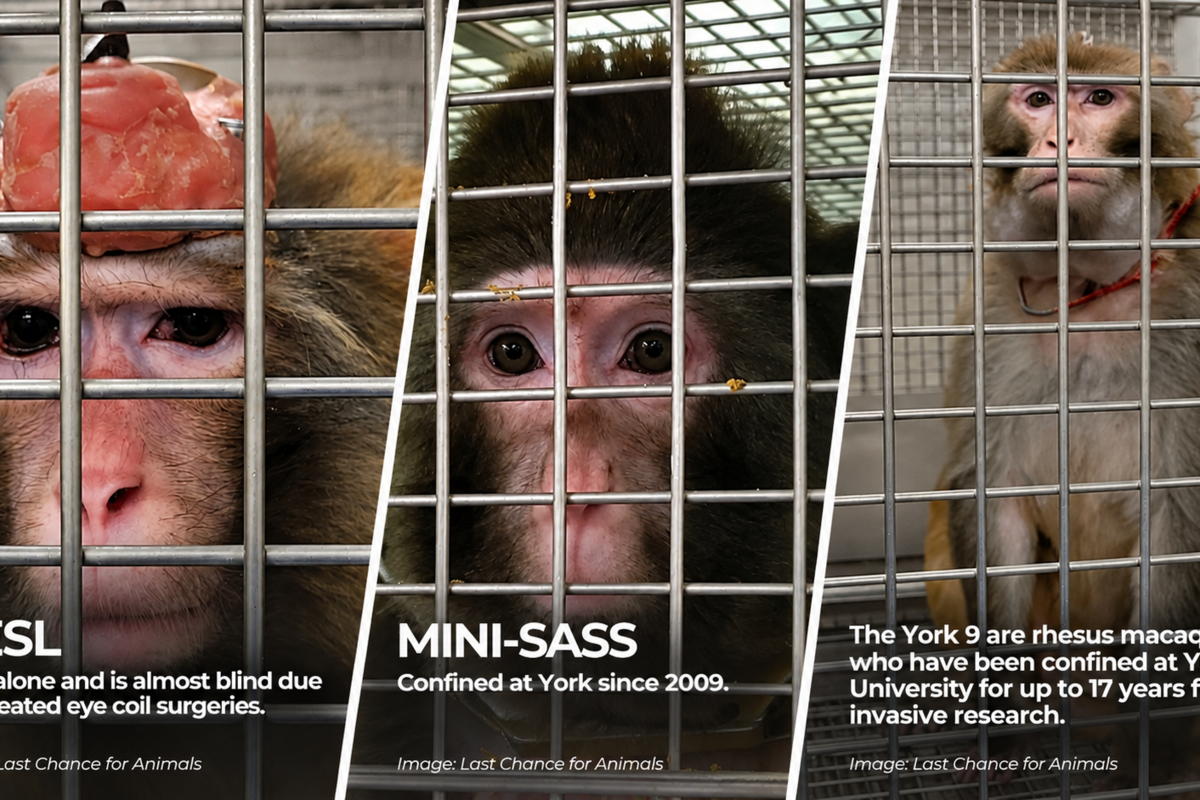
Undercover Simcoe County investigator reveals observations at school’s research lab while Tiny Township advocate presses for stronger protections
Katherine Logan remembers the last time she saw Hannah.
It was May 4, 2025, and the Collingwood investigator was finishing her final shift as an animal attendant at York University when one of the nine rhesus macaques in her care caught her attention.
“She was playing peekaboo with me,” Logan recalls, describing how Hannah covered her eyes with her hands before moving them away.
Logan returned the gesture, and the two repeated it several times before she finally closed the door.
“We did this a few times and then I broke down and closed the door and said goodbye.”
For nine months, Logan had worked undercover at York University for the animal advocacy organization Last Chance for Animals (LCA) but during that time she developed relationships with animals whose individual personalities have stayed with her.
“I have questioned the lack of protection since my first lab investigation at ITR Labs in Montreal, featured on W5,” she says. “I continued to investigate labs to prove this lack of enforcement.”
A veteran animal rights investigator with more than a decade of experience, Logan worked at York from Aug. 6, 2024, until May 4, 2025. She was one of several animal attendants responsible for the monkeys’ daily care, including feeding, cleaning and assisting with medical needs.
The male and female macaques were housed in separate rooms for different research studies, where they could see but not physically interact with others of the same sex. Logan says the animals only left their cages for research procedures conducted outside the attendants’ access.
While Logan did not witness the research procedures, she observed the monkeys’ daily behaviour and came to recognize their individual personalities.
Virginia, she remembers, was spirited and often lunged toward people approaching her enclosure, making faces and seemingly inviting a response. Mini-Sass was much quieter, appearing withdrawn and revealing little of her personality.
Logan also recalls several monkeys excessively grooming themselves and pulling out their own hair.
“Liesl, considered almost completely blind as a result of the eye coils, would look directly into my eyes if I got close enough,” she says. “She would vocalize these sweet little noises that would break my heart.”
Olivia, a diabetic macaque, became Logan’s favourite.
Because animal attendants wore protective clothing that left little of their faces visible, Logan began communicating with Olivia through slow blinks and briefly closing her eyes, gestures she believed helped establish trust.
“She changed so quickly,” Logan recalls. “And she would cooperate with me when I would go in to give her her injections or take a blood sample. She would just cooperate. She would get into position.”
Logan says Olivia was not being used in experiments during her employment because of her diabetes, leaving her to question why the animal remained at the research facility.
Other observations were far more troubling.
Logan says she witnessed male macaques drinking their own urine, behaviour she believes was associated with restricted access to water.
The practice, referred to as “water control,” was used to encourage the animals to cooperate during research tasks by offering water as a reward, according to her account.
“If they were thirsty, which they always were, they would cooperate in order to get water as a reward.”
Published veterinary guidance on fluid regulation in research monkeys emphasizes scientific justification, veterinary monitoring and measures to protect the animals’ health.
Her account forms part of a broader controversy that emerged publicly in April 2026, when an investigation by LCA brought attention to the treatment of nine macaques at York University.
The allegations include the use of implanted devices, restraint and restricted water access, practices associated with some forms of neuroscience research.
The research examines how the brain processes visual information and controls movement. Scientists use macaques in some studies because of similarities between their nervous systems and those of humans, although animal welfare advocates argue that more research should move toward methods that do not involve animals.
The investigation sparked demonstrations calling for the retirement of York University’s nine macaques — Bento, Kenny, Magneto, Do, Hannah, Liesl, Mini-Sass, Olivia and Virginia. Approximately 50 activists gathered on campus May 15, followed by protests Aug. 24 and Sept. 18.
On Oct. 16, activists joined the fourth annual Anti-Vivisection World Protest, involving 58 cities worldwide, before extending their outreach along Toronto’s subway line from York University to Dupont station. Another campus demonstration was scheduled for this past Monday.
The growing campaign has also drawn support from Tiny Township resident Rosie Mankiewicz, who has spent months pressing university officials, animal protection organizations and politicians to secure sanctuary retirement for the nine macaques.
“My greatest fear is that these monkeys will spend the remainder of their lives in laboratories when a peaceful retirement should be possible,” she says.
Her advocacy recently reached CUPE Local 3903, representing workers at York University. According to Mankiewicz, a motion she presented received 82 per cent support from those voting, and the union agreed to write to the university outlining her concerns.
On Sept. 17, she met virtually with Solicitor General Michael Kerzner’s policy team to advocate for stronger protections for primates used in research and greater consideration of sanctuary retirement.
Mankiewicz also contacted Tiny Township municipal election candidates, including David Kohler, who spent an hour discussing the macaques with her and expressed deep concerns about their welfare.
“I realize these are provincial issues and not municipal. But again, I say, it needs a municipal voice.”
Her efforts have reached Simcoe North MP Adam Chambers, whose office contacted the Canadian Council on Animal Care (CCAC) following concerns about York’s research program.
“I am aware of the passionate advocacy by Ms. Mankiewicz and many others regarding animal research,” Chambers said.
According to Chambers, a CCAC inspection of York University earlier this year found no significant concerns but identified areas for improvement. He said the university has yet to respond to the recommendations.
The Jane Goodall Institute has called for the macaques’ retirement, while Story Book Farm Primate Sanctuary has previously cared for retired research monkeys from York University. No confirmed transfer agreement has been announced for the nine animals at the centre of the campaign.
York University addresses its animal research on its website, noting that the school “is committed to conducting world-class research while upholding the highest standards of animal welfare, ethics, transparency and accountability.”
The university says it recognizes the serious responsibility that comes with animal research and therefore prioritizes transparency, continuous improvement and rigorous oversight.
“At York, animal research is conducted only where there are no suitable alternatives for scholars seeking to answer important scientific questions, such as those to inform next-generation technologies and treatments that require an understanding of complex, interconnected biological systems and how the brain and body function as a whole,” the school says.
“All research involving animals is subject to strict ethical and regulatory oversight and must be approved in advance by York University’s Animal Care Committee.”
For Logan, the political discussions and questions about oversight ultimately come back to the animals she cared for and the people who worked alongside her.
Despite her criticism of the research, she is careful to distinguish those conducting experiments from the employees responsible for feeding, cleaning and caring for the animals.
“The people that were there to care for them, provide the daily care and feed them and water them and clean their cages, those people truly did care,” she says.
“They did love those monkeys, even if they have not come to realize that they are indirectly supporting the research.”
For Logan, working undercover meant setting aside her emotions long enough to complete each shift.
“As soon as I walk through those doors, I’m somebody else. I’m there to do a job, to get the evidence, to get out, and then cry all the way home from work.”
She questions how inspections can adequately assess animal welfare if the concerns she witnessed were not considered significant.
Logan believes continued public attention, particularly from university students, could play an important role in determining what happens next.
“I think the best way to get them out of there is public pressure,” she says.
“And I look forward to seeing them again, this time in a sanctuary where they can thrive, and know freedom, and feel the sun on their faces.”