
Timing sodium bicarbonate supplementation before a cycling race may be more complicated than previously thought. Riders who use the supplement to prepare for repeated attacks, demanding climbs, or decisive high-intensity efforts often plan their intake around when blood bicarbonate levels are expected to peak. But new research involving highly trained cyclists suggests that spending several hours on the bike can substantially change that timing, raising questions about whether conventional pre-race supplementation schedules accurately reflect what happens during competition.
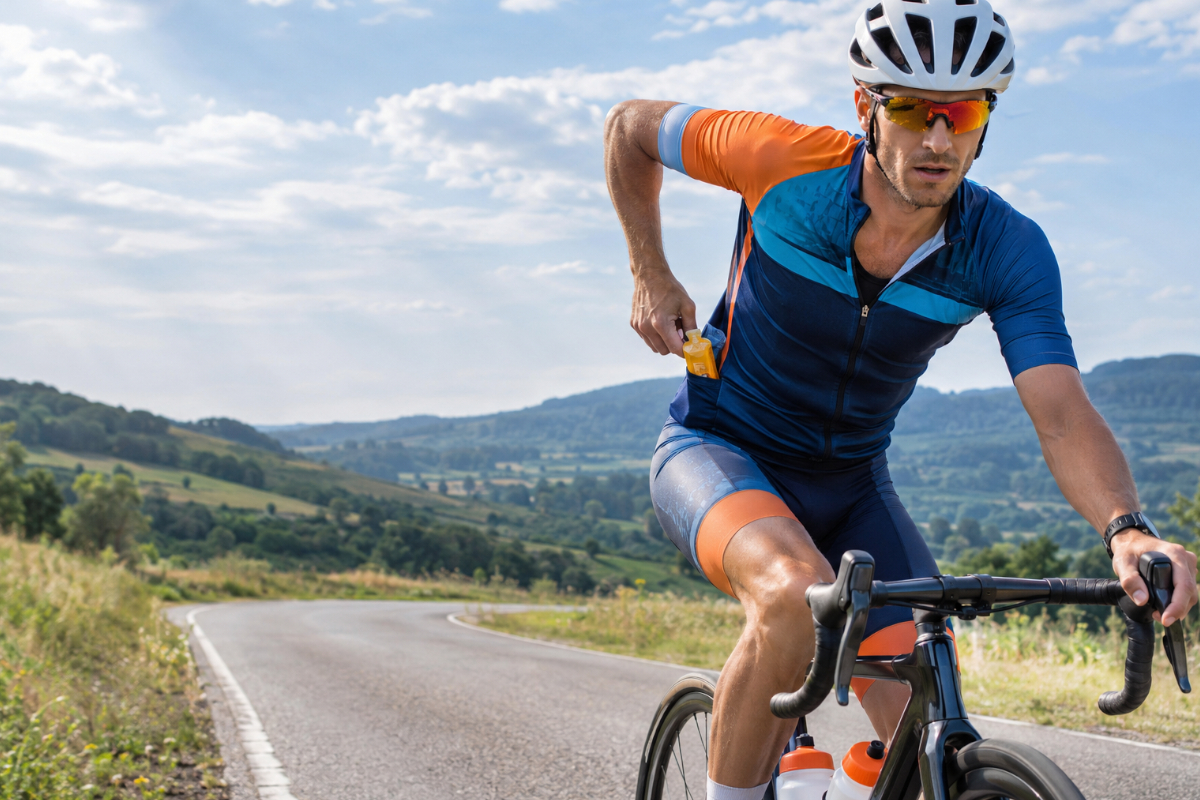
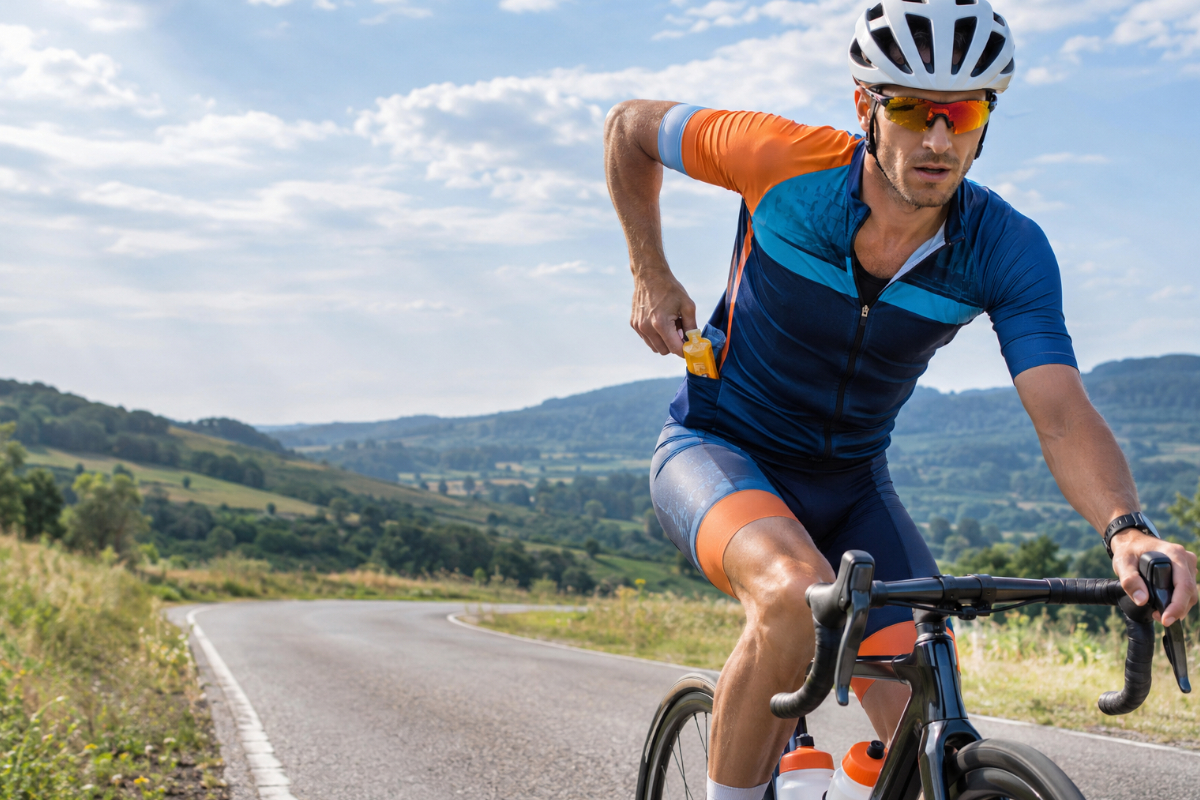 Road cyclist in a blue and orange jersey reaching for an energy gel while riding. Image: TodoMountainBikeBlood bicarbonate levels peaked 62 minutes later during cycling
The study, titled Timing of Sodium Bicarbonate Uptake During Exercise and Rest in Highly Trained Cyclists, was published in the Journal of Science and Cycling on October 31, 2026. Researchers affiliated with the Red Bull Athlete Performance Center and the University of Salzburg investigated whether prolonged cycling altered the blood bicarbonate response to supplementation compared with passive rest.
Fourteen highly trained cyclists, including nine men and five women, participated in the investigation. Each received 0.3 grams of sodium bicarbonate per kilogram of body weight, delivered as mini-tablets incorporated into a carbohydrate hydrogel mixture. The researchers then compared sodium bicarbonate absorption during cycling with the response observed under resting conditions.
Participants completed two experimental conditions on separate visits. In the exercise condition, they rode indoors for three hours at approximately their first lactate threshold, averaging 3.0 watts per kilogram, while consuming 50 grams of carbohydrates per hour. In the resting condition, they remained inactive without additional food intake. Both sessions began with the same standardized breakfast and bicarbonate dose, with blood measurements collected throughout the protocol.
The difference was substantial. During cycling, blood bicarbonate reached its peak increase an average of 208 ± 42 minutes after ingestion. During rest, the corresponding figure was 146 ± 22 minutes. The 62-minute delay was statistically significant, indicating that the blood bicarbonate response followed a different time course when the athletes were exercising.
However, exercise did not significantly reduce the maximum increase in bicarbonate concentration. The researchers recorded a rise of 9.0 ± 1.8 mmol/L during cycling, compared with 9.3 ± 1.4 mmol/L at rest. In other words, the supplement produced a similar peak increase under both conditions, but reaching that peak took considerably longer when participants were riding.
Why the timing difference could matter during a long cycling race
Sodium bicarbonate supplementation for cycling performance is based on its ability to increase extracellular buffering capacity, helping the body regulate acid-base balance during demanding efforts. This mechanism can support performance during certain high-intensity activities, particularly those involving substantial anaerobic energy production and repeated efforts that challenge the body’s ability to maintain muscular function.
For road racers, mountain bikers, and competitive gravel riders, this distinction could be relevant when intense efforts occur several hours into an event. A rider might encounter a decisive climb after a long period of steady riding, face repeated accelerations during a breakaway, or need to sustain high power output after significant accumulated fatigue.
The new findings suggest that planning supplementation exclusively around blood measurements obtained at rest could produce a different response once the athlete begins exercising. If peak blood bicarbonate timing shifts during prolonged cycling, the anticipated increase may not align precisely with the part of a race where the rider hopes to benefit most.
There is an important limitation, however. The researchers measured blood bicarbonate concentrations, not improvements in competitive performance. The study did not establish that reaching peak bicarbonate at a particular moment produces the greatest power output or the best race result. Elevated bicarbonate levels may remain useful outside the exact peak, meaning a 62-minute difference in blood concentration does not necessarily translate into a 62-minute shift in performance benefits.
Individual responses also varied. The average time to peak during exercise was 208 minutes, but the standard deviation was 42 minutes, compared with 22 minutes during rest. These differences reinforce the difficulty of applying a single supplementation schedule to every cyclist.
Another consideration is that the exercise and resting conditions differed in more than physical activity. Riders consumed carbohydrates during the cycling session, whereas no additional food was provided during rest. Consequently, the results describe the combined response to exercise and the accompanying fueling protocol rather than isolating cycling itself as the only possible explanation for the delay.
Different bicarbonate formulations could produce different results
The administration method is particularly relevant because the researchers used mini-tablets delivered in a carbohydrate hydrogel mixture. This was not conventional baking soda dissolved in water, nor does the study establish that the same timing applies to capsules, other buffered formulations, or commercially available bicarbonate systems.
The timing of bicarbonate supplementation before racing has traditionally been an important consideration for sports nutritionists. The International Society of Sports Nutrition, in its position stand titled International Society of Sports Nutrition position stand: sodium bicarbonate and exercise performance, identifies 0.2 to 0.5 g/kg as a range investigated for performance benefits, with 0.3 g/kg commonly considered an effective single dose. Its recommendations for single-dose protocols generally place ingestion between 60 and 180 minutes before exercise.
Those recommendations primarily concern pre-exercise supplementation. The new findings introduce an additional variable for endurance events in which riders may spend hours exercising before reaching the most demanding portion of the race. They do not, however, establish a replacement dosing schedule.
The research also reported that none of the 14 participants experienced gastrointestinal adverse effects during the experimental sessions. This is noteworthy because stomach discomfort, bloating, nausea, and diarrhea can limit the practical use of sodium bicarbonate, particularly during competition. Nevertheless, the small sample and specific formulation prevent conclusions about its tolerability across the wider cycling population.
A separate study published on September 25, 2026, in Scandinavian Journal of Medicine & Science in Sports provides additional context. Titled Bicarbonate and Carbohydrate Co-Ingestion During Exercise in a Novel Gel Format Improves Time-Trial Performance After 3 h of Moderate-Intensity Exercise in Trained Cyclists, it investigated a different approach involving bicarbonate and carbohydrate gels consumed during prolonged cycling.
That investigation included 11 trained cyclists and found that bicarbonate co-ingestion improved average power during a subsequent 12-minute time trial by 12 watts compared with carbohydrate intake alone. However, the researchers did not observe statistically significant improvements in the six-second sprint tests or the two-minute time trial. The findings suggest a potential performance benefit under specific conditions, but they cannot be directly combined with the newer absorption study to determine an optimal ingestion schedule.
For cyclists considering bicarbonate supplementation during endurance events, the distinction between these investigations is important. One demonstrates that blood bicarbonate can peak later during prolonged exercise, while the other provides preliminary evidence that a different bicarbonate delivery strategy can improve certain performance outcomes after several hours of riding.
The experimental dose also deserves attention. At 0.3 g/kg, a cyclist weighing 154 pounds (70 kilograms) would consume approximately 21 grams of sodium bicarbonate, a substantial quantity that also delivers a considerable sodium load. Such doses can cause gastrointestinal disturbances and may be unsuitable for individuals with certain medical conditions or sodium restrictions. They should not be treated as universal recommendations or tested for the first time on race day.
The unanswered question is whether adjusting bicarbonate intake to account for the delayed blood response would actually improve racing performance. Larger studies will be needed to determine whether the effect persists with different formulations, feeding strategies, exercise intensities, and competitive conditions, particularly when high-intensity efforts occur at different points during prolonged endurance exercise.