
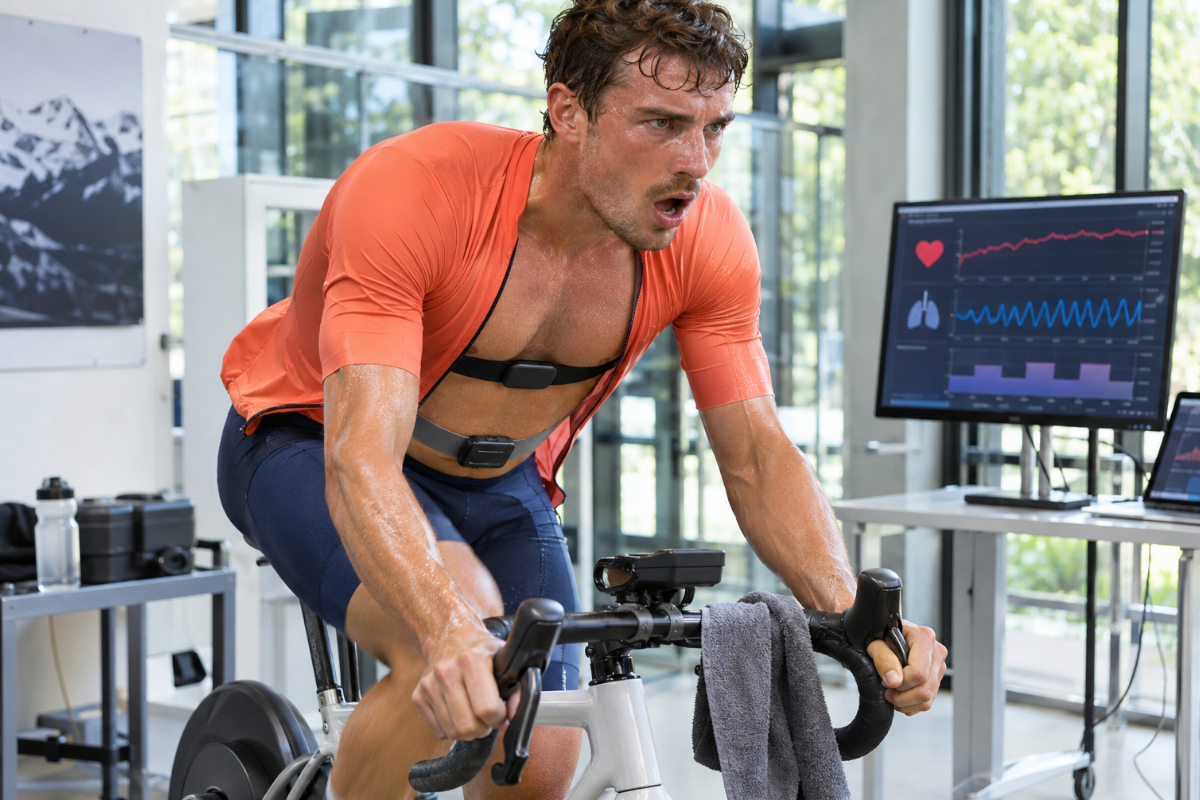
Your heart rate monitor shows nearly identical numbers during the final repetitions of a hard interval workout, yet every effort feels more difficult than the last. Your legs are burning, your breathing is getting faster, and the recovery periods no longer seem long enough. According to new research involving exercise physiologist Stephen Seiler, that growing disconnect may reveal an important limitation of heart rate monitoring. The investigators found that breathing frequency can continue to rise even when heart rate begins to level off, raising questions about how accurately current training metrics capture the physiological demands of repeated high-intensity efforts.
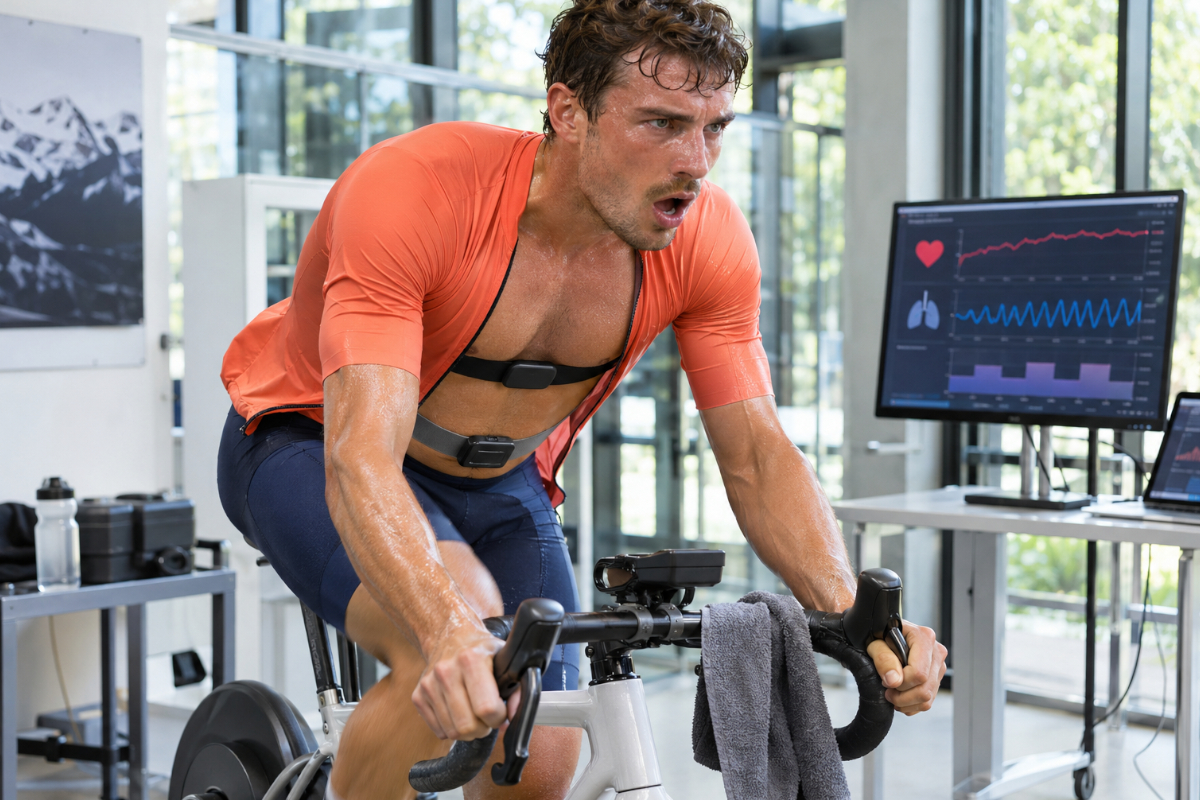 Cyclist performing an indoor cycling stress test with heart rate and breathing sensors. Image: TodoMountainBikeWhen heart rate stops climbing but breathing keeps accelerating
The research, published October 31, 2026, in the Journal of Science and Cycling, is titled A mobilization index for intermittent work: combining breathing frequency and heart rate for training intensity monitoring. Conducted by researchers at the University of Agder in Norway, including Stephen Seiler, the study investigated whether combining heart rate and breathing frequency could provide a more complete picture of the internal physiological stress experienced during interval training.
The investigation involved 13 trained male athletes who participated in cycling and running. Across four laboratory visits, the researchers performed physiological assessments and examined responses to repeated high-intensity efforts. The interval protocol included two sets of ten 40-second efforts separated by 20 seconds of passive recovery. Participants exercised at approximately 139% of their power output at the second ventilatory threshold, making the sessions substantially more demanding than conventional steady-state endurance training.
Throughout the testing, heart rate was measured using electrocardiography, while breathing frequency was recorded with a specialized strain-measuring belt. The results revealed a potentially important difference for heart rate monitoring during cycling intervals: although both measurements increased during exercise, breathing frequency showed a more pronounced relative response as the repetitions accumulated.
The distinction became particularly apparent during the second interval set. Heart rate tended to approach a plateau, while breathing frequency continued to rise. Athletes also reported greater perceived exertion, with average ratings increasing from 18.2 during the first set to 19.0 during the second on the conventional 6-to-20 Borg scale. The difference was statistically significant, even though blood lactate concentrations did not differ significantly between sets.
This behavior reflects a known limitation of cardiovascular monitoring. Heart rate does not respond instantly when exercise intensity changes, and its ability to signal further increases in exertion becomes more limited as it approaches high values. Breathing frequency responds through partly different physiological mechanisms, including neural signals associated with muscle activity and the regulation of respiratory effort.
A new experimental metric could reveal accumulated training stress
To explore these differences, the researchers proposed a metric called the mobilization index for high-intensity exercise. The concept combines heart rate reserve and breathing frequency reserve into a single ratio, allowing investigators to compare the relative activation of cardiovascular and respiratory responses during repeated efforts.
The calculation divides breathing frequency reserve by heart rate reserve, with both variables expressed relative to their individual physiological ranges. A value above 1 indicates that breathing frequency has increased proportionally more than heart rate within those normalized ranges.
At the end of the first interval set, the average ratio was 0.90. By the end of the second set, it had increased to 1.05, exceeding the researchers’ reference value of 1. This finding was consistent with the higher perceived exertion reported by participants and suggests that the combined metric may capture aspects of accumulated internal stress that heart rate alone does not fully describe.
The researchers are not suggesting that breathing frequency directly measures muscle fatigue or that the new index can replace established training metrics. Instead, the findings support further investigation into whether respiratory measurements could provide additional information about how demanding a workout becomes as recovery periods accumulate and physiological strain increases.
Previous scientific research has already explored the relationship between breathing frequency and perceived exertion. What makes this investigation different is the attempt to combine respiratory and cardiovascular responses into a quantitative indicator that could potentially be monitored throughout an interval session.
What this means for Garmin, Wahoo, COROS, and other training devices
For cyclists who train with power meters, chest straps, GPS bike computers, and smartwatches, the findings raise an interesting technological question: could respiratory rate tracking in cycling make training data more informative?
Modern cycling computers and sports watches already offer extensive performance analysis, including heart rate zones, power zones, training load, recovery estimates, and various physiological metrics. However, a device’s ability to estimate breathing frequency does not necessarily mean that it can measure the rapid respiratory changes seen during demanding exercise with laboratory-grade accuracy.
The study did not compare devices from Garmin, Wahoo, COROS, or other manufacturers. Nor did it demonstrate that an existing commercial wearable can calculate the proposed mobilization index reliably. The investigators used dedicated laboratory equipment, making validation with consumer sensors an essential step before the concept could become a practical training feature.
The potential application is nevertheless relevant to cyclists using power-based interval training and heart rate zones. A power meter measures the mechanical output generated by the rider, providing immediate feedback during short efforts. Heart rate describes part of the body’s cardiovascular response, while perceived exertion captures the athlete’s overall experience of the workload. Breathing frequency could eventually complement those measurements by identifying situations in which respiratory strain continues to increase despite relatively stable heart rate readings.
Consider an indoor cycling workout involving repeated 40-second efforts above functional threshold power (FTP). The power meter can confirm whether the rider maintains the prescribed wattage, but it cannot independently determine how difficult that workload has become physiologically. Meanwhile, heart rate may remain within a narrow range during the final repetitions. An accurate respiratory measurement could potentially reveal an additional change in internal load, although this practical application still requires validation.
There are important limitations. The study included only 13 participants, all of them trained men, so the results cannot automatically be generalized to female cyclists, recreational riders, or athletes with different fitness levels. The findings also depend on the specific interval protocol, and the researchers noted differences between running and cycling respiratory responses that support calibrating breathing-frequency zones separately for each sport.
For now, cyclists should not abandon their existing training metrics or adjust workout intensity based on an unvalidated respiratory index. Combining power output, heart rate, and rating of perceived exertion during interval workouts remains a practical approach to understanding how the body responds to training.
The next challenge is determining whether respiratory sensors can reproduce these laboratory observations consistently during real-world riding, where movement, changes in posture, and environmental conditions may affect measurement quality. Researchers must also establish whether the proposed index improves training decisions or provides meaningful benefits beyond existing methods.
Until those questions are answered, the study offers a useful reminder about a familiar training experience: two intervals can produce almost identical heart rate readings while feeling very different to the cyclist completing them. Breathing frequency may eventually help explain that difference with another measurable physiological signal.