
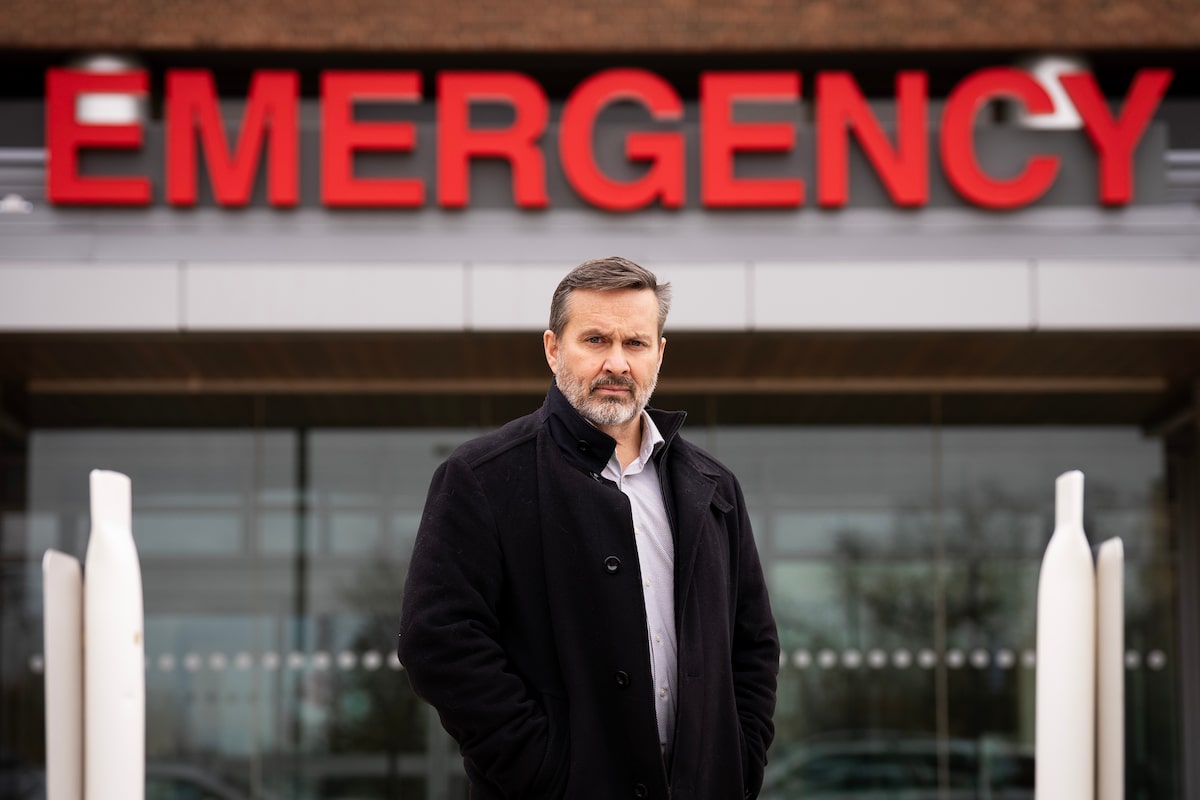
Dr. Paul Parks outside the Medicine Hat Regional hospital in Medicine Hat, Alberta Oct. 30. Dr. Parks moved to Medicine Hat from Edmonton in 2009 with his wife and two kids.Todd Korol/The Globe and Mail
Alberta emergency physician Paul Parks, a long-time health care advocate and prominent critic of the UCP government, never imagined himself entering politics. But now he’s doing just that.
On Sunday, Dr. Parks announced that he is seeking the Alberta New Democratic Party nomination for the riding of Cypress-Medicine Hat, a reliably conservative electoral district in southeast Alberta. The seat is currently held by the United Conservative Party’s Justin Wright, who serves as Minister of Primary and Preventative Health Services.
NDP Leader Naheed Nenshi, in a statement, said Dr. Parks is an “extraordinary candidate” and would help, if elected, drive the party’s health care policy. Dr. Parks, however, may have to fight for the party position should others put their name forward.
Dr. Parks has spent the past two decades pushing for a better health care system for workers and patients, including as the past president of the Alberta Medical Association. He said he’s frustrated with the provincial government ignoring the voices of front-line workers while the state of emergency departments (EDs) continues to crumble.
“Advocating within the normal channels and through the AMA and through my roles as a physician are broken,” said Dr. Parks. “I don’t want to be a politician, but I think the only way to afford meaningful change now, in the current environment, is to run for politics.”
Dr. Parks has been a staunch critic of Premier Danielle Smith and her government’s handling of the health care file, opposing, for example, the UCP’s venture into private health care delivery and its dismantlement of Alberta Health Services as the single health authority.
Alberta NDP accuses Smith of gerrymandering as province prepares to unveil new electoral map
One of his chief criticisms has been the UCP’s inaction to address severe overcrowding in provincial EDs. In January, he led a call to action from doctors working in Edmonton’s major hospitals for Alberta to declare a formal emergency after the death of Prashant Sreekumar. He died on Dec. 22 after spending eight hours in one of the city’s EDs.
Also in January, Dr. Parks collected a list of at least six preventable deaths and more than 30 “near-misses” that occurred in Alberta emergency rooms, which he said underscored how precarious the situation had grown for health care professionals and patients.
“I think we can change the path we’re on,” Dr. Parks said. “I want to try to improve day-to-day life. I don’t want to be just sitting in the back trying to advocate and be critical. I want to roll up my sleeves and try to make it better.”
One of Dr. Parks’ chief criticisms has been the UCP’s inaction to address severe overcrowding in provincial emergency departments.Todd Korol/The Globe and Mail
The UCP government has strongly pushed back against his critiques, arguing that improvements have been made in health care delivery, while acknowledging that there is still work to do. Last week, Ms. Smith said the health system is “better prepared than ever” to handle respiratory virus season, which tests hospital capacity each year.
Dr. Parks said, in addition to his frustrations growing over what he said is government inaction to fix the health system, the UCP’s use of the Canadian Constitution’s notwithstanding clause pushed him to enter the political ring. He disagrees with the UCP’s “top-down approach.”
The clause – historically viewed to be a last resort – allows governments to override certain sections of the Charter of Rights and Freedoms for up to five years. The UCP used it to shield its trio of laws affecting transgender youth from court challenges and to order teachers back to work last year.
Alberta’s NDP has been gaining political momentum in recent months after capitalizing on opposition to the recent referendum on separatism. One sign of growth came in September when the NDP flipped a conservative stronghold riding with a win in the Calgary-Shaw by-election.
But in areas like Cypress-Medicine Hat, the NDP will face a steep challenge winning local support. In the referendum, electors in the area voted yes to all nine of Ms. Smith’s proposals to challenge the federal government on immigration and constitutional issues.
The NDP strongly rejected the referendum and advocated for Albertans to say No to all nine questions, underscoring a stark division of opinions.
Dr. Parks, who describes himself as “fiscally conservative and socially progressive,” acknowledged that it would be a difficult task to rally support for the NDP in his community but said his deep connections in the region give him a leg up. He said his values on health care and beyond align with the NDP.
“You don’t join the battle when you know the war is won. You jump in and join when you think you can help win the battle,” he said.
Dr. Parks moved to Medicine Hat from Edmonton in 2009 with his wife and two kids and has, since then, cared for patients at the Medicine Hat Regional Hospital. He also co-founded the city’s first craft brewery, Hell’s Basement Brewery, in 2016 and is an active member of Medicine Hat’s local theatre community.
He said his neighbours are more concerned about the daily pressures of everyday life – the cost of groceries, health care access and school funding – than the contentious issues outlined in the referendum.
“They want government that works to make their community better,” he said. “They want to be able to have a family physician in their community. They want ambulances, when they call, to respond in time so loved ones don’t die waiting.”
Mr. Nenshi said the NDP has a “real plan” for health care focused on reducing waiting lists and ED congestion and hiring more family doctors.
Alberta’s next general election is scheduled for Oct. 18, 2027.