
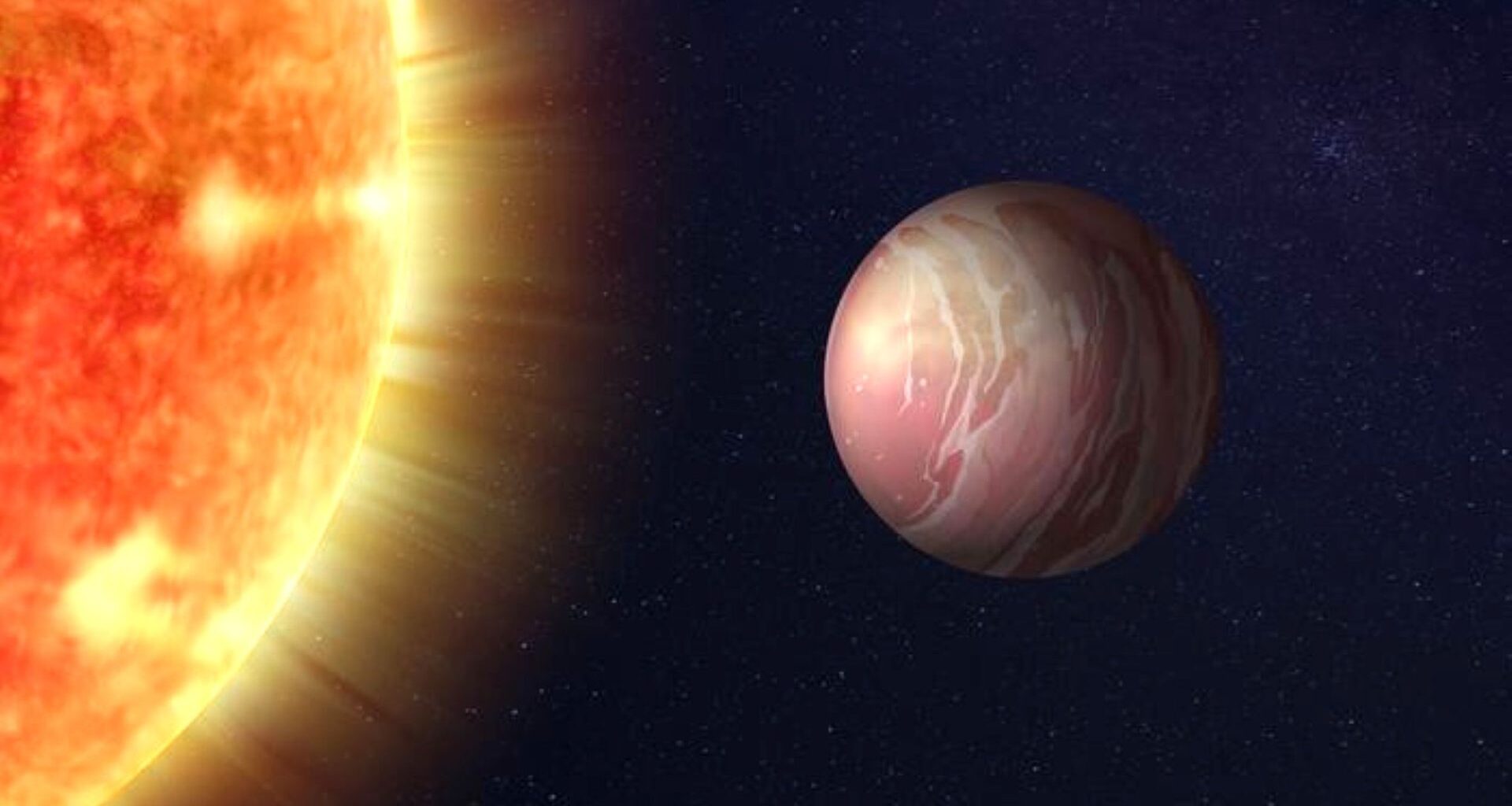
NASA’s James Webb Space Telescope has found evidence of a thick atmosphere and reflective mineral clouds on a scorching lava planet.
A rocky planet orbiting extremely close to its star might be expected to be bare, scorched stone, its atmosphere stripped away long ago by intense radiation.
Yet new observations from the James Webb Space Telescope suggest that a lava planet called TOI-561 b still has a thick atmosphere.
Something in that atmosphere reflects most of the starlight that hits it.
If that reading holds up, a small rocky planet can keep its gas in a place where astronomers expected only bare rock. The planet is about 280 light-years away, and its atmosphere is not livable.
Anjali Piette, an assistant professor of astronomy at the University of Birmingham in the U.K., is part of the international team behind the work.
“Our discovery challenges current theories,” Piette said. “We would expect a heavily irradiated rocky planet like TOI-561 b to have lost its atmosphere billions of years ago.”
The study was led by Samuel Boucher of the Université de Montréal, with Lisa Dang of the University of Waterloo in Canada as project lead.
The planet should be bare rock
TOI-561 b is a little more than twice Earth’s mass and about 1.4 times as wide. It circles its star in about 10.7 hours, so a full year there passes in less than half an Earth day.
At that distance, one side of the planet always faces the star and the other always faces away.
The day side is likely covered by an ocean of molten rock, which is why astronomers call it one of the lava planets.
TOI-561 b is also lighter for its size than most planets in such tight orbits, which tend to match Earth-like rock. Its star is unusual too: at least 10 billion years old, more than twice the age of the sun, and poorer in heavy elements.
Watching a whole orbit
The first hint of air came from a 2025 study led by Johanna Teske. Her team measured heat from the planet’s day side each time it passed behind its star.
It was too cool for bare rock, and too cool even for an atmosphere made only of rock vapor.
The heat measurements came from a single 37-hour stretch in one Webb observing program.
During that time, the planet passed behind its star four times. Boucher’s team analyzed the whole stretch, night side included.
The long watch also let the team separate the planet’s signal from slow flickering on the star’s surface, where hot gas rises and sinks.
The day side ran cool
The researchers calculated how hot the day side would get if the planet were dark, bare rock with no air to carry heat around. The answer was about 5,300°F (3,200 K). Webb measured about 3,200°F (2,050 K) instead.
The missing heat could have gone one of two ways. Air could have carried it around to the night side, or the planet could have reflected it away before absorbing it.
The night side came in at about 1,500°F (1,100 K). That’s warm for a side that never sees its star, so some heat is reaching it. It isn’t warm enough to explain the gap, though.
Reflection has to cover the rest. The team estimates the planet reflects about 74% of the starlight that hits it, close to the share reflected by Venus, the brightest planet in our night sky.
Lab tests show that molten-rock surfaces reflect very little light, so something above the surface has to be doing the reflecting.
Rock clouds could reflect light
To find out what that could be, the team compared Webb’s readings with computer simulations of the planet’s climate.
Heat moving around the planet couldn’t explain the readings alone. The best matches came from a thick atmosphere, with surface air pressure between one and 10 times Earth’s, holding something that reflected a lot of light.
The leading candidates are mineral clouds, made from rock that evaporates off the molten surface.
In the simulations, clouds of silicon dioxide, the mineral in quartz and most sand, and magnesium silicate could form on the day side.
They would gather near the edge where day turns to night, where the air cools enough for those minerals to condense.
Clouds like that would work as a sunscreen, sending starlight back out before it can heat the planet.
Venus or a hotter Io?
The gas that makes up most of the atmosphere is still unknown. It could be a thick layer of carbon dioxide, like a much hotter version of Venus.
Or it could be rich in sulfur dioxide, a gas released by the volcanoes on Io, one of Jupiter’s moons.
Another lava planet, 55 Cancri e, is also thought to have a substantial atmosphere, probably carrying carbon dioxide or carbon monoxide.
Earlier work by Dang, Piette and their colleagues pointed to gases from TOI-561 b’s interior refilling its air.
How the atmosphere is still there at all is the bigger puzzle.
“This raises major questions such as whether the planet started with an unusually large supply of gases or if the ocean of molten rock covering its surface acts as a planet-wide volcano that is constantly feeding its atmosphere,” Piette said.
Webb has more to look at
The temperatures are best estimates. Webb watched the planet in a narrow band of infrared light, and that band misses the wavelengths where the planet gives off the most heat.
The two detectors inside Webb’s instrument also didn’t agree perfectly once their data were compared with the climate simulations.
The difference could come from the instrument, from the star, or from clouds or gases that look different at different wavelengths, and the team can’t yet say which.
Webb also recorded the planet passing in front of its star during the same observation.
Those data will get a paper of their own, which should help show how thick the atmosphere is and whether clouds are really there.
“The next big question we will seek to answer is whether TOI-561 b’s atmosphere resembles Venus or an extreme version of Io,” Dang said.
“Observing the planet at longer wavelengths with JWST could give us insights and help explain how a planet this hot has held on to an atmosphere for billions of years.”
Carbon dioxide absorbs light at one of those longer wavelengths. A full orbit watched there with Webb’s mid-infrared instrument could show whether the sky over TOI-561 b looks more like Venus.
The full study was published in the journal The Astronomical Journal.
—–
Like what you read? Subscribe to our newsletter for engaging articles, exclusive content, and the latest updates.
Check us out on EarthSnap, a free app brought to you by Eric Ralls and Earth.com.
—–