
Nasa.gov
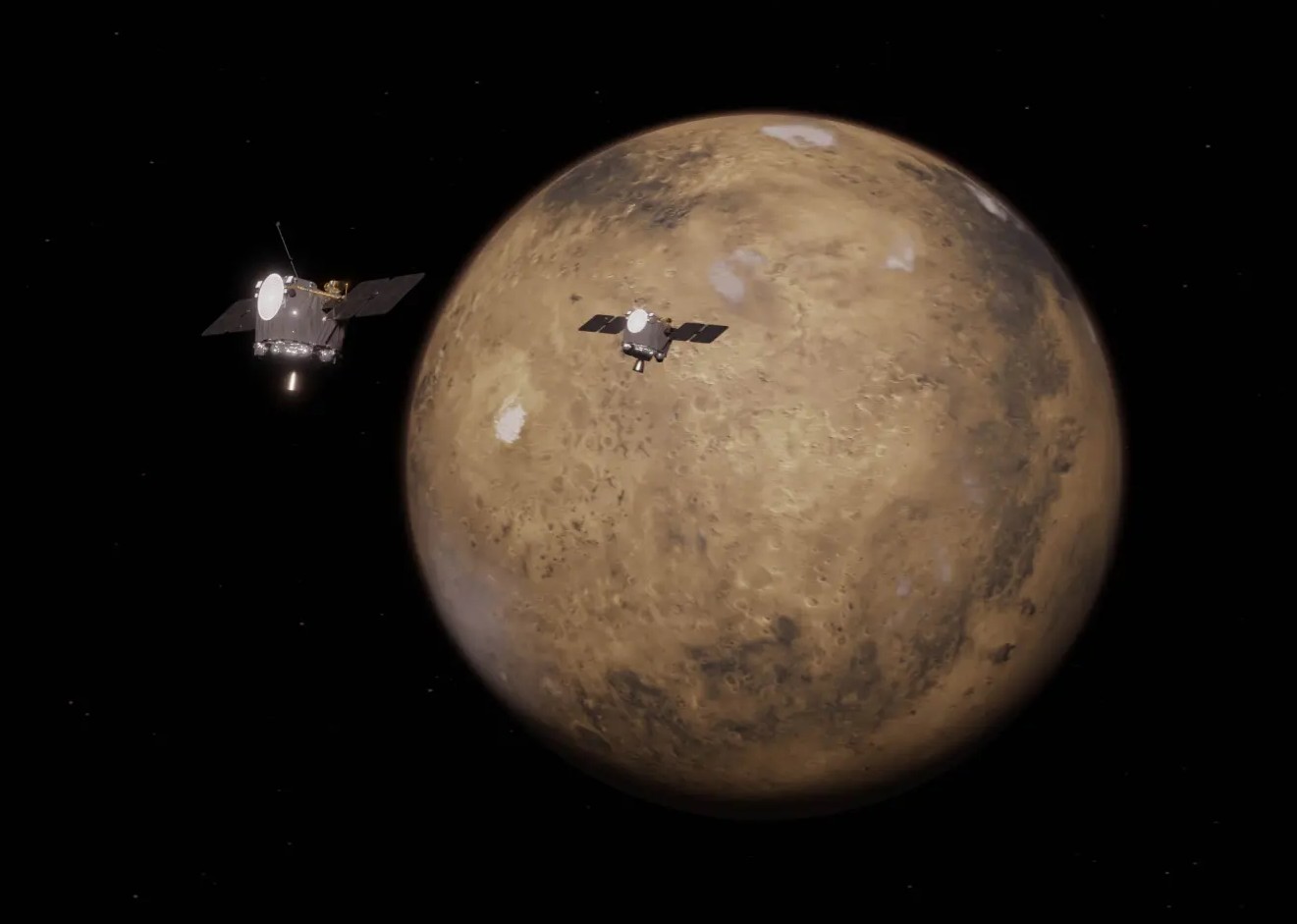
For the first time in the history of spaceflight, a deep-space mission will fire its engine at Earth — not to escape it, but to use it. NASA’s twin ESCAPADE spacecraft, Blue and Gold, will each execute a precise engine burn at their closest point to Earth this week: Blue on November 7, 2026, and Gold on November 9. The maneuver, known formally as a powered flyby or Oberth maneuver, has never been attempted by any government-operated spacecraft before. If the engines light correctly, both probes will slingshot onto a trajectory to Mars, arriving in September 2027 — and the aerospace community will have a proven playbook for sending spacecraft to the Red Planet on almost any schedule, not just when the planets line up.
First Powered Flyby: What Makes This Different From Every Mars Mission Before It
When most people picture a gravity assist, they picture a spacecraft using a planet’s gravitational pull to change direction — a slingshot. That is what Voyager 1 did at Jupiter, and what every Mars-bound mission has done at Earth when the geometry allowed it. The spacecraft falls toward the planet, curves around it, and emerges with a new velocity vector. The planet’s gravity redirects the trajectory; no fuel is burned.
ESCAPADE’s maneuver this week is fundamentally different from passive slingshots. It is a powered flyby, also called an Oberth maneuver after the Austro-Hungarian physicist Hermann Oberth who described concept in 1927 in his treatise Ways to Spaceflight. The physics is elegant: kinetic energy scales with velocity squared, so a fixed engine burn produces far more energy when it happens at the moment of peak speed than it would at any other point in a spacecraft’s orbit. At the point of closest approach to Earth, ESCAPADE’s spacecraft will be traveling at the highest velocity in their entire year-long loiter trajectory — and that is precisely when their engines will fire for approximately 9.5 minutes.
The result is an energy multiplication. The engine burn provides a fixed change in velocity (called delta-v in mission engineering), but at periapsis — the lowest point in the orbit — that same delta-v translates into a far larger gain in total orbital energy than it would produce during a slower portion of the trajectory. Firing at periapsis while performing a gravity-assisted trajectory around Earth gives ESCAPADE’s mission designers both effects simultaneously: the planet’s gravity reshapes the trajectory toward Mars, and the engine burn at maximum speed amplifies every kilogram of propellant used. This combination — often called a “powered gravity assist” — is categorically more efficient than a passive slingshot and has never been used by any NASA or peer-agency spacecraft on a planetary mission before this week.
Blue will approach Earth to within approximately 373 miles (600 kilometers) — about the altitude of the International Space Station above Earth’s surface, but on the opposite side of the planet’s trajectory. At that moment, its engines will ignite over southern Australia. The burn is scheduled to complete in roughly 9.5 minutes. Gold will repeat the identical procedure 48 hours later.
Why ESCAPADE Spent a Year Near Earth — and Why That Changes Everything
If ESCAPADE’s powered flyby is the week’s headline event, the year leading up to it is the broader story about what this mission means for the future of Mars exploration.
Every Mars mission before ESCAPADE has been constrained by the same orbital calendar. Earth and Mars reach an optimal alignment for spacecraft transfers roughly every 26 months, during a window that lasts only a few weeks. Miss the window and a mission team either launches anyway into an inefficient trajectory that demands far more fuel, or waits nearly two years for the next opportunity. This is why Mars missions tend to cluster — 2020, 2022, 2024 — and why a mission ready to fly in the “wrong” year faces an expensive, sometimes project-killing delay.
ESCAPADE broke this constraint by design. After launching November 13, 2025, aboard New Glenn rocket from Cape Canaveral, both spacecraft did not head directly toward Mars. Instead, they were directed to a “kidney bean-shaped” loiter orbit around Earth-Sun Lagrange Point 2 (L2), a gravitationally semi-stable region approximately 930,000 miles (1.5 million kilometers) from Earth in the anti-sunward direction — the same general vicinity where NASA’s James Webb Space Telescope orbits.
The L2 loiter orbit is the mission’s most unconventional strategic choice. Rather than launching during an alignment window, Advanced Space LLC planned for the spacecraft to wait at L2 for however long it took the planetary geometry to become favorable — in this case, approximately one year. When Earth and Mars reached alignment in late 2026, the spacecraft departed L2, fell back toward Earth, and positioned themselves for this week’s powered flyby. The flyby itself serves as the trans-Mars injection burn: the moment Blue and Gold fire their engines at Earth periapsis, they are not just completing a complex orbital maneuver — they are simultaneously beginning their cruise to Mars.
The implication, if the maneuver succeeds, is significant for every future Mars mission: a spacecraft can launch to L2 at almost any time, wait for Mars to come around, and then execute a powered flyby to depart. The rigid 26-month cycle that has governed Mars exploration since the first robotic missions becomes, in principle, optional.
A Year at L2 Was Not the Plan for Gold
The loiter strategy worked as designed for Blue. Gold’s path was rougher.
During trajectory correction maneuvers in late 2025, Gold’s propulsion system produced lower thrust than expected. The resulting lower-than-expected burn performance delayed a critical trajectory correction; a replacement maneuver was completed January 6, 2026. Mission controllers confirmed both spacecraft were on correct trajectories following that correction, and both remained on schedule for the November 2026 flybys.
The engine performance issue on Gold illustrates exactly the kind of risk the mission was designed to accept. ESCAPADE’s principal investigator, Robert Lillis of UC Berkeley‘s Space Sciences Laboratory, has been explicit about the tradeoff: “Instead of spending $800 million for a 95% chance of success, can we spend $80 million for an 80% chance?” The Gold propulsion incident was a real test of that philosophy — a setback that a higher-budget mission might have avoided through additional redundancy, but one that ESCAPADE’s team was prepared to work through.
The stakes for the upcoming burn remain high. If either spacecraft’s engines fail to ignite during the November flyby window, the spacecraft would miss the trans-Mars injection opportunity; the next viable window would not open for approximately two years.
Two Mars Spacecraft for the Price of One
The full cost of the ESCAPADE mission is under $80 million, Lillis says — his own repeated description of the budget. For comparison, NASA’s MAVEN mission to Mars, which launched in 2013 and studies the same atmospheric-escape processes ESCAPADE will study, cost approximately $671 million. The Mars Reconnaissance Orbiter cost roughly $720 million. ESCAPADE’s budget is approximately 10% of what a typical Mars orbiter costs.
Rocket Lab built both spacecraft — the company publicly known for its Electron small launch vehicle — under NASA’s SIMPLEx program (Small Innovative Missions for Planetary Exploration), which funds interplanetary science missions with higher risk tolerance and compressed timelines. Rocket Lab completed both probes in approximately 3.5 years — roughly half the timeline a standard planetary mission typically requires. The launch itself was provided by Blue Origin’s New Glenn vehicle, which had completed its first orbital mission earlier in 2025.
The cost advantage comes from a deliberate set of design choices. ESCAPADE carries lighter instruments than heritage Mars orbiters, operates with higher risk tolerance, and runs mission operations on a compressed team. The two spacecraft also share a communications strategy: NASA’s Deep Space Network (DSN) will contact them simultaneously using Multiple Spacecraft per Aperture (MSPA), which allows both probes to be reached through a single antenna dish. That halves the DSN time required to operate two spacecraft versus the usual allocation.
What ESCAPADE Will Actually Study at Mars
When Blue and Gold arrive at Mars in September 2027, they will enter elliptical science orbits ranging from 100 miles to 6,200 miles (160 to 10,000 kilometers) above Mars’ surface. The science objective is something no single spacecraft has been able to achieve: simultaneous two-point measurements of Mars’ unusual hybrid magnetosphere.
Earth has a global magnetic field generated by its churning iron core, which deflects the solar wind and protects the atmosphere. Mars lost its internal dynamo roughly 4 billion years ago. What remains are isolated patches of magnetized crust — remnant fields from ancient, long-cooled volcanic rock — surrounded by a hybrid magnetosphere shaped by direct interaction between the solar wind and Mars’ ionosphere.
The consequence of that lost magnetic field is an atmosphere that has been slowly stripped away for billions of years. The solar wind interacts directly with Mars’ ionosphere, energizing ions and ejecting them into space — a process called atmospheric sputtering. Today, Mars’ atmospheric pressure stands at 0.6% of Earth’s at sea level, down from what planetary scientists believe was once a thicker, more hospitable environment. NASA’s MAVEN spacecraft has measured this loss process since 2014, but MAVEN is a single orbiter — it sees the magnetic and plasma environment at one location at a time.
ESCAPADE’s advantage is simultaneity. With Blue and Gold flying in coordinated formation — in their initial string of pearls configuration, separated by 2 to 30 minutes of arc along identical orbital paths — scientists will be able to distinguish for the first time whether changes in Mars’ magnetospheric readings are due to real spatial variations in the magnetic environment or changes over time at a single location. This ambiguity — are two readings different because they sampled different places, or because conditions changed between measurements? — has limited every single-spacecraft magnetospheric study conducted before ESCAPADE.
The mission’s timing as it approaches Mars is also scientifically useful. In the hours before the Earth flyby, both spacecraft will pass through Earth’s distant magnetotail — the region stretching millions of miles behind Earth on the anti-sunward side, where our planet’s magnetic field is drawn out into a long streamer by solar wind pressure. The flyby period will give ESCAPADE’s instruments a calibration opportunity against a well-studied space environment before they begin operations at Mars.
Understanding how Mars lost its atmosphere is not merely a historical science question. Nicky Fox, associate administrator of NASA’s Science Mission Directorate, noted the direct connection to crewed exploration: “The ESCAPADE mission is part of our strategy to understand Mars’ past and present so we can send the first astronauts there safely.” Surface radiation on Mars averages approximately 0.64 millisieverts per day — roughly equivalent to a chest X-ray every five days — and the lack of a global magnetic field means future crews will need detailed knowledge of how the radiation environment fluctuates.
Frequently Asked QuestionsWhat is an Oberth maneuver, and why is ESCAPADE the first spacecraft to use one this way?
An Oberth maneuver at periapsis is a technique in which a spacecraft fires its engine at the point of closest approach to a planet — the moment when the spacecraft is traveling fastest. Because kinetic energy scales with velocity squared, a fixed engine burn produces far more total energy when executed at high speed than at any other point in an orbit. Every prior Mars mission has used passive gravity assists (slingshots with no engine burn) or has launched directly during alignment windows without an Earth flyby at all. ESCAPADE is the first NASA mission to combine an Earth flyby with a simultaneous engine burn at periapsis, multiplying the fuel efficiency of the trans-Mars injection maneuver.
Why does it matter that ESCAPADE launched when Earth and Mars weren’t aligned?
Every previous Mars mission — including Viking, Pathfinder, Curiosity, Perseverance, and MAVEN — launched during the roughly three-week alignment window that opens every 26 months when Earth and Mars are optimally positioned for a minimum-energy transfer. Missing that window typically means waiting up to two years. ESCAPADE broke this constraint by launching to a holding orbit near Earth-Sun Lagrange Point 2 and waiting there until Mars came around. If the powered flyby succeeds, the L2-loiter strategy would become a proven template for Mars scheduling — a potential paradigm shift for human Mars mission planning, which cannot easily accommodate two-year delays.
What happens to the mission if one spacecraft’s engines fail to fire this week?
If a spacecraft’s engines fail to ignite during the November flyby window, that vehicle would miss its trans-Mars injection opportunity. The next viable window would not open for approximately two years — the next time Earth and Mars reach alignment. The mission could potentially proceed with a single spacecraft, but the core science advantage of ESCAPADE — simultaneous dual-point magnetospheric measurements — would be compromised. Principal investigator Robert Lillis has described this risk as a known and accepted tradeoff: the SIMPLEx philosophy accepts higher risk in exchange for dramatically lower cost.
How will two spacecraft costing $80 million total study something NASA’s $671 million MAVEN mission is already studying?
MAVEN is a single-point instrument — it measures Mars’ magnetosphere and atmosphere at one location at a time. ESCAPADE adds a second simultaneous measurement point, which resolves an ambiguity that has limited all prior Mars magnetospheric science: when a spacecraft records a change in plasma or magnetic field readings, it cannot determine whether that change is because the spacecraft moved to a different location or because conditions changed at a fixed point. Two synchronized spacecraft traveling near-identical orbits eliminate that ambiguity. The low cost comes from NASA’s SIMPLEx program design philosophy: lighter instruments, higher risk tolerance, streamlined operations using shared Deep Space Network antenna time, and a faster build schedule executed by Rocket Lab in approximately 3.5 years.