
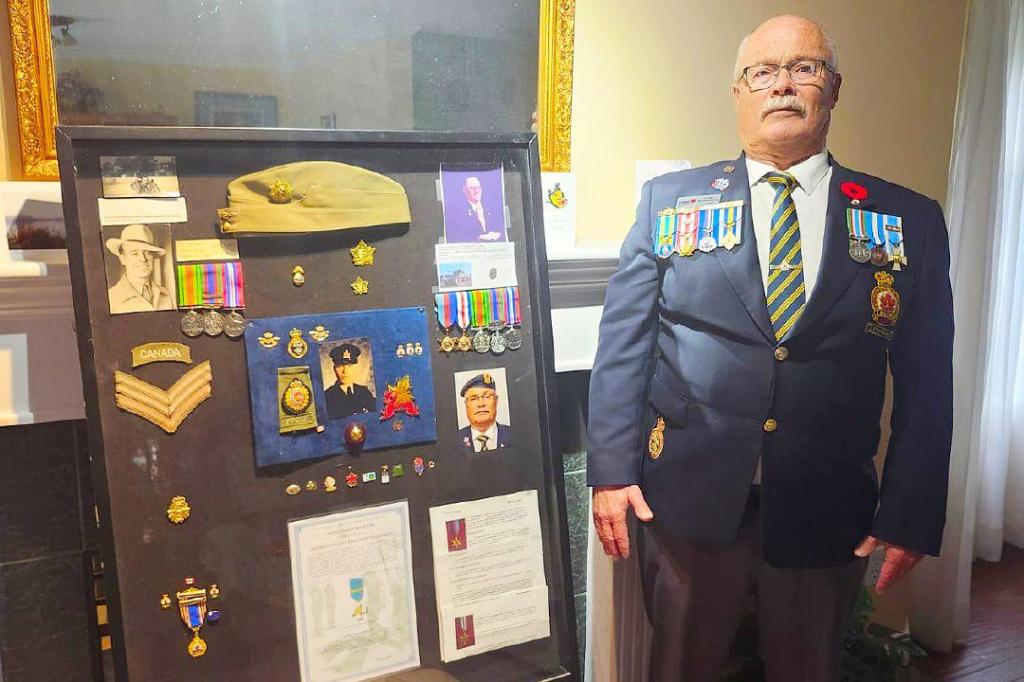
Every year when the Poppy Campaign kicks off, Lorne Russell Stoutenburg II thinks about his dad, Lorne Russell Stoutenburg I.
Stoutenburg Sr. Was a tank driver in the Second World War. He was overseas from 1942 to 1946.
A member of the 10th Canadian Armoured Regiment (Fort Garry Horse), Stoutenburg Sr. fought in several campaigns in Europe receiving two WWII campaign stars, the France and Germany Star and the 1939-1945 Star.
“Fort Garry Horse is a tank division and he was a tank driver,” Stoutenburg Jr. said. A member of the Cloverdale Legion, Stoutenburg Jr. also served Canada as a soldier with Princess Patricia’s Canadian Light Infantry—PPCLI.
“He signed up in 1942 and after training, he went to England,” he added.
Born March 15, 1923, in Creelman, Sask., Stoutenburg grew up between the village of Ernfolds, Sask., and Winnipeg. When he was 15, he started working as a tractor driver after dropping out of school after Grade 8.
In the winter of ’41-’42, he was gainfully employed, but decided to enlist to do his part. He was 18.
He started out at District Depot for the 10th Armoured Regiment (Fort Garry Horse) in Winnipeg. After three months there he was sent to Camp Borden in Simcoe, Ont., for further training.
In December of ’42, Stoutenburg was transferred to the No. 2 Canadian Armoured Corps Reinforcement Unit (2 CACRU). The unit was stationed in the U.K. between Aldershot or Witley Camp.
A reinforcement and holding unit, 2 CACRU received new armored personnel from Canada who were sent there to complete or update specialized training. This could encompass driving tactics, use of guns or other armaments, or communications. Once in the unit, troops waited to be sent as reinforcements to operational units such as the Fort Garry Horse or other regiments fighting in Europe.
It wasn’t until July 16, 1943, that’s Stoutenburg Sr. was transferred to “A” Squadron of the 10th Armoured Regiment. In 1944, he was moved over to “C” Squadron ahead of the D-Day invasion.
D-DAY
On D-Day, A, B, and C Squadrons of the Fort Garry Horse were part of the Normandy landings.
“C” Squadron was equipped with Duplex Drive Sherman tanks. They were amphibious “swimming” tanks. They had dual propulsion systems—tracks for land and a pair of rear-mounted propellers for the water.
Affectionately called “Donald Ducks” by the tankers, they were designed to be a part of the beach invasions and provide heavy-armour fire support for the infantry.
The Donald Ducks of “C” Squadron landed in support of the North Shore regiment at Saint-Aubin-sur-Mer. However, none of them actually landed at sea, but were transported to shore.
“C” faced little resistance at first, but when the German defenses finally trained on them, they lost four tanks on the beach. There were also no places to exit the beach at Saint-Aubin-sur-Mer. So, the squadron had to drive through a minefield and lost even more tanks. The rest of the squadron assisted the North Shore Regiment as they liberated Saint-Aubin and Tailleville.
Squadrons A and C also suffered losses on D-Day. Together the Fort Garry Horse landed 69 tanks and 418 troops, suffering 14 killed and 11 wounded on June 6, 1944.
After D-Day, the 10th Armoured Regiment, as part of the 2nd Canadian Armoured Brigade, was attached to the British 21st Army Group, led by General Bernard “Monty” Montgomery. For the remainder of the war, the Fort Garry Horse’s movements, actions, and locations were part of the 21st Army Group’s theatre of operations as they advanced through France, Belgium, the Netherlands, and into Germany.
“After fighting ended, I know he was helping assist people in Holland,” Stoutenburg Jr. noted. “They were part of post-war (efforts).”
Stationed in Doetinchem, Holland following the German surrender, the Fort Garry Horse stayed for several months of occupation and stabilization duties. From there, the 10th Armoured Regiment sailed back to Canada. When the regiment finally got back to Winnipeg, it was officially disbanded at Minto Armouries on January 31, 1946.
Stoutenburg was discharged from the Army on Valentine’s Day in 1946. After a short time in Manitoba, Stoutenburg Sr. left for Alberta. First to Wetaskiwin for a little while and then to Edmonton.
He started to drive truck after the war and met Carol Patenaude in 1951. Lorne Jr. was born in 1952.
“He didn’t talk about the war,” added Lorne. “Never.”
Lorne Russell Stoutenburg I died on Valentine’s Day in 1994 in Millet, Alberta. The Second World War veteran was 71.