

As extreme weather becomes more frequent in the context of climate change, a research project led by Concordia University is working to improve forecasting so Canada is better prepared to respond.
Funded over five years, WxAlliance brings together nine schools and eight societal partners across the country — including Environment and Climate Change Canada (ECCC) — to develop forecasting models that combine traditional methods with machine learning to improve predictions.
“I think for Canada, it’s extremely important,” said Brian Vermeire, principal investigator of the project and associate professor of mechanical, industrial and aerospace engineering at Concordia. “Canada is so large and so geographically diverse, the weather systems are very different across the country. We really need to have accurate forecasts to help protect people’s lives (and) to prevent financial damages.”
Traditional weather forecasting relies on a series of equations solved by supercomputers, Vermeire explained: “You take a snapshot of what the atmosphere looks like right now, and then you numerically solve those equations using a supercomputer to predict what the weather is going to be, let’s say, tomorrow.”
But there are some processes in the atmosphere for which there may not be adequate equations, leading to a loss of accuracy, Vermeire added, using the example of a forecasted ice storm in Montreal last winter that never came to be.
Machine learning, meanwhile — a relatively new technology — relies on historical weather data to make its predictions instead.
“It pulls out patterns from the historical data and then tries to sort of match those patterns to the current condition to predict the future,” Vermeire said.
But since machine learning also has limitations, WxAlliance’s goal is to find a hybrid approach: “How can we couple them together in a way to get better forecasts?” Vermeire said.
Stéphane Gaudreault, research manager at ECCC, said the agency’s scientific machine-learning research team has already started experimenting with combining the methods — an approach called spectral nudging.
“What we do is make small corrections to the physical model based on what the machine-learning model tells us,” he said. “It’s a bit as if the machine-learning model were telling the physical model ‘that storm should track a little farther north’ — the physical model would then apply very small adjustments to nudge it in the direction suggested by the other model.”
The agency has noticed that machine-learning models perform better for broad patterns over large geographic areas, like hurricanes, but not as well for fine details “such as the intensity of a storm or smaller-scale features occurring over a few kilometres,” Gaudreault explained.
Combining them, then, is “the best of both worlds.”
Editor’s Picks
Like Vermeire, Gaudreault pointed out that when it comes to extreme weather, accurate forecasting is what allows decision-makers to decide on courses of action — such as when to evacuate an area in the event of fires or floods.
“Having better weather forecasts will help us make better decisions where needed, in a context where severe events may be occurring more frequently, and with levels of intensity that perhaps we have not seen in the past,” he said.
Asked about the accuracy rate the agency is striving for, Gaudreault said it’s difficult to say since new methods are constantly being discovered.
“In a way, it’s a bit like building an airplane while it’s already in flight,” he said.
The WxAlliance project seeks to define accuracy, given that the definition can differ depending on context, Vermeire said.
“Accuracy might mean something very different to an ordinary citizen on the weekend if they want to go outside or not, compared to, let’s say, an insurance company when they’re trying to forecast risk, versus a farmer when they’re trying to spray their crops,” he said.
ECCC provides a variety of forecasts, from daily weather to watches and warnings to seasonal outlooks. Kathleen Maynard-Leclerc, one of several meteorologists at the agency who scans radars daily, said that ECCC, like other agencies around the world, is shifting its focus to impact-based forecasts.
“It’s to help … emergency managers to plan their resources if they need to be displaced in certain areas for power outages … but also for individuals to take their own measures to protect themselves, whatever that may be,” she said, pointing out that some extreme weather impacts everyone in a given area, while some impacts people with specific vulnerabilities, like those whose basements tend to flood.
“We try to focus on high-impact weather and try to communicate as best as we can to the public,” she said.
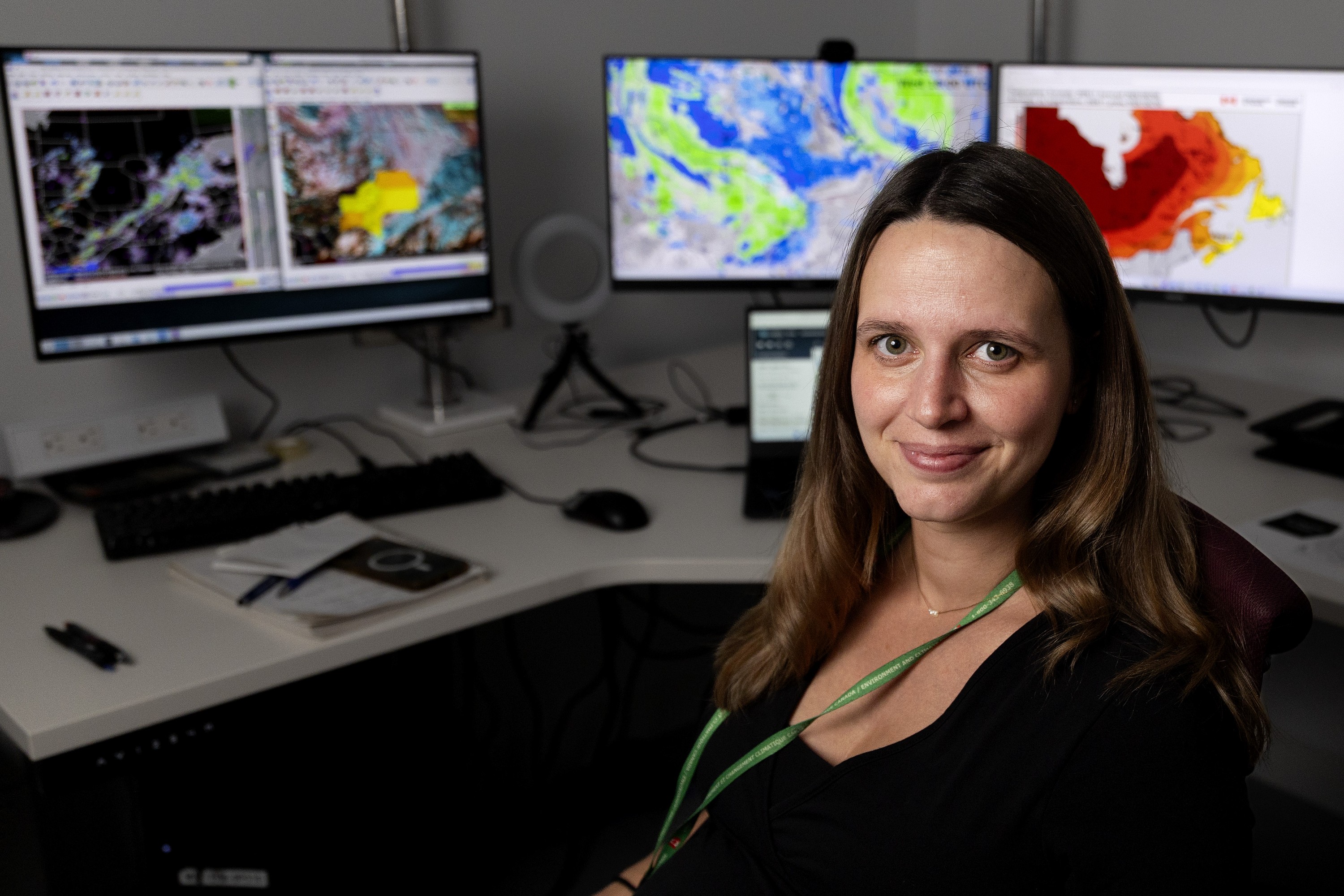 Kathleen Maynard-Leclerc, Warning Preparedness Meteorologist at Environment and Climate Change Canada in Montreal, on Wednesday, Oct. 7, 2026. Allen McInnis / Montreal Gazette
With the first snowfall on the horizon, the fact that some drivers may not have installed their winter tires yet will influence ECCC’s alerts, Maynard-Leclerc explained.
“It might be just 10 centimetres instead of 15 or 25, but we know … people are going to not be prepared, and they haven’t driven in winter weather in a while — so that’s how we try to adjust our warnings,” she said. “But it’s a work in progress. It’s not easy to anticipate all the vulnerabilities.”
Maynard-Leclerc also pointed out that the atmosphere is a chaotic environment, meaning “there’s always going to be a level of unpredictability to it.” She suggests downloading the Environment and Climate Change Canada app to stay alert.
When it comes to WxAlliance — which received $5 million in funding from the Natural Sciences and Engineering Research Council of Canada Alliance Society in September — Vermeire said he suspects the team will be able to make “pretty significant contributions” to forecasting over the next five years. That includes the training of 35 to 40 new weather forecasting experts on new techniques — “so that Canada has a workforce that has the expertise we need going forward.”