
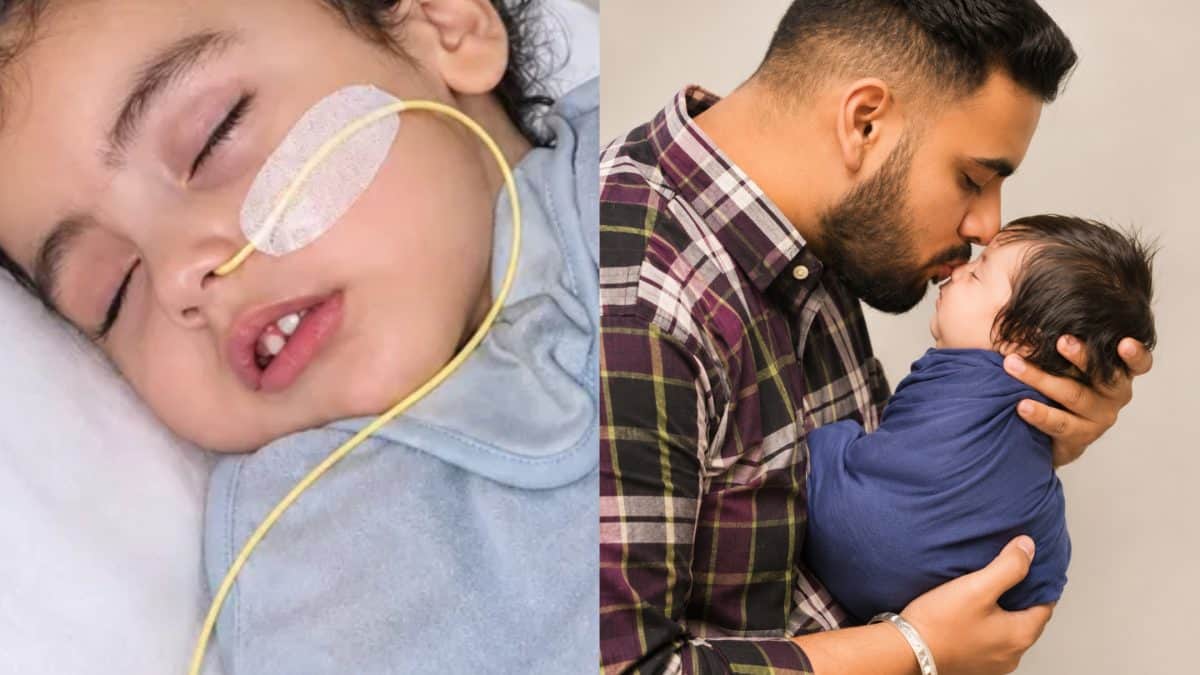
Brampton father Mandeep Chandi is trying to raise $5.5 million for a gene therapy treatment for his son, Zorawar. (Photos: GoFundMe)
Expensive gene therapy considered experimental in Canada could help a Brampton toddler who is unable to walk due to rare and serious genetic disorder.
“It affects his nervous system, so his body is not able to produce dopamine and serotonin,” Mandeep Chandi said of his son Zorawar in an interview with INSAUGA Canada.
Zorawar has Aromatic L-amino acid decarboxylase (AADC) deficiency. It’s a rare genetic disorder that affects the brain’s ability to produce an enzyme needed to make neurotransmitters – chemical messengers that help control mood, movement, and other essential functions.
At two-and-a-half years old, most toddlers are walking and talking. But Chandi says his son hasn’t hit any of those milestones due to the rare genetic disease.
“(Zorawar’s) just in a newborn situation right now, his brain isn’t able to get the proper function,” Chandi says. “He’s not able to walk, talk or sit. He can’t do anything, he just sits in his mom’s lap 24/7.”
Chandi moved to Canada from India in 2015 and says English is his second language, and says becoming first-time parents dealing with the medical system has been stressful for him and his wife Ramandeep. She’s been his constant caregiver, with help from Mandeep’s mother.
And while Mandeep says there’s a treatment that’s been approved in the U.S. which could have Zorawar up and walking within a year, the treatment isn’t approved in Canada.
It’s called KEBILIDI, and is the first AADC deficiency approved by the U.S. Food and Drug Administration, and the first approved gene therapy to be given directly into the brain, according to the Boston Children’s Hospital.
Mandeep says an application for out-of-country funding to the Ontario Ministry of Health was denied, and it will cost the family more than $5.5 million to make the trip to Boston for the treatment.
Last 30 Days: 44,211 Votes
All Time: 1,604,160 Votes
1420 VOTES
What should your newly elected mayor focus on during their first 100 days?
“While treatment requires specialist assessment and results cannot be guaranteed, we are fighting for Zorawar to have the opportunity to be evaluated for this therapy and receive it if he is eligible,” reads a GoFundMe page started by the family to raise funds for the procedure.
The therapy only lasts about eight hours, and could see results in four months, Mandeep says.
The Boston Children’s Hospital says that, without treatment, AADC deficiency “is a progressive, life-shortening disorder that can lead to severe disability.”
But with early diagnosis and gene therapy, “the outlook has improved for some children.”
“While gene therapy has shown positive results in clinical trials, the long-term benefits are still being evaluated,” the hospital’s website reads.
The family is hoping to raise $5.5 million, and had collected more than $23,000 as of Nov. 4. Donations will help with medical assessments, treatment-related expenses, travel, accommodation, transportation and necessary follow-up care, the family says.
INSAUGA Canada’s Editorial Standards and Policies
Stay in the know.
Subscribe now to receive our daily email of today’s top stories in your city!