
A rainy forecast can ruin your plans for a long road ride or a morning on the mountain bike trails. But skipping a ride doesn’t have to mean spending the day on the couch. With just 20 minutes and a little floor space, you can work on leg strength, core stability, and mobility without touching your bike or setting up an indoor trainer. This simple routine targets muscles that matter to cyclists while giving your body a different kind of workout.
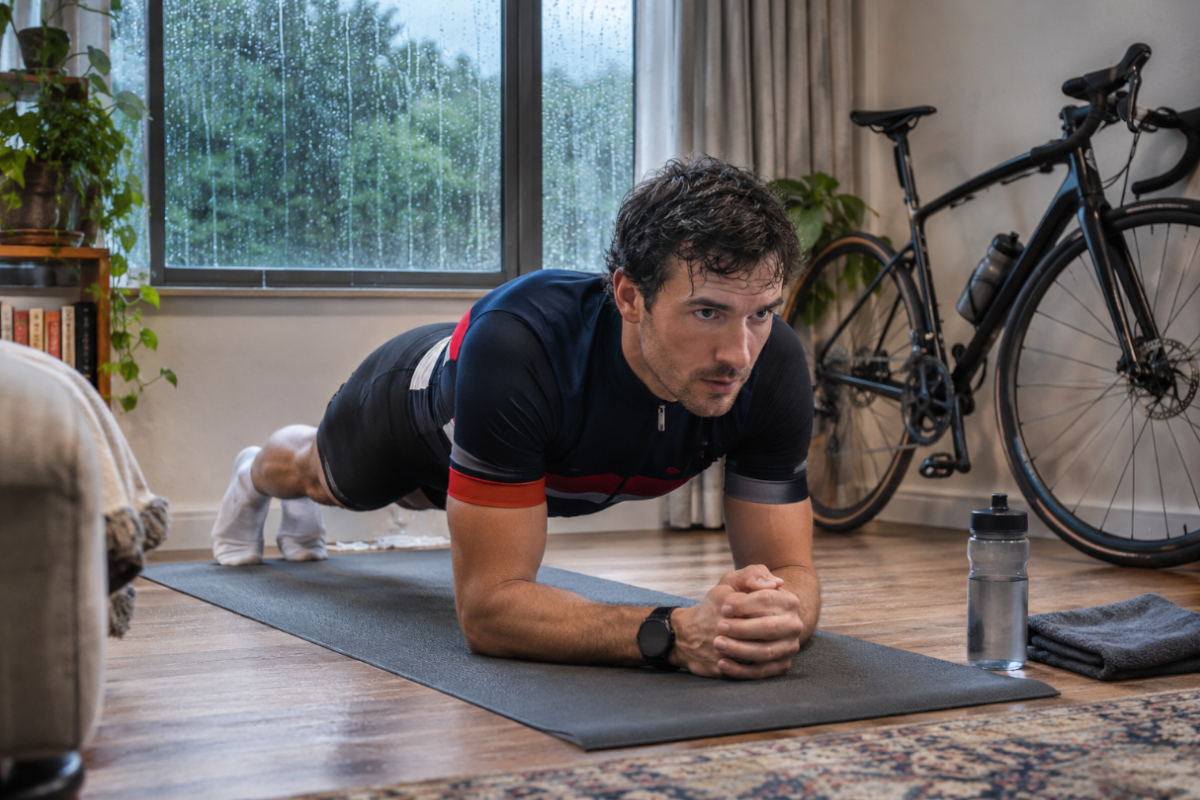
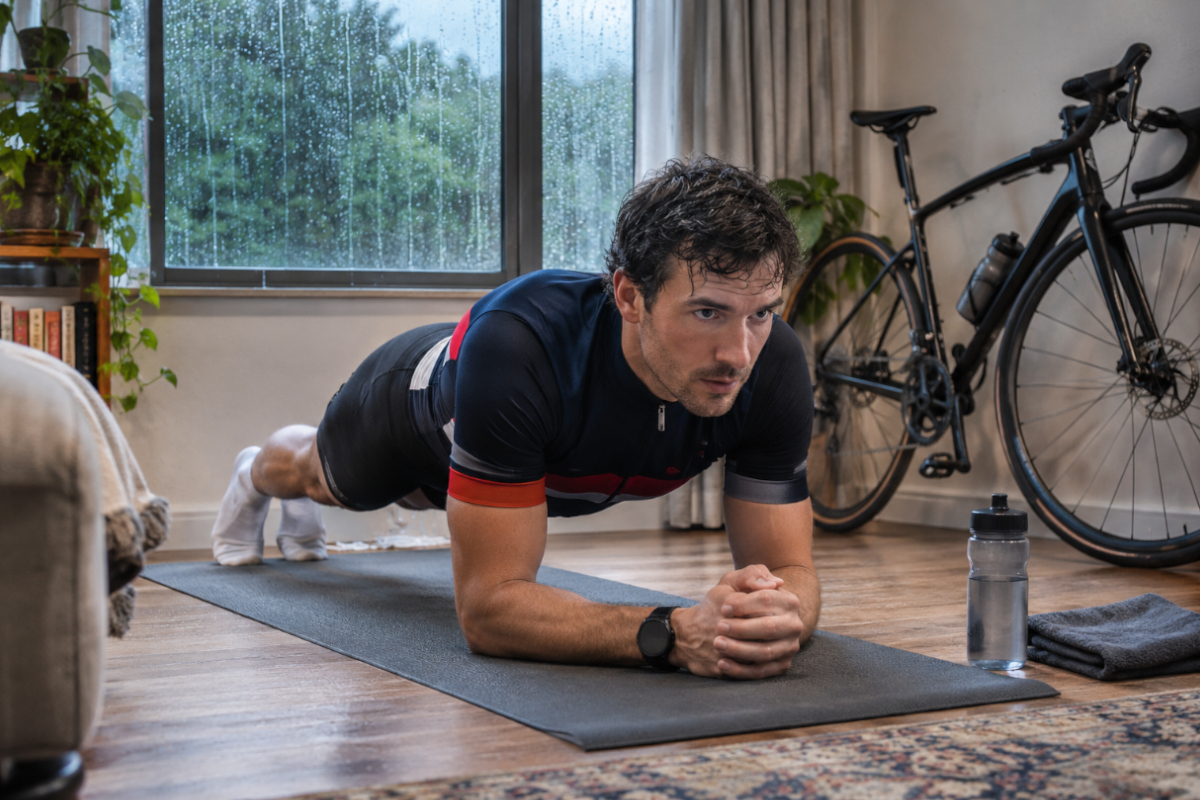 Cyclist doing a forearm plank at home on a rainy day, with his road bike in the background. Imagen: TodoMountainBikeA 20-minute indoor workout designed for cyclists
Cycling places repeated demands on the quadriceps, glutes, and other lower-body muscles, but it doesn’t challenge every muscle group equally. Strength and stability exercises can complement regular riding by developing movement patterns that don’t get much attention in the saddle. This 20-minute workout for cyclists combines seven bodyweight exercises that require no weights, machines, or specialized equipment.
The session has three parts: a three-minute warm-up, a 14-minute main circuit, and a three-minute cooldown. During the main circuit, you’ll complete each exercise for 40 seconds, followed by 20 seconds of recovery. After finishing all seven exercises, repeat the sequence once more. Two rounds take exactly 14 minutes, including the recovery intervals.
Start with a short warm-up to prepare your muscles and joints. March briskly in place for one minute, spend another minute gently rotating your shoulders and moving your hips, and finish with shallow squats and alternating knee raises. Increase your effort gradually rather than trying to break a sweat immediately.
Seven bodyweight exercises to keep your cycling muscles active
The following movements focus on the legs, glutes, core, and upper body. They also introduce balance and coordination challenges that can complement your usual cycling routine. Perform each exercise at a controlled pace, prioritizing proper technique over the number of repetitions.
Bodyweight squats. Stand with your feet approximately shoulder-width apart. Push your hips back, bend your knees, and lower yourself as far as you can comfortably control while keeping your heels on the floor. Return to standing by pushing through your feet. Squats engage the quadriceps and glutes, two major muscle groups involved in pedaling.Alternating reverse lunges. Take one step backward, bend both knees, and lower your body without letting your front knee collapse inward. Push through your front foot to return to standing, then switch legs. Reverse lunges challenge each leg independently while engaging the muscles responsible for hip and knee stability.Glute bridges. Lie on your back with your knees bent and feet flat on the floor. Tighten your glutes and lift your hips until your shoulders, hips, and knees form a roughly straight line. Lower slowly without excessively arching your lower back. This exercise targets the glutes and helps develop strength through hip extension.Forearm plank. Position your forearms on the floor with your elbows beneath your shoulders. Extend your legs and keep your body aligned from head to heels. Brace your abdominal muscles without holding your breath. If necessary, keep your knees on the floor to reduce the difficulty. Planks develop core endurance and trunk stability, both useful for maintaining control over the bike.Push-ups. Place your hands slightly wider than shoulder-width apart and lower your chest toward the floor by bending your elbows. Push back to the starting position while keeping your torso stable. Beginners can perform the movement with their knees supported or against a wall. Push-ups strengthen the chest, shoulders, and triceps, which contribute to supporting your upper body and controlling the handlebars.Bird dogs. Start on your hands and knees, with your wrists beneath your shoulders and knees beneath your hips. Extend one arm forward and the opposite leg backward while keeping your pelvis level. Return to the starting position and alternate sides. The exercise challenges coordination and core stability without placing a heavy load on the spine.High-knee marching. Stand upright and march in place, raising your knees alternately while moving your arms naturally. Maintain a brisk but controlled rhythm that moderately increases your breathing rate. This final movement introduces a light cardiovascular challenge before starting the next round.
Once you’ve completed the seventh exercise, begin the circuit again. There’s no need for additional rest between rounds because the 20-second recovery period is already included. If you need more time to recover, extend the breaks, although the workout will take longer than 20 minutes.
How to adjust the workout to your fitness level
The intensity of this no-equipment home workout should reflect your current fitness and experience with strength training. Beginners can start with 30 seconds of exercise and 30 seconds of rest during each one-minute interval. More experienced cyclists can increase the number of controlled repetitions or use slightly more demanding variations, provided their technique remains consistent. Movements should never be rushed simply to make the workout harder.
For the final three minutes, gradually reduce your effort. Spend the first minute walking slowly in place, the second performing gentle hip and spinal mobility movements, and the third stretching your quadriceps, glutes, and hamstrings. Avoid forcing any stretch or moving into a painful range of motion.
One advantage of these bodyweight exercises for cyclists is that they involve muscles and movement patterns beyond those used during repetitive pedaling. Squats and lunges challenge the legs through a different range of motion, while planks and bird dogs focus on trunk control. Push-ups add upper-body work that road cycling and Mountain Biking don’t necessarily provide in sufficient amounts to develop strength.
However, a short strength circuit cannot fully replace a ride. Twenty minutes of bodyweight training won’t reproduce the sustained aerobic demands of a two-hour road ride, a long gravel adventure, or a challenging mountain bike session. It also won’t automatically improve FTP, VO2 max, or sprint power. Those adaptations require training that specifically targets the physiological demands involved.
The routine can still be useful as part of a broader training schedule. For cyclists who already spend several hours a week riding, a rainy day cycling workout offers an opportunity to include some supplementary strength work without adding another demanding endurance session. The goal is to remain active and develop a more balanced fitness routine, rather than compensate for every missed mile.
Recovery is worth considering, too. If you have a hard interval session or a long ride planned for the following day, avoid pushing squats and lunges to the point of significant muscular fatigue, especially if you’re unfamiliar with strength training. Soreness from an unusually demanding workout can interfere with the quality of your next ride.
Consistency makes a difference. An occasional 20-minute session is a practical way to break up a sedentary day, but meaningful improvements in muscular strength and endurance generally require repeated training and appropriate progression. If bad weather keeps you indoors for several days, you can alternate strength sessions with mobility work, recovery days, or aerobic training on an indoor bike. Modify or skip any movement that causes pain, and seek individualized guidance when managing an injury or medical condition.