
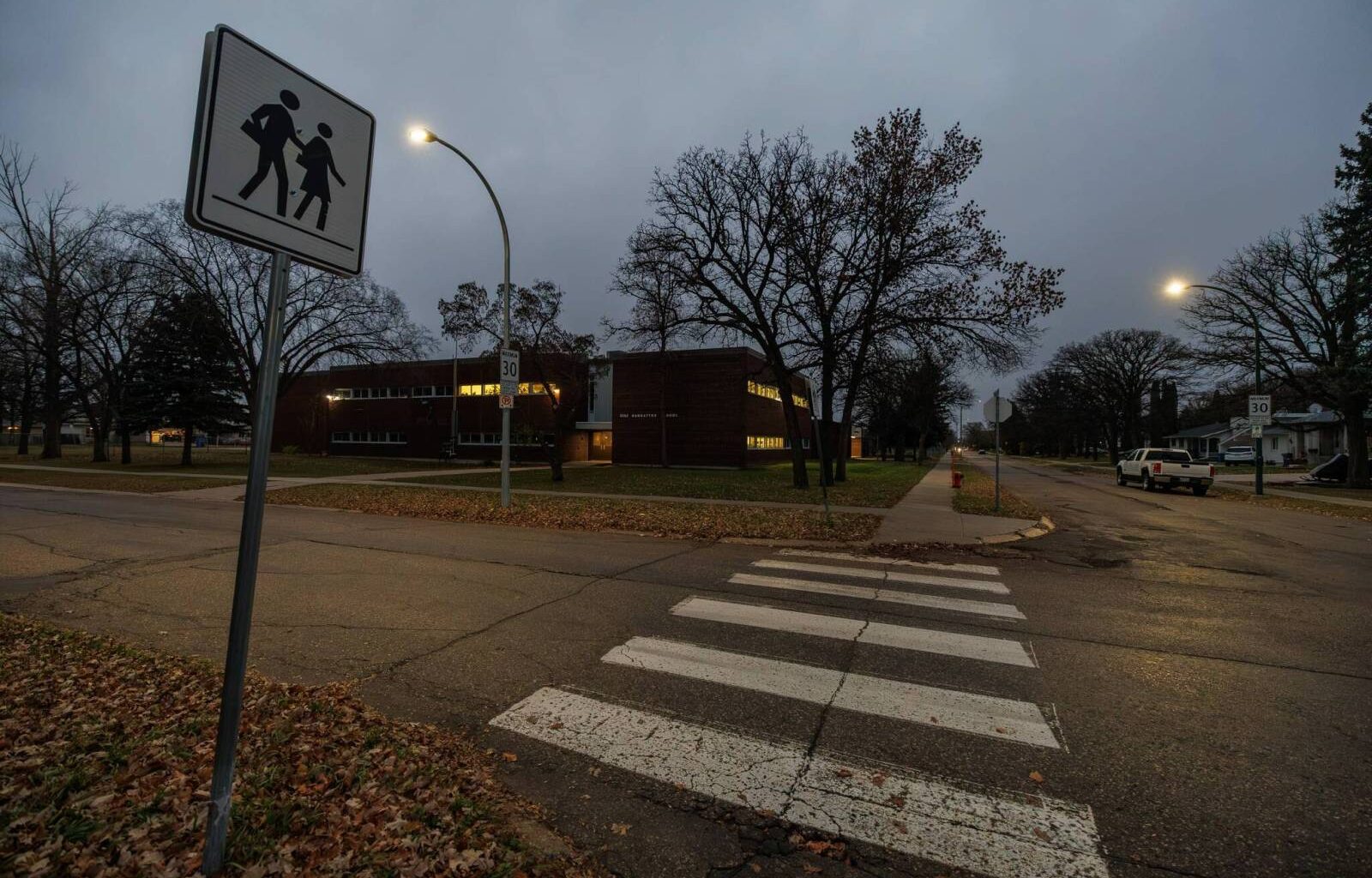
School officials are fielding complaints about Manitoba’s decision to abandon biannual clock changes as they urge children to wear bright clothing and take other safety precautions to commute to class in the dark.
The St. James-Assiniboia School Division board office has received two formal complaints related to the province’s new year-round time zone — Manitoba Standard Time (MBT).
“Both were concerned about student safety in the dark and one questioned if we would be changing the start times of all our schools,” said Tara Smith, chairperson of the board of trustees.
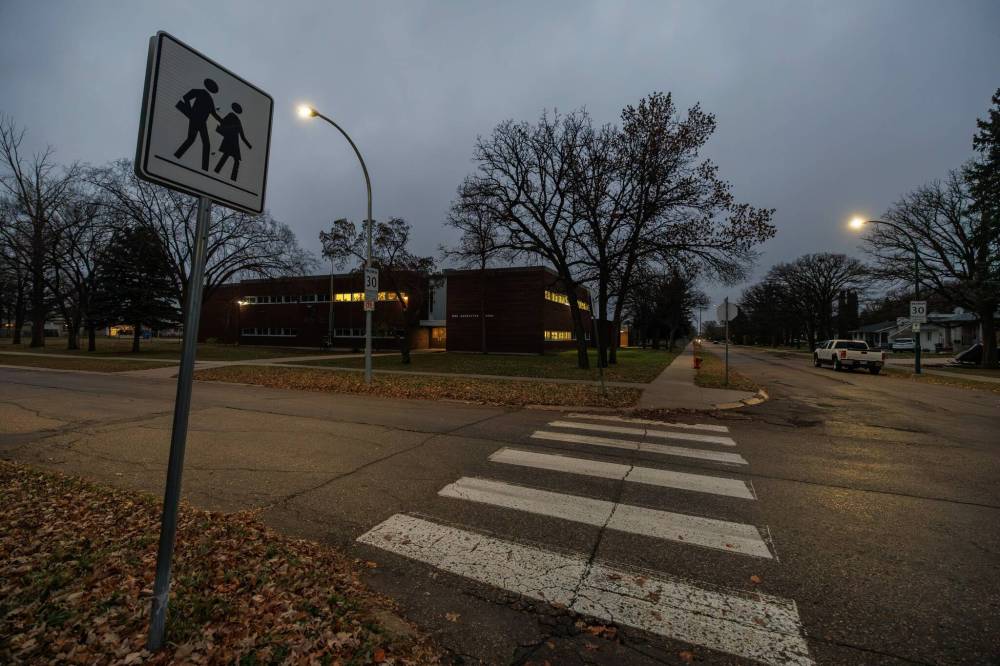
A pedestrian crosswalk near Bannatyne School on Thursday morning just after 8 a.m. The sun was expected to rise at 8:24. (Mike Deal / Free Press)
Smith said in an email that the division, encompassing Deer Lodge, Westwood and surrounding areas, has no plans to adjust schedules at any of its kindergarten-to-Grade 12 buildings.
The newest iteration of the board is scheduled to host its first public meeting on Nov. 10. Among their duties, trustees serve as community liaisons who can bring local education issues to the attention of division administration and the provincial government.
St. James-Assiniboia leadership sent a letter to families last week to remind them their clocks weren’t to fall back an hour on Sunday.
In their memo, superintendent Jenness Moffatt and secretary-treasurer Michael Schroeder said most students would be walking or commuting to school “in pre-dawn light” between November and mid-March.
The letter included a list of nine tips for commuters “to support visibility” and better protect themselves, which include “chart a well-lit path to school,” wear bright clothing, and invest in LED walking gear, such as armbands or light clips, and reflective strips.
Pembina Trails and Seven Oaks school divisions contacted families with similar suggestions in memos sent on Wednesday and Friday respectively.
Winnipeg’s public elementary and secondary schools typically start classes between 8:15 a.m. and 9:15 a.m.
Canada’s sunrise calculator suggests that in Manitoba the sun is anticipated to rise at 9:27 a.m. on Jan. 1. (The federal government’s online tool has yet to be updated to reflect that Manitoba is now in MBT rather than CST.)
Caregivers, principals and road safety advocates have told the Free Press they’re concerned about how the changes will affect active transportation habits and visibility during morning rush-hour.
Maia Graham-Derham started getting involved with Streets for People Winnipeg because she was already concerned about safety issues in school zones.
“It’s not safe for me or my kids to move around outside of a vehicle,” said the mom of two students.
Graham-Derham said dim lights are a common problem, along with speeding and confusing reduced-school speed zone rules.
“Should my kids have to wear reflectors and hard hats and blinking lights just to be able to go to school or play in their playground?” she said.
“We could design our streets to say, ‘we just don’t want to kill kids.’”
Premier Wab Kinew gave residents about six weeks to prepare to permanently stay on daylight time, citing the results of an EngageMB survey with about 72,000 participants.
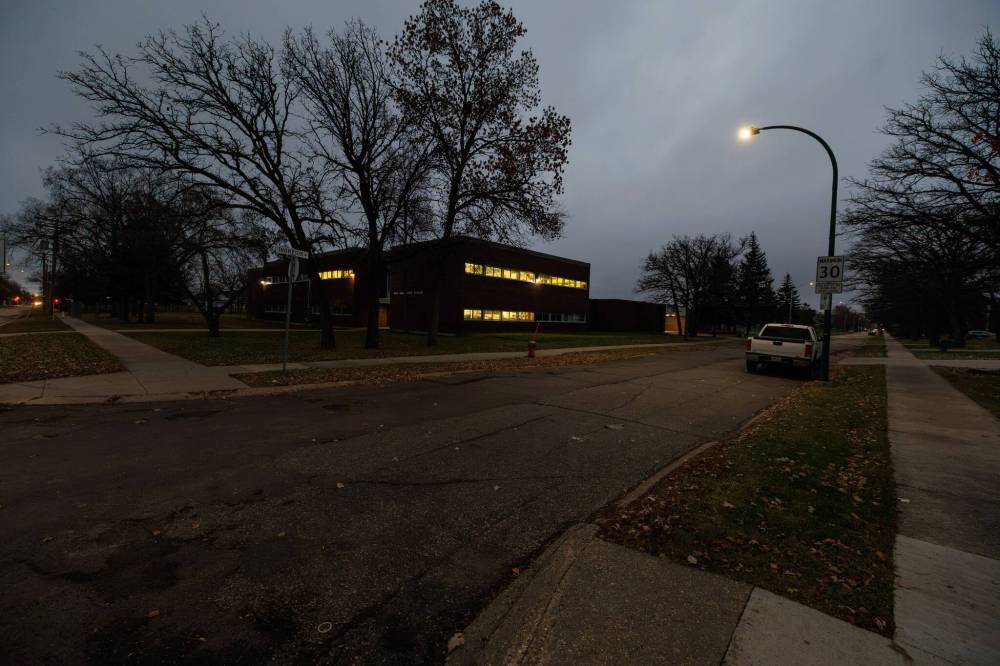
The streets around Bannatyne School at 363 Thompson Dr. are dark despite the streetlights just after 8 a.m. Thursday. (Mike Deal / Free Press)
“This was a shoot-from-the-hip reaction from the premier without much thought about how this would all rollout,” said Jeff Cieszecki, a teacher in northwest Winnipeg.
Nine in 10 voters indicated they wanted to stop changing clocks, but opinions on when the final adjustments should be made were varied.
Kinew sided with 58 per cent of voters. Just over a third of respondents, 34 per cent of them, wanted the province to adopt standard time on a permanent basis.
Cieszecki, president of the Seven Oaks Teachers Association, likened the decision to stop changing clocks on a biannual basis to Premier Wab Kinew’s recent proposal to ban YouTube, a key educational tool, in classrooms.
The latter — which Kinew pitched in May to be part of his yet-to-be-finalized plan to stop children and youth aged 15 and younger from using social media — sparked outcry across the K-12 sector.
Manitoba Teachers’ Society president Lillian Klausen condemned the idea to outlaw an app that members regularly use to access and screen educational videos.
Winnipeg Free Press | Newsletter

“Did you bother to ask?” said Cieszecki, who oversees an MTS local with approximately 960 members working in the Maples, Garden City and elsewhere in north Winnipeg.
Cieszecki noted key stakeholders weren’t consulted in any meaningful way ahead of either major announcement and now education officials are grappling with “scheduling chaos” and urging children to take extra precautions to commute to class in the dark.
“We went the wrong way,” he said.
His division’s recent memo appealed to motorists to use extra caution in school zones and “be alert for students who may be difficult to see in darker conditions, particularly during periods of snow, rain or reduced visibility.”
maggie.macintosh@winnipegfreepress.com

Maggie Macintosh
Education reporter
Maggie Macintosh reports on education for the Free Press. Originally from Hamilton, Ont., she first reported for the Free Press in 2017. Read more about Maggie.
Funding for the Free Press education reporter comes from the Government of Canada through the Local Journalism Initiative.
Every piece of reporting Maggie produces is reviewed by an editing team before it is posted online or published in print — part of the Free Press‘s tradition, since 1872, of producing reliable independent journalism. Read more about Free Press’s history and mandate, and learn how our newsroom operates.
Our newsroom depends on a growing audience of readers to power our journalism. If you are not a paid reader, please consider becoming a subscriber.
Our newsroom depends on its audience of readers to power our journalism. Thank you for your support.