
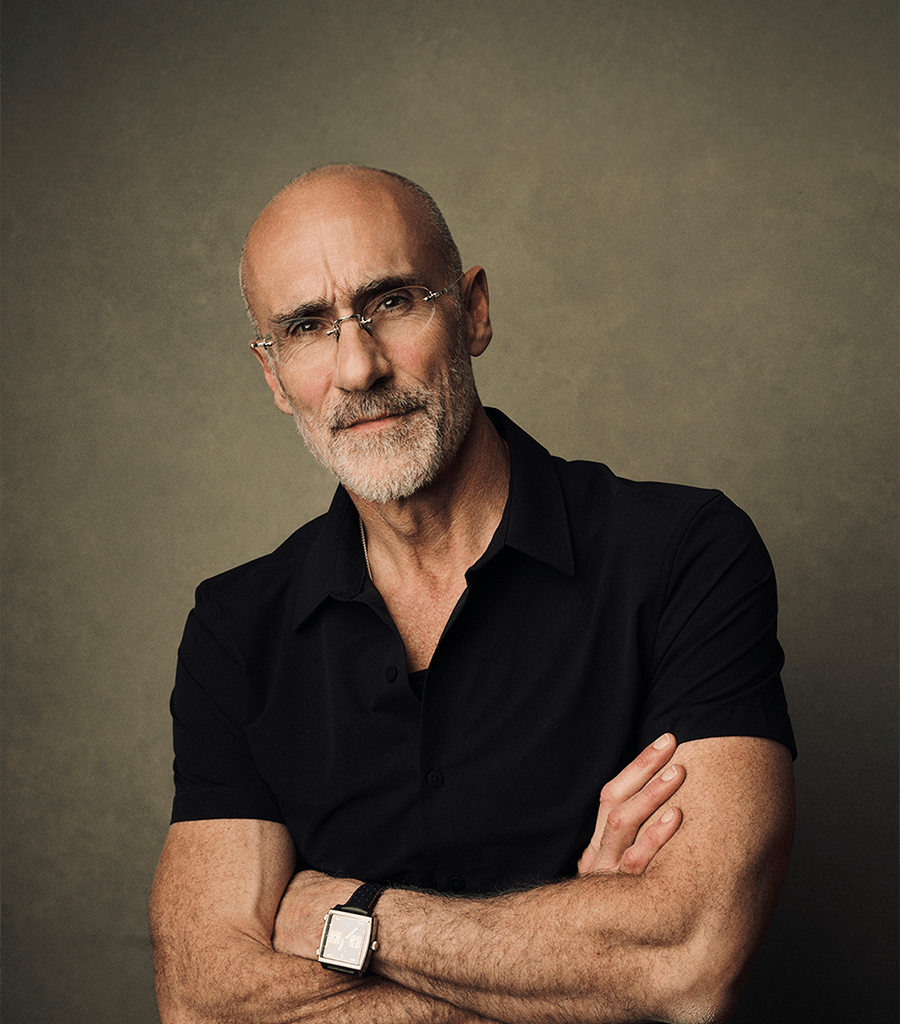
Arthur Brooks has spent years telling people that happiness is not a mood you wait for. It is a set of skills you build, the way you would build anything else. He teaches it at Harvard Kennedy School and Harvard Business School, writes it in bestsellers, and talks it through on his podcast. What he does not usually mention is where he practices it: a home gym, seven days a week, for an hour, starting 15 minutes after he wakes up.
If you have seen him on a podcast, you have probably noticed the other thing. The man has arms. Brooks will tell you, cheerfully, that this is not the point. He trains for his head. The biceps are what happens when you do that every day for decades without getting hurt.
That last part is the quiet discipline underneath everything. When he got serious about lifting in his 30s, Brooks went looking for the oldest fit men he could find in gyms across the country and asked them to teach him. What they handed him was less a program than a way of staying in the game. At 62, with a new book out and roughly eight percent body fat by his own count, he is still following it.
You’re in the gym every single morning. What are you actually there for?
“What I’m really working out for is the psychological, and that’s to say the neurobiological, benefit of it.”
The arms, he says, are the happy byproduct.
You’ve said you learned to lift from the oldest guys in the gym. Why them?
“I was starting to travel a lot for my work, and I would go to the oldest iron gyms I could find in every city. I would find the guys in their 70s who were ripped, and I would ask them to teach me. The reason is because they were old and still fit for a reason… they’re not getting hurt, and they have good discipline.”
They taught him form, how to build a session, and how to stay mobile: dumbbells over barbells, so the shoulders can move freely. He credits that advice with keeping him relatively injury-free ever since.
You study happiness for a living. Is the workout about getting happier?

Sign Up for the AGEIST newsletter
“My problem isn’t that I’m trying to get happier. I’m trying to manage negative affect.”
Does it have to be first thing in the morning?
“Anybody who works out hard in the morning is going to find that they have a clearer, better outlook on life because they’re not being distracted by a lot of the negative affect that they normally would.”
He is quick to add that the time of day is not the requirement. The work is.
“The worst thing you can do for mood management is to be sedentary. When you can get into the gym and do it, you should do it. That’s 90 percent of it. Work out hard, and that’s 90 percent.”
So what’s the other 10 percent?
The details: when he trains, how he trains, and lining both up with what the research on well-being suggests. He likes the early slot for how it fits his daily cortisol rhythm, and he prioritizes strength work over everything else. Then there is a reason no study will capture.
“I love having done the hardest physical thing of the day, first thing in the morning.”
Walk us through the week.
Because he trains daily, Brooks rotates rather than repeating full-body sessions: a push day, a pull day, a leg day, and an arms-and-shoulders day, each opened with 15 minutes of cardio. On push and pull days he adds one two-exercise superset for the legs before the upper-body work.
“I superset everything, because I’m rolling through everything for 60 minutes.”
Sign Up for the AGEIST newsletter
You use blood flow restriction cuffs on arm day. Why?
“To keep muscle mass, you need to move a significant amount of weight around. On arm day, that’s hard because you’re going to hurt your joints when you get older.”
The cuffs, which partially restrict blood flow to a working muscle, let him get the stimulus with lighter weights and less wear on the elbows.
“I love having done the hardest physical thing of the day, first thing in the morning.”
Try Arthur’s Arms-and-Shoulders Day
Two parts. Warm up with 15 minutes of easy cardio first.
Part 1: The giant set. Run the three moves back to back with no rest, stopping each one when you feel you could do about three more reps. Do the trio twice, then rest two minutes with a plank, a cobra pose, or back extensions. Repeat three times, six rounds total.
Incline dumbbell curl
Rope triceps pushdown
Standing dumbbell overhead press
Part 2: The finisher. Four sets each, one move after the other: 30 reps on the first set, 15 on sets two through four, 30 seconds of rest between sets. Brooks does these with blood flow restriction cuffs; you can skip the cuffs entirely and still get the work in. If you want to try BFR, talk to a trainer who knows the method before you do.
Dumbbell preacher curl, stopping at peak contraction rather than going all the way up
Overhead cable triceps extension
This article was adapted from superage.com
Don’t Miss