
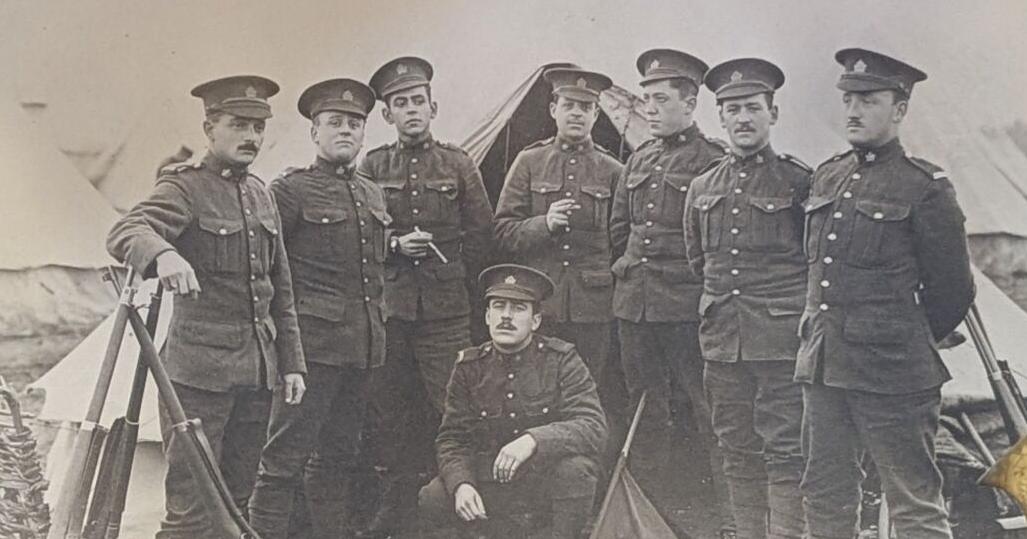
The Royal Montreal Regiment Museum has mounted an exhibit, as it does every year at this time, to mark Remembrance Day. This year’s exhibit, 112 years after the start of World War I — Le Sacrifice D’Ypres — is an homage to the French-Canadians who volunteered for military service, and to the Battles of Ypres, some of the most brutal engagements of what would come to be referred to as “the war to end all wars”.
It is the Battles of Ypres and their casualties that we all reference when reciting Lt. Col. John McCrae’s In Flanders Fields, and the reason we wear the poppy.
As politics shifted in Quebec during the Second World War, attitudes toward military service among the French-Canadian community were different than they had been during the Great War. Lieutenant-Colonel Retired Colin Robinson, former commanding officer of the RMR, points out, emphatically, that the French-Canadians had volunteered for service. “They absolutely, 100 per cent, wanted to volunteer to go fight for Canada,” Robinson says. Many of them were second-generation and living in the United States who “jumped on a train as soon as war broke out and came back into Montreal so they could sign up.”
The RMR was the only unit that was allowed to have sub-units led by French-speaking officers. “They received all their instructions, and all their drills, and all their orders in French, which was actually against regulations at the time.” Sir Sam Hughes, then Minister of Militia and Defense, was against allowing French-speaking units. The RMR did it anyway. The Royal 22e Régiment — the Van Doos — was formed months after.
The exhibit was designed by Amynte Eygun, assistant curator of the RMR Museum. Researching photos that the museum received as a donation, Eygun says they realized that the soldiers in the photos were French-Canadians of the RMR. “I felt very connected to them,” she says. “They were the same age as me.
“Ypres was really the big major battle that they fought in first, and it really affected them,” she explains. “So, I really wanted to represent their history, to show that the French-Canadians did sign up, and they did fight, just as much as the English.”
The exhibit includes photos of the young French-Canadians of the RMR, with names like Pte. Émile Fournier, Sgt. Émile Martin, and Lt. Henri Desrosiers.
Canada was a very young nation when the war broke out. In many ways, World War I is when Canada lost its innocence. The 20th century, Eygun suggests, really only began, socially and culturally, after WWI. “The men were really 19th century men fighting a 20th century war.”
Men and women signing up for World War II had the first war as a reference. “Everybody who signed up for World War II most likely had a family member who fought in World War I, so they knew what they were up against,” Eygun says. They didn’t in World War I.
The horrors of war cannot be understated, but it was more acute during WWI. To illustrate that fact, the exhibit features the story of Pte. Delphis Godard. Long before shell-shock, battle-fatigue, and PTSD entered the vernacular, men returning from war psychologically-damaged were called “hysterical” or “insane.” Godard, whom the newspapers referred to as the “legless veteran,” had volunteered with the RMR in September 1914, and fought in Ypres. He lost his legs due to shrapnel wounds two years later.
Shipped home to Montreal, Godard tried to build a life. In 1923, he married 19-year-old Suzanne Colin. Months later, he would strangle her to death in a state of mania that we would today call untreated PTSD.
Le Sacrifice d’Ypres is on at the Royal Montreal Regiment Museum in Westmount until November 15.