
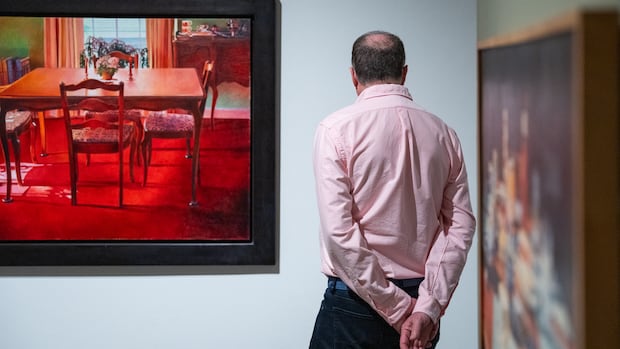

Listen to this article
Estimated 5 minutes
The audio version of this article is generated by AI-based technology. Mispronunciations can occur. We are working with our partners to continually review and improve the results.
Nearly-empty jam jars gleaming like jewels. A woman looking through binoculars on the deck of a ferry, as expressionless as the open sky behind her. A grey ship in greyer water, barely visible through falling snow. These scenes are the sort of slice-of-life moments that the Atlantic Realists — a group of artists who got their start in 1960s New Brunswick — captures.
“I think it’s really about the significance of the everyday,” says Ray Cronin, director of the Marion McCain Institute for Atlantic Canadian Art at the Beaverbrook Art Gallery. A former journalist who’s written books on many of the Atlantic Realists, he says that this is artwork with an important reminder for modern life, even if it was made decades ago.
“It’s not that you have to invent castles in the air,” he says, “It’s that there’s as much wonder and significance in an apple on your desk as there is in anything else. I think that’s something that is very important for us as human beings to see: It’s about being present in your life, present in the world. ”
Comprising artists Alex Colville, Tom Forrestall, Christopher Pratt, and Mary Pratt, the Atlantic Realist movement is, as Cronin says, one of the most important artistic movements in the country’s history. Colville, especially, stands out: He was an art teacher to the others, who Cronin refers to as “Colville’s three most famous students,” at Sackville, N.B.’s Mount Allison University.
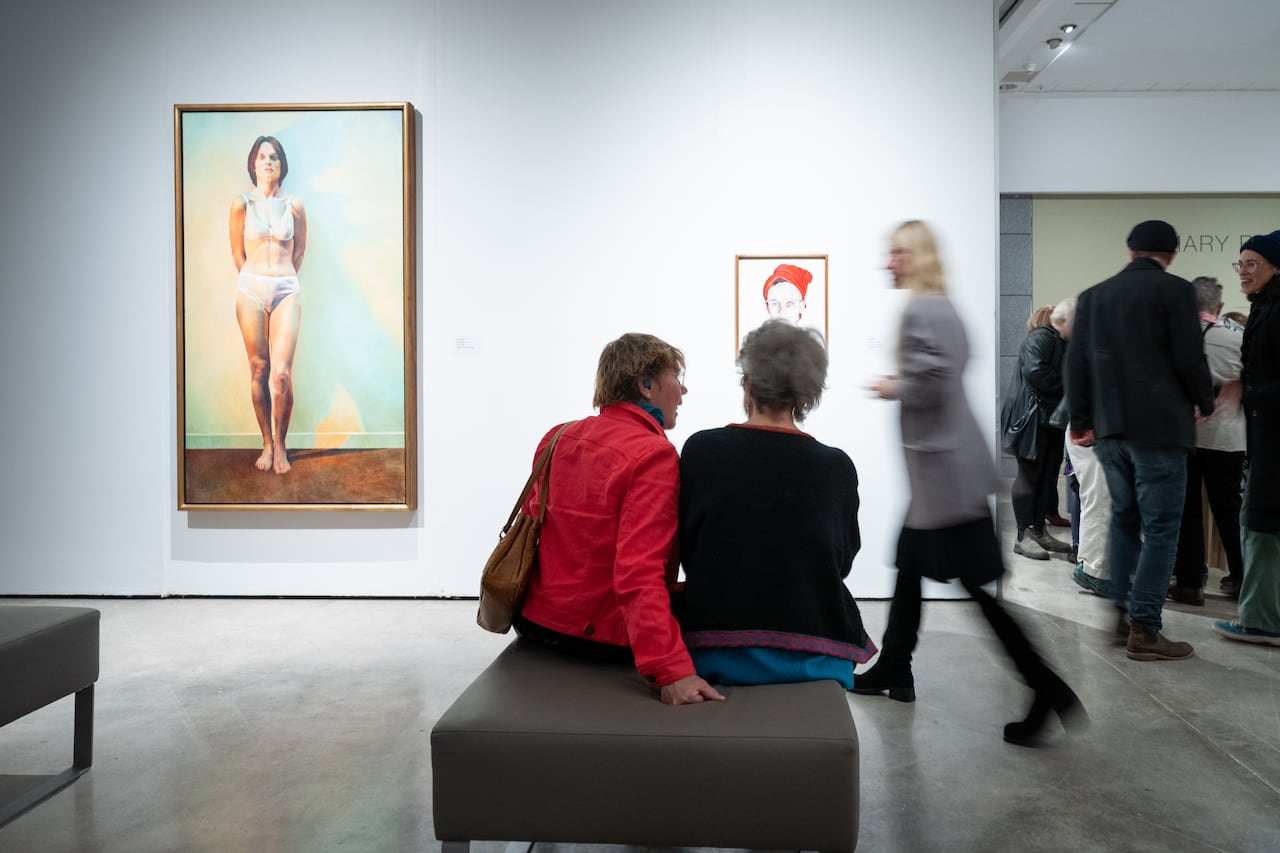
Audiences at the Work Behind the Work at the Art Gallery of Nova Scotia. (Courtesy of the Art Gallery of Nova Scotia/Dean Casavechia)
While these artists themselves often chafed against being grouped together into a single movement Cronin takes care to explain how each artist’s style varied a lot — they did have a unifying preoccupation with capturing every day moments on canvas.
While museums and galleries across the nation have Colvilles and Pratts displayed as part of their permanent collections, the chance to capture the movement’s breadth and depth can be rare — until now. Colville, Forrestall, Pratt & Pratt: The Work Behind the Work, on view at the Art Gallery of Nova Scotia in Halifax until Jan. 24 2027, offers a chance to see works by these pillars of Canadian art, all together. It also, as AGNS Chief Curator David Diviney says, gives a glimpse into how these great artists made their landmark works.
“These are four artists who are very familiar to the community here in Atlantic Canada,” he says “They have made works that have captured the popular imagination, and I feel that audiences here and abroad truly see themselves reflected in the images that they’ve made,” he says.
By putting the preparatory sketches on view alongside these famed finished works, Diviney says that showgoers will get to see the art making process more clearly. He likens it to watching the long journey that an artist takes from first inspiration to final product, a peek behind the metaphorical curtain that “demystifies” the work and how it was created. (Diviney is also the show’s co-curator.)
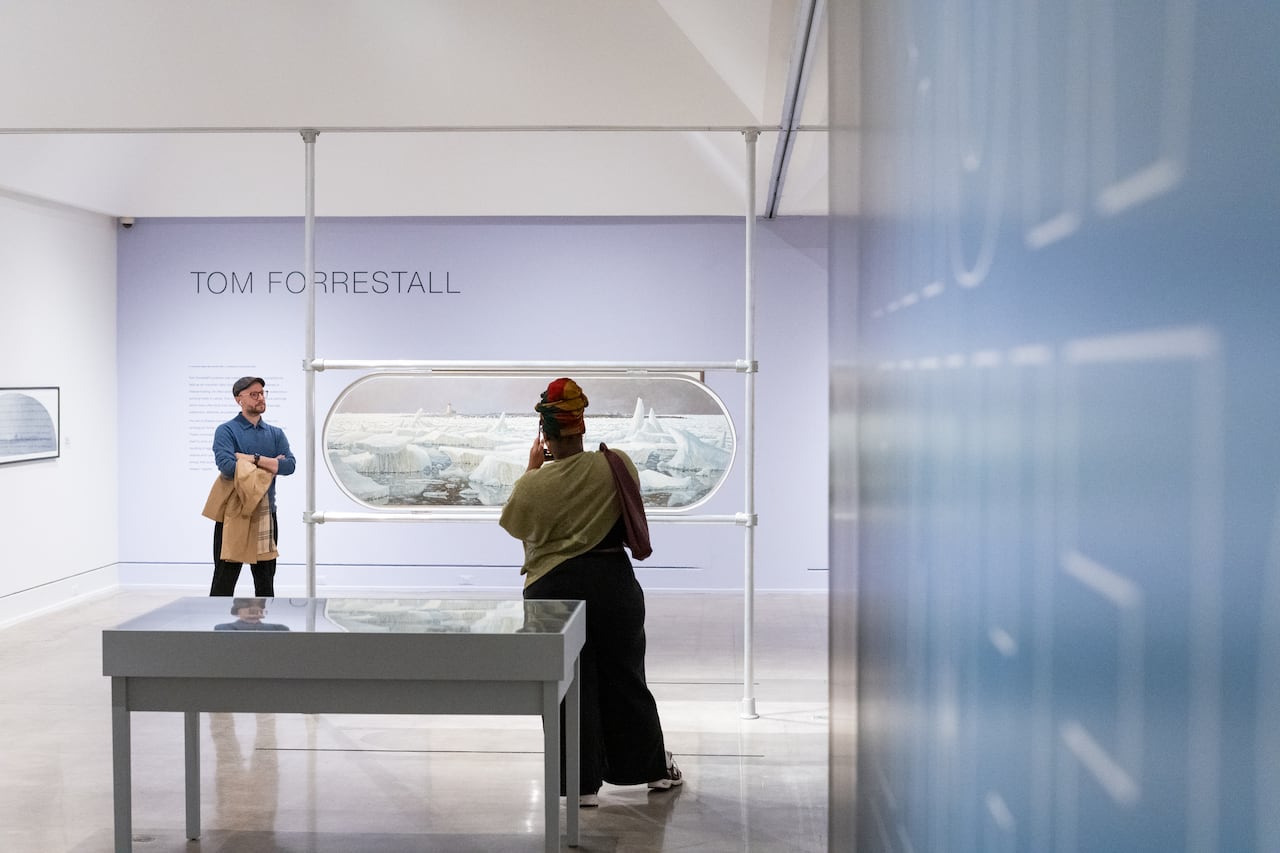
Audiences at the Work Behind the Work at the Art Gallery of Nova Scotia. (Courtesy of the Art Gallery of Nova Scotia/Dean Casavechia)
Cronin explains that this high level of technical skill — and a commitment to representational accuracy — are hallmarks of Atlantic Realism. Diviney agrees: “Each of them is leaning into a more representational style of image making that is rooted in intellectual rigour, technical precision and careful observation of the world around them.”
This, Diviney explains, is why having preparatory sketches — and even a few of Mary Pratt’s diary entries — on view alongside finished works makes Colville, Forrestall, Pratt & Pratt: The Work Behind the Work feel extra-special: It feels like the art world equivalent of listening to the demos of your favourite band, or seeing behind-the-scenes footage from your favourite director.
While Atlantic Canada was becoming known for folk art, and the rest of the art world was focusing on abstraction, the artists in this show broke away from the trends as they remained committed to making a record of life where they were, the way they lived it. From Mary Pratt’s focus on domestic spaces to Tom Forestall’s love of landscapes, Diviney says the subject matter and the rigor it was treated with is what makes the legacy of the so-called Atlantic Realists endure, adding that Colville, in particular, “really looked at painting not as a direct transcription of reality, but as a disciplined construction of ideas about it. He relied on this rigorous geometric planning and mathematical calculation to generate an imposed sense of order and balance that exceeds what’s observable.”
By combining familiar surroundings, everyday scenes and personal experiences, all the artists — and Colville in particular — created works that Diviney says “result in symbol-like compositions that meditate on the human condition. And, as a result, I think a door opens in the images he has given us, allowing each of us to bring our own intuition and experience to how we read them. And I think people see themselves reflected in these works.”
Colville, Forrestall, Pratt & Pratt: The Work Behind the Work runs until Jan. 24, 2027 at the Art Gallery of Nova Scotia (1723 Hollis St.) in Halifax.