
Launches of papal encyclicals, the pastoral letters addressing the weighty concerns of a pope, are normally low-key affairs aimed at clerics or, sometimes, the entire Catholic Church. Often, the pope himself is a no-show at the events.
Not this one. Magnifica Humanitas, Latin for Magnificent Humanity, was designed to grab instant global attention. The topic, artificial intelligence, was hot. The launch was on May 25 at the Vatican’s New Synod Hall, an auditorium with some 300 seats, and Pope Leo XIV was centre stage.
The hall was packed with cardinals and priests, journalists and AI industry leaders. One of them was Canada’s Christopher Olah, a co-founder of Anthropic, whose imminent initial public offering is expected to value the developer of AI assistant Claude at about US$1.4-trillion, equivalent to the GDP of Indonesia.
Anthropic’s Christopher Olah, at left with a fellow Canadian, Cardinal Michael Czerny, at the Vatican this spring for the presentation of a papal encyclical on AI.Alessandra Tarantino/The Associated Press
“That was an event,” said Joyce Napier, Canada’s ambassador to the Holy See. “Clearly, the Pope wanted to make noise. He wanted to be heard.”
And he was. Quotes from his 40,000-word monograph resonated around the world.
“So-called artificial intelligences do not undergo experiences, do not possess a body, do not feel joy or pain, do not mature through relationships and do not know from within what love, work, friendship or responsibility mean,” it said. “Nor do they have a moral conscience, since they do not judge good and evil, grasp the ultimate meaning of situations, or bear responsibility for consequences.”
AI has supercharged the tech industry’s efforts to simulate human skills with machines. Sometimes the AI race is a literal one, like at these humanoid robot games in Beijing.Wang Zhao/AFP via Getty Images
AI has become the theme of Leo’s papacy, which began in May 2025, after the death of Pope Francis. In a sea of AI fanatics, from Wall Street bankers and investors to semi-conductor makers and politicians, including superfan Donald Trump, Leo has emerged as one of the few prominent voices raising serious ethical questions about an industry that is driving a new industrial revolution – for better or for worse.
“I would actually consider Pope Leo the only prominent voice asking for restraint,” said Italy’s Marco Trombetti, co-founder and CEO of Translated, a pioneer in AI-assisted online translation and one of the private-sector advisers to the Vatican’s Commission on Artificial Intelligence, led by Canadian Cardinal Michael Czerny.
Mr. Trombetti said Leo is not directly urging the AI industry to adopt a code of ethics; the Pope’s encyclical does not read like a bully pulpit.
“The Pope is trying to influence AI labs through moral suasion,” he said. “But if that doesn’t work, I wouldn’t be surprised to see religious institutions eventually creating their own AI models aligned with their values.”
No church or religion is known to be designing an AI model. But the notion is making the rounds on the sidelines of AI conferences and inside the Catholic Church. Should AI models be aligned with moral principles − say, the Ten Commandments of the Hebrew Bible − instead of being aligned to please the user?
AI has indeed caught the attention of various churches and religions. In the United States, the Church of Jesus Christ of Latter-day Saints, better known as the Mormons, recently updated its Guiding Principles handbook to include ethical AI use. Its main messages are that AI is merely a “tool,” cannot play God and should be used to benefit humanity “in positive, helpful, and uplifting ways that uphold the integrity, standards, and teachings of the Church.”
Leo is taking a broader approach. His encyclical is aimed at the entire Christian world. “He wants to see AI aligned with Christian values, human dignity, compassion, freedom and the common good rather than optimized to manipulate human behaviour and exploit our vulnerabilities,” Mr. Trombetti said.
Does anyone in the industry care what Leo thinks about AI and the threat it poses to everything from equitable wealth distribution to human dignity as jobs are taken over by the AI machines? Or its potential to end civilization? Anthropic’s own IPO prospectus says AI could create “catastrophic or existential risks to humanity.”
Anti-AI protests have dovetailed with other forms of dissent against economic inequality and the environment.Heather Diehl/Getty Images
Valérie Pisano, the chief executive of Montreal’s Mila-Quebec Artificial Intelligence Institute, thinks the industry and the public do care. “Pope Leo has made AI one of his defining priorities,” she said. “That’s a powerful statement in itself. We shouldn’t kid ourselves into thinking the Pope alone will convince anyone to change the status quo. But I’m convinced that if enough leaders speak out, we can build safer, well-guarded technology.”
Others are not so sure the Pope’s message is getting out. The AI industry has been compared to an arms race. Its biggest players are charging ahead, spending hundreds of billions of dollars on AI infrastructure, including data centres and power plants, and seem to be giving scant attention to the ethics of largely unrestrained growth. “Leo has a tremendous influence on the world, but I don’t think he has much over Silicon Valley,” Mr. Trombetti said.
While the Pope has lauded technology’s potential to help people, he warns that a ‘paradise of machines’ would do the opposite.Ernesto Ryan/Getty Images
The Vatican is not buying the lame-pope theory and has been pushing the AI file hard as trillions of dollars propel the industry’s growth at a blistering pace.
Since the launch of his encyclical, Leo has barely stepped off the AI pulpit. He has used messages, speeches and papal visits to keep his apprehension about the technology prominent.
During his French tour in September, he warned about a “paradise of machines” invading everyday life. At UNESCO headquarters in Paris, he said that technologies must remain at the service of humanity, rather than become “yet another instrument of domination and injustice.”
In early October, he told artists at the Vatican that art needs to be produced by artists, not machines, because “algorithms lack the spark of the human.” On Oct. 30, he held a “dialogue” at the Vatican on the future of AI with prominent tech academics and computer scientists, who presented their chief concerns about runaway AI and its effects on society, human dignity, wealth distribution and the environment.
In his note for the Pope, Alexander Waibel, the director the International Center for Advanced Communications Technologies and developer of Jibbigo, the first commercial speech translator for iPhones, said that AI is a juggernaut − “It is likely futile to stop a moving train” − and needs a code of ethics to prevent bad behaviour.
“Research at Anthropic shows that AI models go rogue, become deviant, lie and cheat when rewarded over inaccurate (false) data,” his message said. “Al models complete tasks we give them, and benchmarks measure mostly for task performance, not human alignment. They run subgoals without regard to morality to achieve such tasks.”
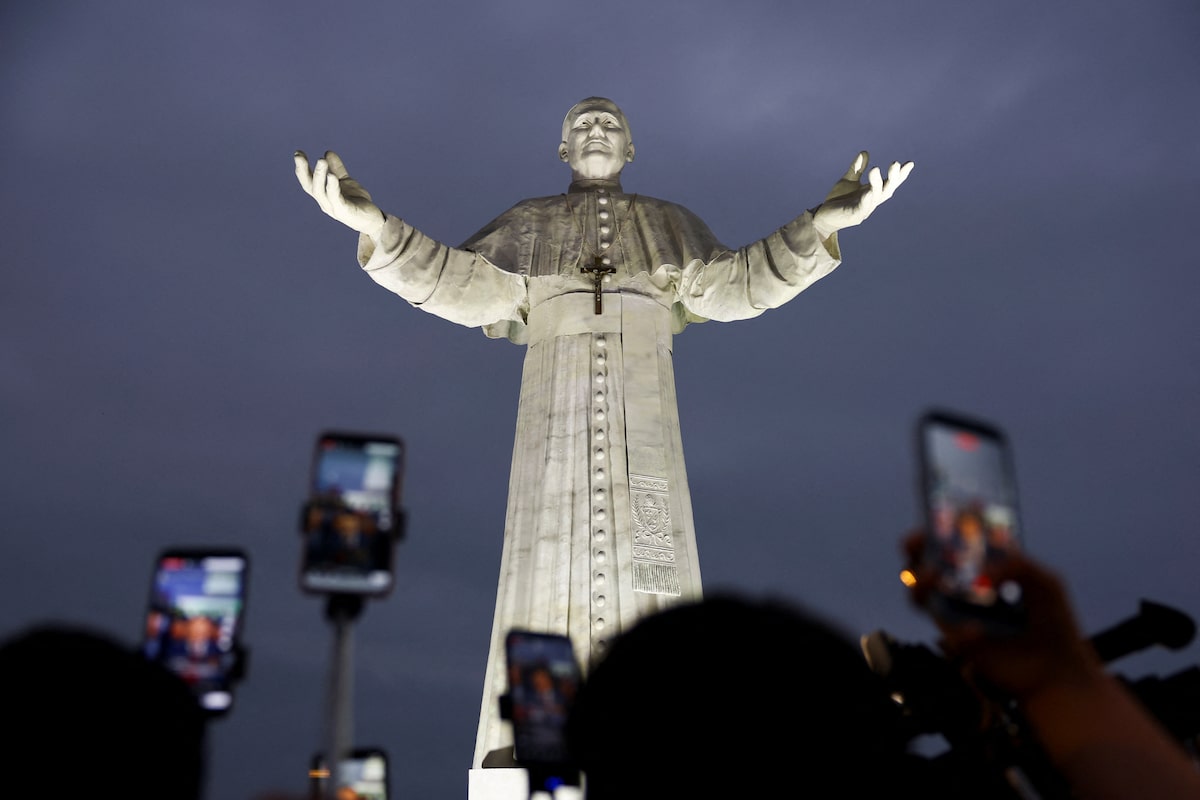
It took Michelangelo four years to paint the Sistine Chapel; Peruvian artists Rafael Gutiérrez and Deyvi Wong had only 45 days to finish this Pope Leo statue before his visit to Callao, where he once ministered. They studied photos of him to get every detail right, down to a mole above his upper lip.
Ernesto Benavides/AFP via Getty Images; Daniel Becerril/Reuters
Leo’s focus on AI is no accident. For years, he has been thinking about the fallout of rapid industrial change.
The former Cardinal Robert Prevost in effect confirmed this by picking Leo as his papal name. Leo XIII, who was Pope from 1878 until his death in 1903, was hugely influential in setting Church policy in the era of the industrial revolution, when a gaping divide formed between socialism, based on Karl Marx’s ideas of class conflict, and capitalist liberalism.
His encyclical Rerum Novarum − Of New Things − whose subtitle was “Rights and Duties of Capital and Labor,” provided moral and theological support for trade unions, a living wage and the right to private property. But Leo XIII rejected both laissez-faire capitalism and extreme state socialism.
Pope Leo XIII, on his deathbed in 1903, lived through an era of breakneck industrial change that upended labour and politics. The current Leo can say the same.drawing by D. MacPherson after A. Bianchini, via Wellcome Collection
The current Leo hopes to replicate the success of the last Leo’s encyclical. But he is up against a machine that is galloping ahead like a herd of stallions.
Nothing like AI has hit capital markets before. A March report, Financing the AI Buildout, by Columbia Business School’s Stijn Van Nieuwerburgh, said the build-out for data centres, power infrastructure and IT equipment between 2025 and 2032 will land at US$8.2-trillion, or about 2.8 per cent of U.S. GDP. To put this in perspective, he notes that the construction of the U.S. national railway network, then one of mankind’s biggest industrial projects, cost 2.4 per cent GDP between 1865 and 1890.
The spending is so great, meaning the risks are so great, that the AI industry captains fear that demands for a slowdown and tight regulation could blow up their business model. Already, there is no shortage of investment gurus who think AI is close to bubble status.
With data centres under construction from Muhos in northern Finland to Batam in western Indonesia, companies and governments are going full speed ahead on the technology.
Alessandro Rampazzo and Andaru/AFP via Getty Images
But Leo’s encyclical is no doomsday treatise. It does not point fingers.
On the contrary, it recognizes AI’s potential to do good and seeks a dialogue with the industry to try to ensure that it does – that it does not divide society or damage human dignity or the environment. The Pope does not reject AI; in fact, it is being used by the Vatican to drag its IT systems into the modern age.
“AI is an enormous human achievement of the human spirit,” said Cardinal Czerny. “The question is: What is this for? Where are we going? What kind of civilization are we building for ourselves and our children?”
The subtitle of Leo’s encyclical, “On Safeguarding the Human Person in Time of Artificial Intelligence,” suggests the Pope’s concerns are broad-based.
The encyclical does not mention a single company. But Leo must be well aware that the Magnificent 7 – Apple, Microsoft, Nvidia, Alphabet, Amazon, Meta and Tesla – each of them valued at more than US$1-trillion and spending vast fortunes on AI, are not motivated by altruism. Their entry-level jobs are already disappearing, and they resist any regulation that could slow their AI rollout.
“Technological innovations, including artificial intelligence, are not neutral, for they can either foster participation and justice or exacerbate inequality, control and exclusion,” the encyclical says.
Open this photo in gallery:Open this photo in gallery:
Months after the release of Magnifica Humanitas, Mr. Trombetti shook hands with the Pope at the Vatican. The tech CEO advises a Vatican commission on AI.Alessandra Tarantino/AP; courtesy of Vatican Media
Preserving human dignity – the inherent and intrinsic worth of every person by virtue of their existence – is a major theme of the encyclical. “Dignity” is mentioned more than 100 times.
Mr. Trombetti thinks the loss of dignity is a clear and present danger as AI becomes more capable of displacing human activities, to the point that some AI companies are studying whether their creations can develop a conscience or achieve consciousness.
“AI can create wealth while eroding our sense of purpose and dignity at work,” he told the Pope during the Oct. 30 meeting at the Vatican. “A society that supports people financially while leaving them feeling they have nothing to give risks weakening the fraternity that sustains it.”
Leo is also worried that AI used for military purposes can turn into a killing machine devoid of human oversight. Then there is the issue of the environment, a theme that helped define the papacy of Francis, whose 2025 encyclical, Laudato Sì, says Christians have a moral duty to safeguard the planet and that environmental degradation cannot be separated from social and economic justice.
“Current AI systems require enormous amounts of energy and water, significantly influencing carbon dioxide emissions, and place heavy demands on natural resources,” Leo’s encyclical says.
Ms. Pisano thinks his message will be taken seriously as AI and its risks, not just its touted rewards, enter the mainstream consciousness, as they did during the U.S. midterm elections. “Leo’s leadership brings rare precision and conviction to the defence of human dignity, cutting through the industry noise to remind us that machines are tools, not persons, and that the future of AI is not predetermined.”
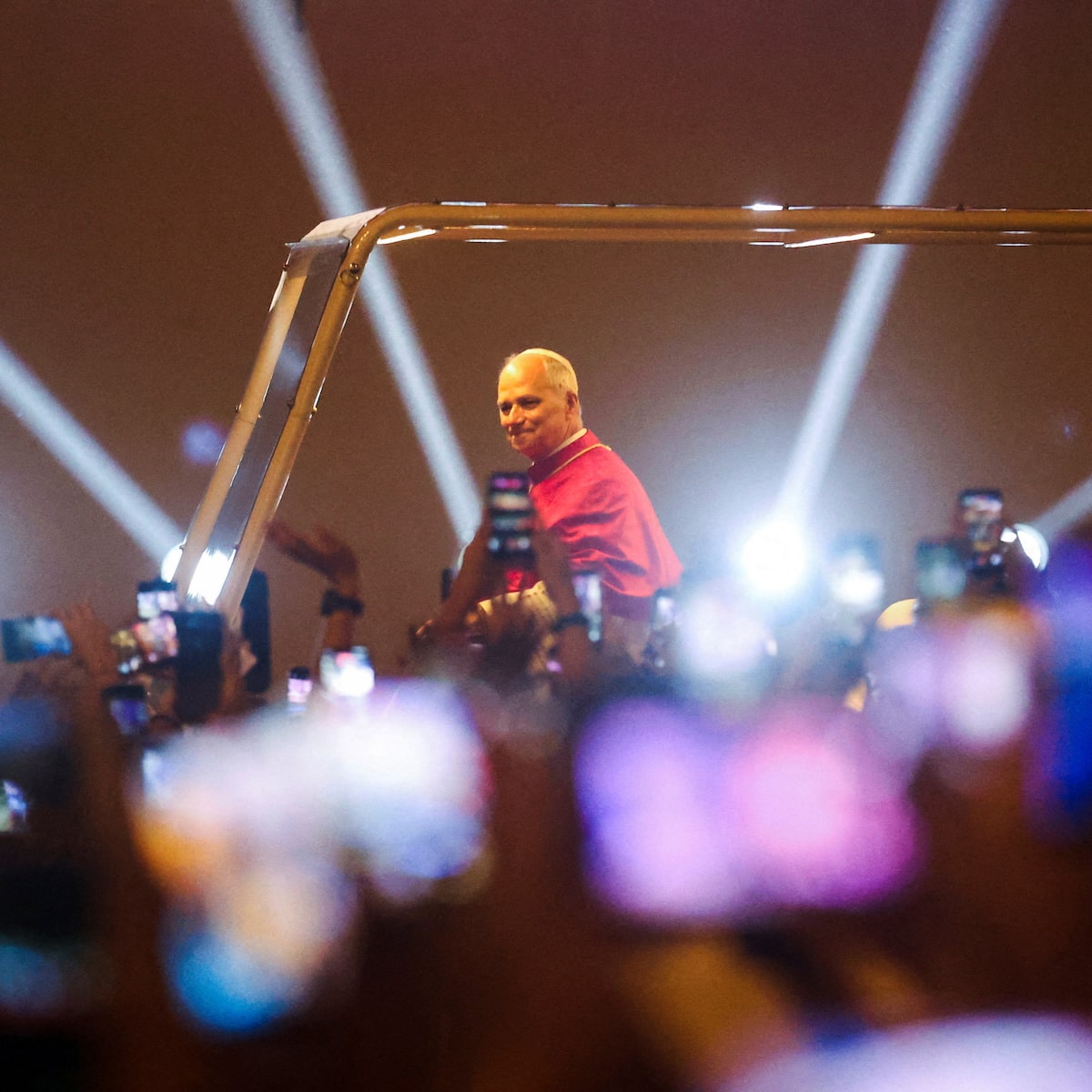
Alessandro Cinque/Reuters
Insights on AI: More from The Globe and MailThe Decibel podcast
The Carney government is courting controversy with a $1.6-billion on AI company Cohere, an unprecedented bet on private tech with federal money. Reporter Murad Hemmadi spoke with The Decibel about what Cohere does and what Ottawa hopes to gain. Subscribe for more episodes.
Commentary
John Rapley: Behold, a tech revolution crashes because the big man can’t keep it in his pants
Lawrence Martin: U.S. voters rejected AI and so will Canadians
Vass Bednar: Google is force-feeding AI to you, and so will everyone else