
Follow us
Add us as a preferred source on Google
Newsletter
Subscribe to our newsletter
Using the Large Hadron Collider (LHC), the world’s largest particle accelerator, scientists have gotten the first glimpse of the “zeptoverse” — the universe as it behaves within less than a hundred-trillionth of a wavelength of visible light, the smallest scale that researchers have explored to date.
The new findings may one day help to answer long-standing cosmic mysteries, such as why there is far more matter than antimatter seen in the universe, and what makes up the dark matter that constitutes about 85% of all matter in the universe, the researchers announced Nov. 3 at a seminar at CERN (the European Organization for Nuclear Research), the organization that operates the LHC. The study, available as a preprint, has not yet been peer reviewed.
Latest Videos FromLive Science
You may like
Peering into the zeptoverse
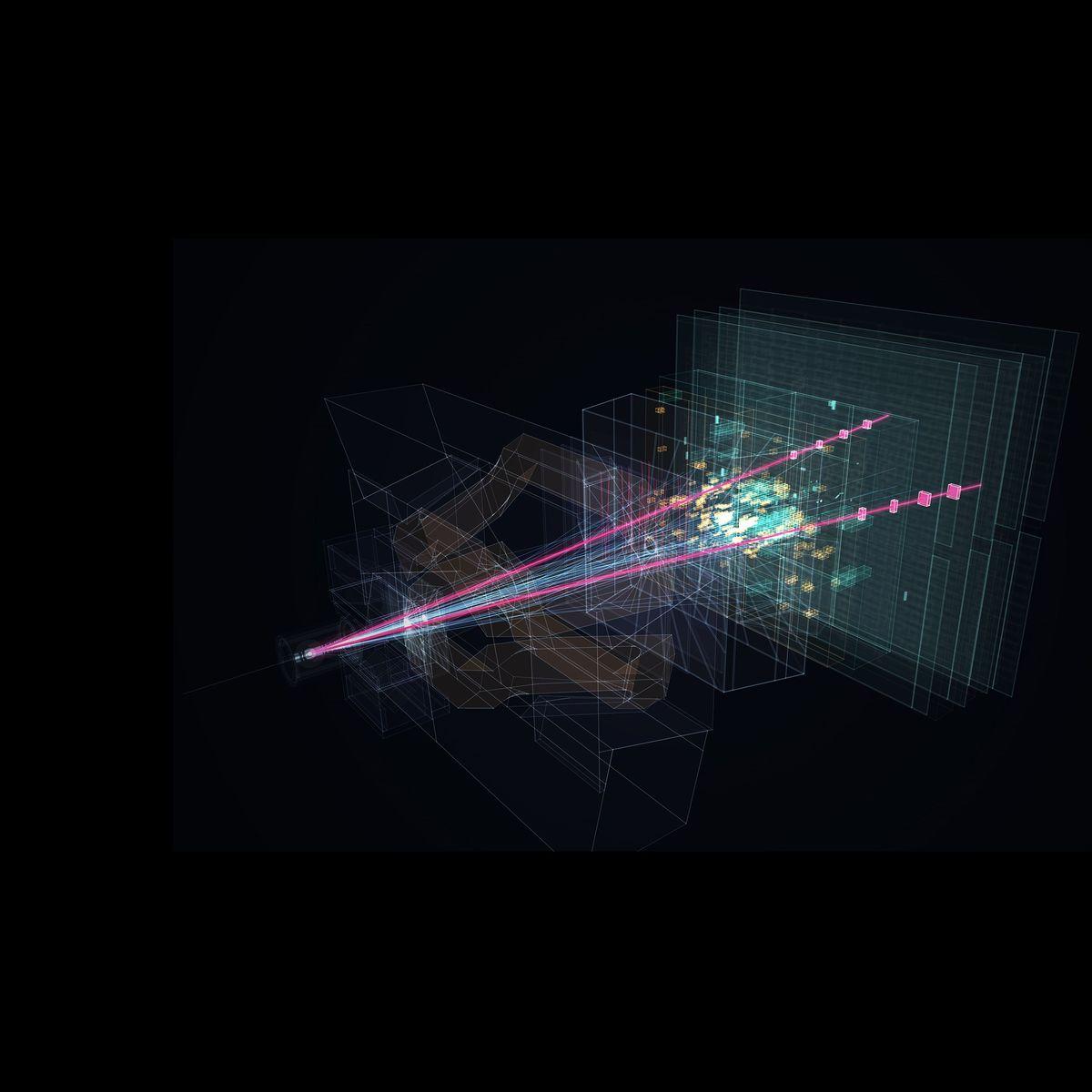
An artist’s visualization of a beauty particle decaying into two muons.
(Image credit: LHCb Collaboration / Federico Leo Rede)
We’re now recording in a single year what took 10 years to record in the past.
Harry Cliff, particle physicist
What to read next