
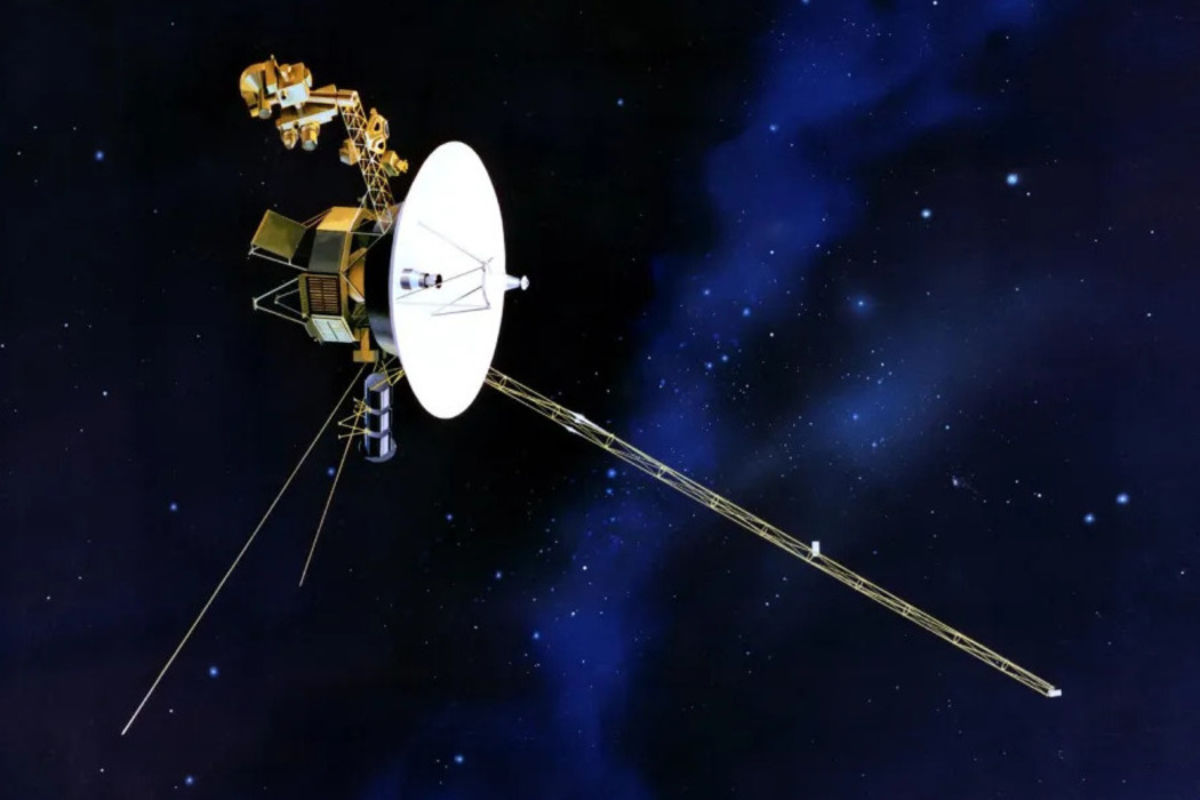
In the early hours of Wednesday morning, long before sunrise in Canada, an ancient space probe about the size of a Mini Cooper that has been sailing through the void for almost 50 years will reach a distance milestone never before achieved.
At precisely 10:17:07 UTC (a little after 5:00 am ET), Voyager 1 will become the first human-made object to travel one light-day’s distance from Earth. It won’t stop there. In fact, it’s never coming home. It’s barely even slowing down.
What is Voyager 1?
Voyager 1 (and its sister ship, Voyager 2) is an interplanetary space mission. Back in the 1960s, Caltech scientist G.A. Flandro calculated that a spacecraft from Earth could visit Jupiter, “slingshot” past it to head to Saturn, and then continue to Uranus and Neptune, visiting all four gas giant planets in a single trip, a so-called “grand tour.”
But those four planets don’t line up very often, only once every 175 years. The last time it had happened was in 1801, long before Neptune was even discovered, never mind space travel. The next window will be around 2152. But right in the middle was 1977. The race was on. On Sept. 5 of that year, Voyager 1 lifted off for the journey of a lifetime.

A Titan-Centaur 7 lifts off from Launch Complex 41 at Cape Canaveral Air Force Station, sending an 1,800-pound Voyager spacecraft on an odyssey through the outer planets. Handout / NASA
How fast is it travelling?
Voyager 1 is hurtling out of the solar system at almost 17 km per second. If you spend five minutes reading this article, it will have travelled the distance from Vancouver to St. John’s in that time.
How far is a light day?
It’s the distance light travels in a day; rounding up, 26 billion kms.
The speed of light (just a shade under 300,000 km/s) is so fast it could circle the world seven times in a second. The moon, which takes astronauts almost four days to reach, is just over one light-second away. The distant sun, about eight light-minutes.
So a light day is the speed of light — 299,792.458 kms times the number of seconds in a day, which comes to 25,902,068,371 kms. If you started running a marathon every day on your 15th birthday, and you lived to be 100, AND you got 20,000 of your high-school friends to do the same, you’d come close to it. It’s huge.

Voyager 2 captured the first detailed images of Uranus in 1986 (left) and Neptune in 1989. Handout / NASA
What is the probe doing?
Exploring. Voyager is equipped with instruments to detect plasma, high-energy particles, magnetic fields, radiation and more. It has cameras, though they were turned off decades ago, there being not much to see in interstellar space.
Voyager flew past Jupiter in March of 1979, just a year and a half after launch. Another 18 months brought it to Saturn, where a planned close encounter with the ringed planet’s moon Titan bent its trajectory, meaning no more planetary encounters.

The trajectories of Voyager 1 and 2 are shown on this map. Handout / NASA
Voyager 2, meanwhile, raced past Uranus in 1986 and, three years after that, Neptune. (Pluto, since demoted to dwarf planet, wasn’t in the lineup but did get its own visitor, the New Horizons probe, in 2015.)
Voyager 1 crossed into interstellar space in August 2012, and Voyager 2 a few years later, in November 2018.
Along the way, they discovered active volcanoes on Jupiter’s moon Io, the first evidence of liquid-water oceans under its moon Europa, a complex atmosphere on Titan, and nitrogen-ice geysers on Neptune’s moon Triton. They also discovered dozens of new moons and details about the planets’ rings.
Voyager 1 also took one of the most famous (and trickiest) photographs in history, the so-called Pale Blue Dot, an image of Earth against the glare of the sun, from the depths of space. Astronomer Carl Sagan argued for it, and on Feb. 14, 1990, Voyager looked over its shoulder, snapped a picture, and sent us a Valentine’s Day present.

The Pale Blue Dot, taken Feb. 14, 1990. The Earth is the tiny spot in the sunbeam at the right. Handout / NASA
“Look again at that dot,” Sagan wrote. “That’s here. That’s home. That’s us. On it everyone you love, everyone you know, everyone you ever heard of, every human being who ever was, lived out their lives … on a mote of dust suspended in a sunbeam.”
What else did Sagan do?
He led a committee that created a message for any extraterrestrial life that might one day find Voyager. It’s a gold-plated record full of sounds, music, pictures of Earth and greetings in 55 different languages.

Both Voyager probes carry a golden record, The Sounds of Earth. Handout / NASA
Does Voyager have a Canadian connection?
It does!
Lyle Broadfoot of the University of Saskatchewan led the ultraviolet spectrometer team. Fellow Canadian Jack McConnell, an atmospheric expert, worked under him. And the Canadian Space Agency notes that Voyager’s instruments are attached to a Canadian-designed boom. (Canada seems to have a thing for designing space arms.)

This archival image taken at NASA’s Jet Propulsion Laboratory on March 23, 1977, shows engineers preparing the Voyager 2 spacecraft ahead of its launch later that year. Handout / NASA
How long will Voyager 1 travel?
Forever.
The ship has a radioisotope thermoelectric generator — think of it as a nuclear battery — that has been producing power for almost 50 years but is almost out of energy. When that happens, likely in the early 2030s, Voyager will still sail on, speedy and silent, into the void.
In another 300 years (give or take) it will have travelled a light-week from home. In the early years of the fourth millennium, a light-month. And one day in about the year AD 19948 it will have travelled one light year.
20,000 years after that, Voyager 1 will drift past another star, Gliese 445, at a distance of a little more than a light year.
“The Voyagers become our silent ambassadors, a little bit of us that continues into space,” Linda Spilker, a long-time member of the Voyager team, told Science News. “It may well outlast humanity.”

NASA produced this retro poster to celebrate some of Voyager’s milestones. Handout / NASA
What is NASA doing to mark this occasion?
On Thursday at noon ET, NASA’s Jet Propulsion Laboratory will meet with mission members to discuss the status of Voyager 1 and 2, their ongoing science mission, and the challenges of keeping them operating for so long over such vast distances. NASA is also working on a documentary, planned for release next year for the mission’s 50th anniversary.
Meanwhile, they invite anyone with a phone or flashlight to step outside after dark on Tuesday night and send VGR, Voyager’s call sign, into the night in Morse code. VGR is dot-dot-dot-dash, then dash-dash-dot, and then dot-dash-dot.
If you miss the chance or it’s cloudy, you can always do it another night. In fact, your great-great-great-great-grandchildren could do it. Voyager 1 will still be out there.