
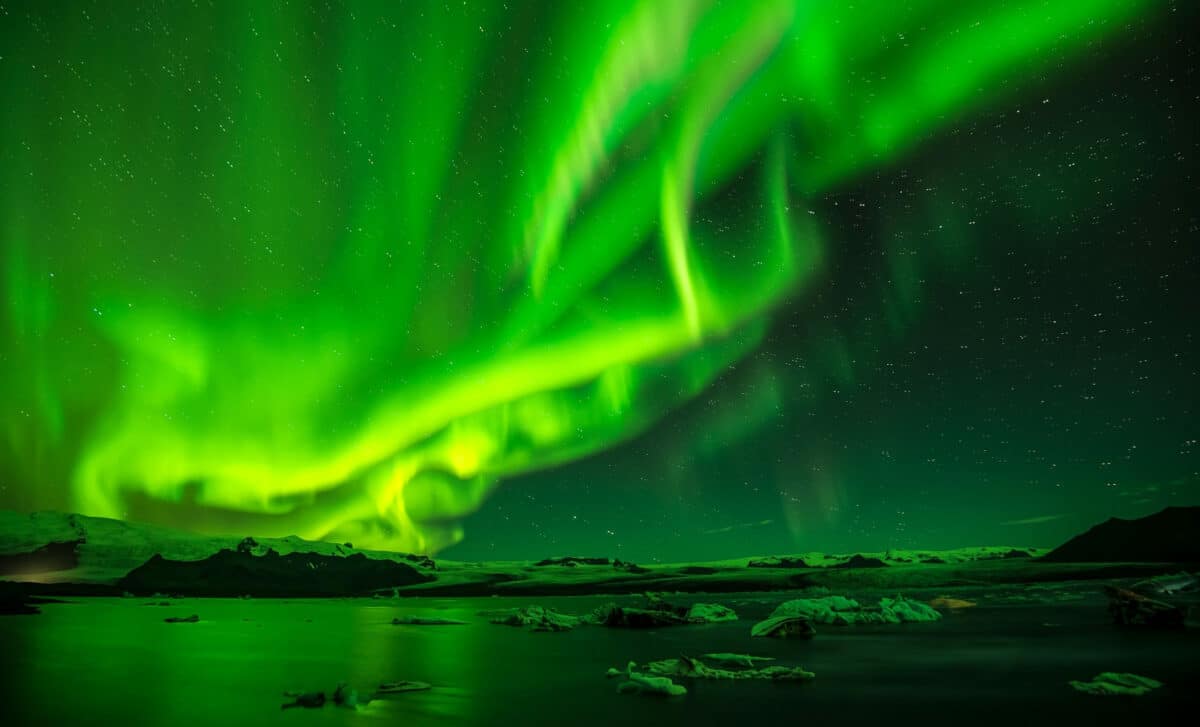
As night falls on Tuesday, November 17, a faint green glow may appear low on the northern horizon along the US-Canada border. Two disturbances from the Sun are expected to reach Earth within hours of each other, and their combined effects could shake up Earth’s magnetic field enough to push the northern lights farther south than usual.
Neither event is particularly strong on its own, but their timing has prompted a formal geomagnetic storm watch and raised the chances of seeing the aurora well beyond the Arctic.
A Minor Geomagnetic Storm With Two Drivers
NOAA’s Space Weather Prediction Center (SWPC) has issued a G1 watch for November 17 and 18, 2026. Forecasters expect isolated G1 (Minor) geomagnetic storms late on November 17 and into the early hours of November 18. The watch was issued at 13:34 UTC on November 15 and remains in effect for both days. According to Watchers, the Kp index is expected to reach 4.67 during the three-hour periods spanning 21:00 UTC on November 17 through 03:00 UTC on November 18.
That forecast sits almost exactly at the threshold for a minor geomagnetic storm.
The Kp index measures disturbances in Earth’s magnetic field on a scale of 0 to 9, with SWPC’s G1 storm category beginning at Kp 5. In the agency’s notation, a reading of 4.67 is written as “5-”, placing it at the lower edge of storm conditions. The contrast with recent activity is considerable: the highest Kp recorded over the preceding 24 hours was just 1, nowhere near storm strength.
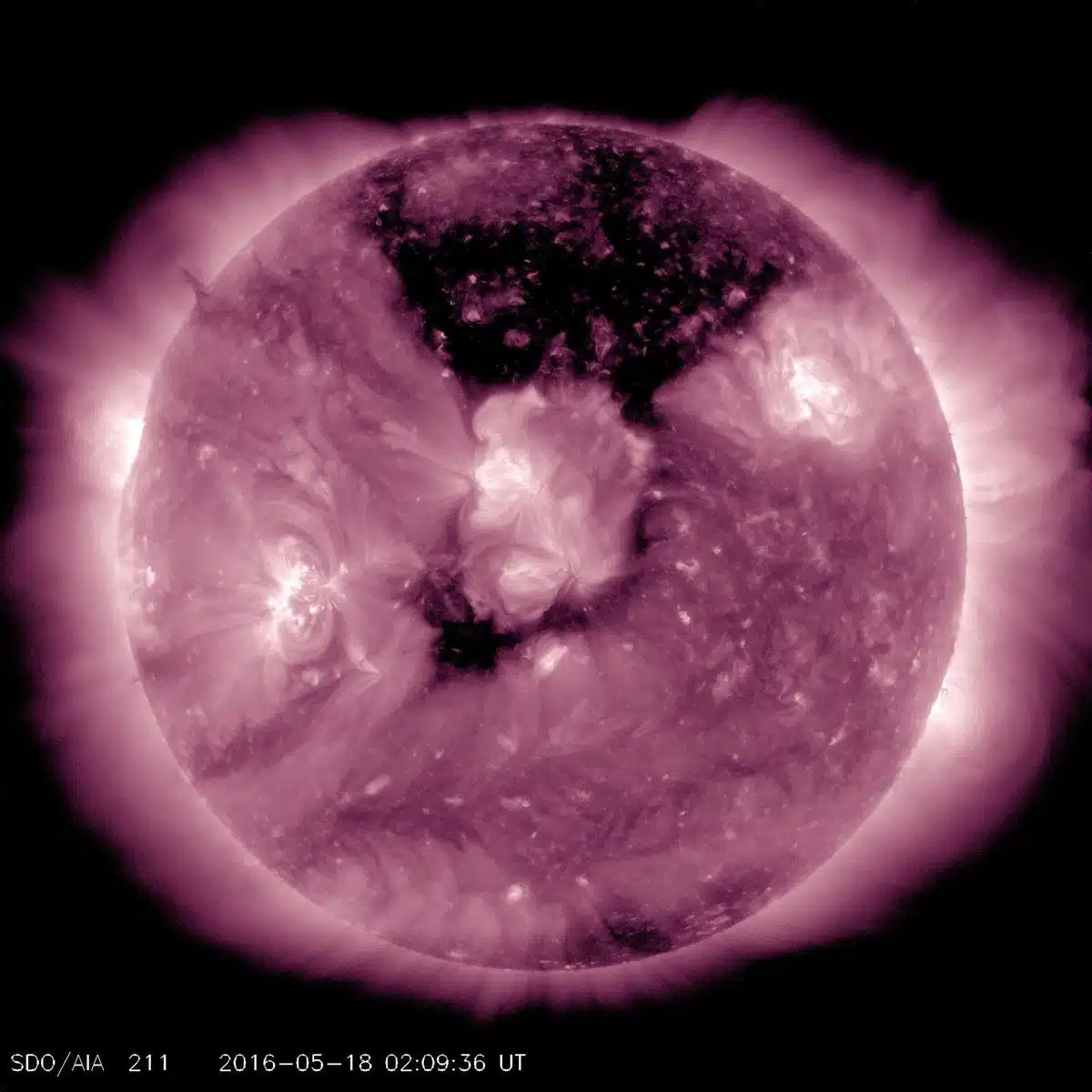 A dark coronal hole appears across the upper portion of the Sun in an extreme-ultraviolet image captured by NASA’s Solar Dynamics Observatory. Coronal holes release streams of high-speed solar wind that can trigger geomagnetic disturbances and auroras when they reach Earth. Credit: NASA/GSFC/Solar Dynamics Observatory
Two different solar disturbances are behind the forecast. One is a positive-polarity coronal hole high-speed stream rotating into a position where its effects can reach Earth. The other is a coronal mass ejection, or CME, that erupted from the Sun on November 14.
Whether the CME will actually strike Earth is less certain. SWPC describes a possible glancing blow but assigns it “low confidence.” The ejected material could arrive late on November 17 or early on November 18.
The disturbance is not expected to last long. By November 19, geomagnetic conditions should settle back to unsettled levels.
Where the Aurora Could Appear
As geomagnetic activity builds, the auroral oval, a ring of light-producing activity surrounding Earth’s magnetic pole, can spread toward lower latitudes. That expansion is what gives people farther south a chance to see the northern lights.
For Tuesday night, Forbes identifies several areas along the US-Canada border where the aurora may be visible. They include northern Washington, Idaho, Montana and South Dakota, much of North Dakota, and northern portions of Minnesota and Wisconsin. Michigan’s Upper Peninsula is also on the list.
Farther north, the outlook improves considerably.
Across most of Alaska, there is at least some chance of seeing the display, with much of the state’s interior facing particularly favorable odds. In the northeastern United States, SWPC notes that G1 storms can bring auroras into high-latitude areas, including northern Michigan and Maine.
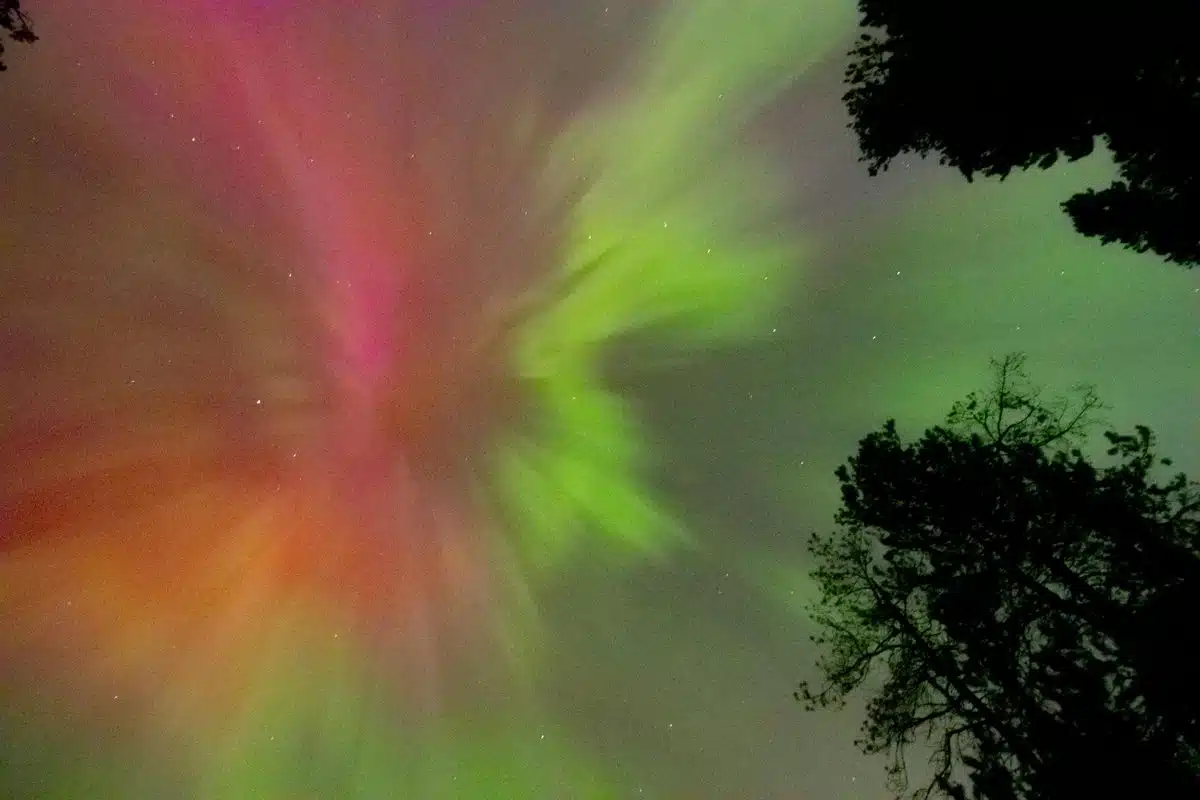 A vivid display of red and green auroras illuminates the sky over southwestern British Columbia during a geomagnetic storm. Credit: NASA/Mara Johnson-Groh
Monday night’s forecast was weaker. NOAA had predicted a Kp index of 3 for Monday night, increasing to 4 on Tuesday night. That rise could make the aurora brighter and extend its visibility farther from the magnetic pole than on an ordinary night.
How Solar Wind Becomes Light
The two disturbances originate in the Sun’s outer atmosphere, although they behave differently. A coronal hole is a region where magnetic field lines open outward into space, allowing solar wind to escape at unusually high speeds. A coronal mass ejection is more abrupt: an eruption that launches a cloud of magnetized plasma into the solar system.
Once that material reaches Earth, the interaction takes place within the magnetosphere, the magnetic envelope surrounding the planet. Energy transferred into the magnetosphere sends charged particles traveling along Earth’s magnetic field lines toward the upper atmosphere. There, the particles collide with oxygen and nitrogen atoms, transferring energy to them. As the excited atoms return to lower-energy states, they release light, with atomic oxygen producing the familiar green glow seen in many auroral displays.
 This artist’s concept shows switchbacks, or large kinks in the Sun’s magnetic field. NASA’s Goddard Space Flight Center/Conceptual Image Lab/Adriana Manrique Gutierrez
For all the spectacle such interactions can produce, a G1 storm remains a relatively modest event. SWPC notes that minor geomagnetic storms can cause weak fluctuations in power grids and small disruptions to satellite operations.
Timing and Observing Conditions
A favorable forecast is only part of the equation. For anyone hoping to catch the lights, local viewing conditions matter just as much as the strength of the geomagnetic disturbance.
NOAA recommends finding an elevated location with an unobstructed view toward the northern horizon, preferably well away from city lights and other sources of artificial illumination. The strongest viewing window generally falls between 10 p.m. and 2 a.m., centered on the hours around local midnight.
A phone camera may pick up colors that are barely noticeable to the naked eye. Switching off the flash, activating night mode and shooting in RAW format can help. So can mounting the phone on a tripod and using a timer to prevent movement during the exposure.
With longer exposures, faint green structures that might otherwise go unnoticed can become visible in photographs.
The November 14 solar eruption also produced a notable radio signal. A Type II radio emission began at 21:27 UTC that day, with an estimated speed of 1,972 kilometers per second. Such bursts originate from shock waves traveling outward through the solar corona ahead of an ejection, and astronomers can use the way their radio frequencies drift to estimate the speed of those shocks.
For the November 14 event, that estimate was 1,972 kilometers per second.