
Breadcrumb Trail Links
Project began two years ago when Laura McKenzie was thinking of how to explain her paralysis to her own kids
Published Jul 18, 2025 • 5 minute read
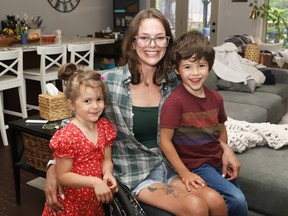 Laura McKenzie, pictured with her kids Sadie, 4, and Leo, 6, has written a children’s book titled Mommy Grew A Wheelchair. Photo by John Lappa/Sudbury StarArticle content
It began as a way to cope while she was in hospital with a life-altering illness, separated from her two young children and wrestling with what the future would look like.
Advertisement 2
This advertisement has not loaded yet, but your article continues below.
Article content
“When I was in rehab, I had a lot of time to focus on doing something,” said Laura McKenzie, who was diagnosed two years ago with a rare neurological disorder that left her paralyzed from the sternum down. “So in windows of time where I was stressing about how I would explain it to the kids, I found it easy to just kind of write about it.”
Article content
Recommended Videos
Article content
Sadie and Leo, her children, were two and four at the time, so she had to use language they would understand and a tone that would make the big change in their lives seem like more of a fun adventure than a scary ordeal.
Then it occurred to her that she could make the sentences rhyme, and draw some pictures to go along with them.
The result is a children’s book titled Mommy Grew A Wheelchair, which features images of the two kids, the author herself (both before and after her paralysis), and the family’s two big, shaggy mutts.
Sudbury Star Morning Briefing
Thanks for signing up!
Article content
Advertisement 3
This advertisement has not loaded yet, but your article continues below.
Article content
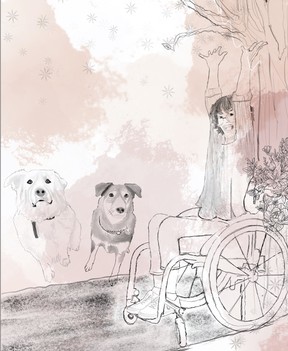 An illustration from the children’s book Mommy Grew A Wheelchair by Laura McKenzie of Sudbury.
McKenzie said she traced photographs as a way to begin the illustrations, so the subjects are very lifelike and recognizable, but her line drawing also gives them a spare, whimsical quality, reminiscent of the pen-and-ink illustrations in Winnie the Pooh.
The prose is simple but moving. “She may roll instead of run, but her love is just the same,” she writes. “And together we’re still laughing, still playing every game.”
That’s just one example. Other lines have the same upbeat, reassuring feel to them.
At first she only shared this work with her own family but after time felt it could be helpful to others.
“For other little kids, generally their introduction to somebody in a wheelchair, if it’s not someone in their family, is going to be at school,” she said. “And I can only imagine how uncomfortable it is for that kid who gets all the questions and all the stares from the kindergarteners coming off the bus. So this would be a way to introduce them to what a wheelchair could look like and what a family with one could look like.”
Advertisement 4
This advertisement has not loaded yet, but your article continues below.
Article content
At this point the book is only available as a PDF, which can be downloaded through Etsy or Ko-Fi, although McKenzie is also in the process of making it accessible as an e-book through Amazon and hopes to have it printed eventually.
“I’m also working on a colouring book that I will make available, as well, to anyone who is interested,” she said.
The 35-year-old mom said it would be great if she could bring in a bit of income from her creative work, as it’s been difficult finding a job since she lost the use of her legs, but that’s not the main focus.
“More than that it’s just really creating awareness and visibility of the disability,” she said.
Leo and Sadie are now six and four — or four-and-a-half, as Sadie will insist on pointing out — and haven proven to be quite resilient and accepting of the new reality, even if their mom can’t kick around a soccer ball with them anymore.
Advertisement 5
This advertisement has not loaded yet, but your article continues below.
Article content
But it has been a “huge adjustment” for them, said McKenzie. “They’ve had to become a lot more independent, because when their dad is not home, there are some things I just can’t do. They’ve become amazing little helpers and really good at paying to attention to things around them, like picking up their shoes at the back door because they know I’ll get stuck on them.”
It’s been a bigger adjustment for McKenzie, who before her illness had led a pretty active and adventurous life. Prior to becoming a mom, the sociology grad lived in a camper van for a couple of years, visiting locations across Canada, and travelled to India, Mexico and New Zealand.
Now it’s a bit of a production to simply get from the house to the family’s van, although the latter has been retrofitted so she can drive it using hand controls, and the former has been equipped with a lift and other accessibility features that make life a lot easier than would have been the case otherwise.
Advertisement 6
This advertisement has not loaded yet, but your article continues below.
Article content
McKenzie is determined to remain as active as she can, however. She’ll go swimming in a local lake whenever possible and is hoping to get a bicycle soon that she can pedal with her hands.
“As my kids are getting bigger, I’m trying to find new ways to keep up with them,” she said.
She’s also become active in a provincial group for people with spinal cord injuries — even though her own condition, called transverse myelitis, was brought on by a virus — and has provided peer support to others who are struggling to adapt to their new reality.
McKenzie said neurologists have told her it’s remotely possible that she could recover use of her legs at some point, and there are some treatments, included epidural stimulation, available in other countries that she hasn’t ruled out trying.
Advertisement 7
This advertisement has not loaded yet, but your article continues below.
Article content
But in general she is not optimistic that she will walk again, and is just learning to live with that, as much as she can.
“I’m generally acceptive,” she said. “But strange things will set you off. I saw a mom crouched down on the road while her daughter ran towards her and the mom picking her up in her arms. That hurt, because I can’t do that anymore. Or just something like getting stuck in corner and having to do a 17-point turn — it can be really infuriating.”
Writing and illustrating the children’s book, on the other hand, felt rewarding, as it was something she not only could do — quite well, as it turned out — but that made a big difference in her own family’s journey.
“For me it was really a relief to do it,” she said of the creative experience. “Like it almost made it feel like it was OK. Just looking at it in a different way, it felt easier to accept. And since I wasn’t at home yet, it was my way of visualizing what being at home would look like again.”
She couldn’t have known for sure that the words she wrote while confined to a hospital bed would turn out to be the reality, but it sure seems like she and her kids are embracing the vision she had for their future.
“Her wheelchair is a part of her now, like magic that grew,” her book concludes. “And with mommy by my side, there’s nothing we can’t do!”
Copies of Mommy Grew A Wheelchair are available at www.etsy.com/ca/shop/LKMMade or ko-fi.com/lauramckenzie/shop.
Article content
Share this article in your social network