
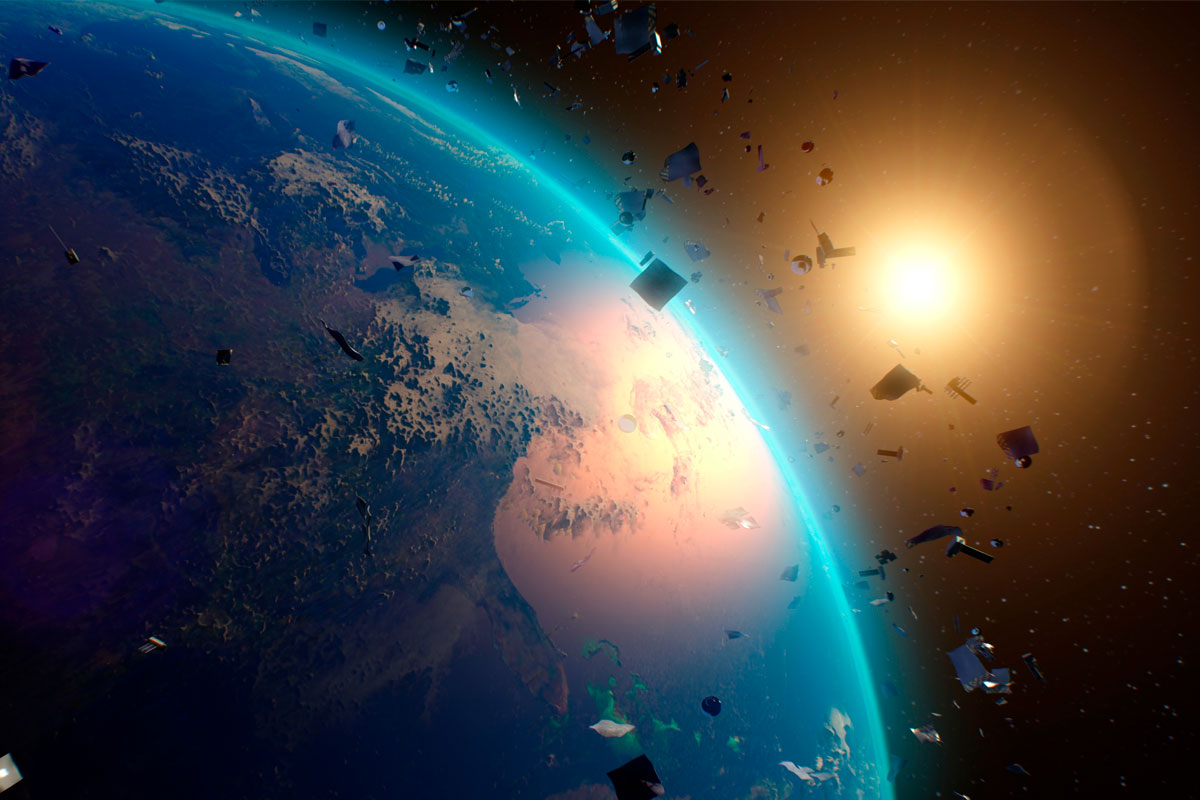
The sky is no longer just a backdrop: it becomes a territory for our exchanges. As new infrastructures unfold there, the anticipated benefits are accompanied by undesirable effects that the law struggles to keep up with. Frenzied race, unclear rules, divergent interests: the equation becomes more complex. What is really happening there, and what does it change for us?
An increasingly crowded sky
The night sky is filled with luminous traces that are no longer stars. In a few years, the number of satellites has exploded, driven by projects like Starlink (SpaceX) and Kuiper (Amazon) which promise global Internet access. However, this technological promise is accompanied by rising environmental concerns related to space pollution.
Mega-constellations, a major source of pollution
Mega-constellations gather thousands of devices in orbit. Starlink already has nearly 5,000 satellites, and each launch multiplies emissions, including carbon dioxide and soot. Injected into the upper atmosphere, these particles alter the atmospheric chemistry and exacerbate the footprint of orbital activities.
A worrying environmental impact
At the end of their life, satellites disintegrate during atmospheric reentry, releasing residues and potentially harmful compounds. According to Eloise Marais (University College London), the impact on the upper atmosphere is “still poorly assessed, but it could be lasting.” Meanwhile, the probability of collisions increases with orbital density, generating more debris and chain risks.
Race for satellites: other projects in the spotlight
Besides Starlink, initiatives like OneWeb and Kuiper target low Earth orbit. This acceleration worries specialists: more objects in orbit mean more emissions, more debris, and a brighter night sky, to the detriment of astronomical observations and the quality of scientific data.
An outdated legal framework
The standards governing space were designed before the era of mega-constellations. Stuart Martin, chairman of the board of the National Space Centre, warns about the inadequacy of this framework in the face of current consequences. The scientific community calls for adapted international regulations, integrating ecological criteria and recognizing space as a common good.
Faced with these challenges, humanity must choose how to use Earth’s orbit without compromising the environment, both on Earth and beyond.