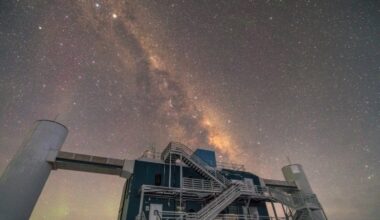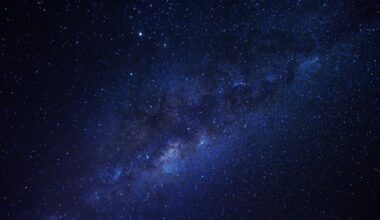
SSpace Read More The Milky Way glows brightly in first-of-its-kind neutrino imageAugust 17, 2026 IceCube has produced the first neutrino image of the Milky Way, revealing high-energy particle activity concentrated along our…
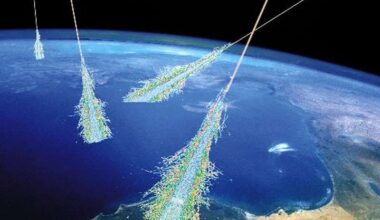
PPhysics Read More The Oh-My-God particle still defies explanationJuly 22, 2026 On the evening of October 15, 1991, the University of Utah’s Fly’s Eye detector at Dugway Proving Ground…
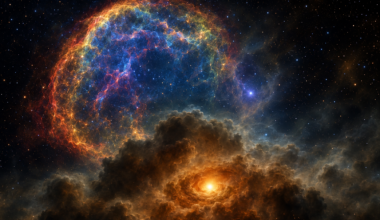
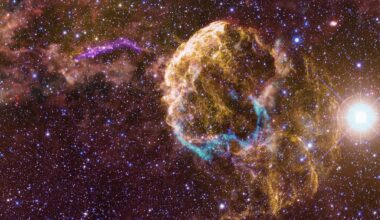
SScience Read More Organic molecules can survive violent supernova explosions – fueling star and planet formationJuly 10, 2026 A supernova remnant is supposed to be a rough neighborhood for a newborn star. Shock waves rip through…
SSpace Read More NASA’s Fermi Mission Uncovers Possible Sibling Supernova RemnantsJune 17, 2026 A new study of two supernova remnants, the debris left behind after stars explode, suggests the explosions came…
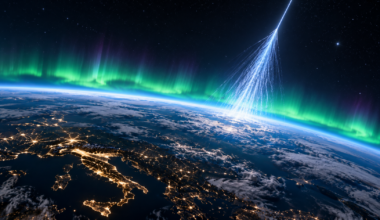
PPhysics Read More The Amaterasu Particle May Not Be a Proton at All, New Research SuggestsJune 15, 2026 In 2021, scientists detected a cosmic ray entering Earth’s atmosphere with as much kinetic energy as a fast-moving…
PPhysics Read More Jupiter Accelerates Electrons to Near-Light Speed, Offering Clues to Cosmic Ray OriginsJune 11, 2026 The giant planet’s bow shock isn’t just deflecting the solar wind, it’s acting as a powerful particle accelerator,…
PPhysics Read More A binary star breaks the 100 TeV barrier, rewrites cosmic particle limitsMay 3, 2026 For years, scientists have searched for the sources of the most energetic particles in our galaxy, cosmic rays…
SScience Read More How The Cold Void Of Space May Have Kick‑Started LifeJanuary 28, 2026 Even in the cold, airless regions between stars, cosmic dust grains can help stitch amino acids into short…
SSpace Read More NASA’s Fermi Spots Young Star Cluster Blowing Gamma-Ray BubblesDecember 19, 2025 For the first time, astronomers using NASA’s Fermi Gamma-ray Space Telescope have traced a budding outflow of gas…