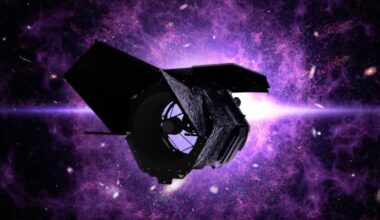
SSpace Read More NASA Completes Nancy Grace Roman Space Telescope ConstructionDecember 4, 2025 NASA’s next big eye on the cosmos is now fully assembled. On Nov. 25, technicians joined the inner…
SScience Read More Our Universe Has Already Entered Decelerating Phase, Study SuggestsNovember 7, 2025 New research from Yonsei University in Seoul, Korea, casts doubt on the long-standing theory that dark energy is…
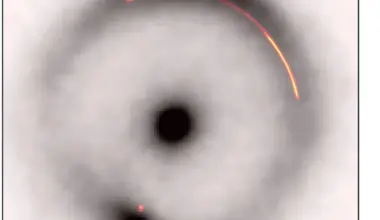
PPhysics Read More Scientists May Have Found the Smallest Clump of Dark Matter Ever Seen — and It’s Still a Million Times Heavier Than the SunOctober 19, 2025 Overlay of the infrared emission (black and white) with the radio emission (colored). The dark, low-mass object is…
PPhysics Read More Information could be a fundamental part of the universe – and may explain dark energy and dark matterOctober 13, 2025 When you buy through links on our articles, Future and its syndication partners may earn a commission. An…
PPhysics Read More Physicists Predict When The Universe Will End in a Reverse Big BangOctober 9, 2025 If recent discoveries that dark energy is evolving hold any water, our Universe will collapse under its own…
SScience Read More Can a satellite unlock the secrets of the universe?October 3, 2025 A space professor who helped design a groundbreaking satellite has said it will “profoundly change our understanding of…
SSpace Read More Most detailed universe simulation yet: ESA’s Euclid project maps 3.4 billion galaxiesSeptember 27, 2025 The catalogue describes each galaxy using more than 400 properties, including brightness, shape, velocity, and star formation rate.…
PPhysics Read More The observable universe is just 5% of reality, 95% remains invisible!September 4, 2025 Ordinary matter, also called baryonic matter, consists of protons, neutrons, and electrons. This is the material that emits…
PPhysics Read More DESI Hints Dark Energy Isn’t What We ThoughtSeptember 3, 2025 The Dark Energy Spectroscopic Instrument is mounted on the U.S. National Science Foundation’s Nicholas U. Mayall 4-meter Telescope…
PPhysics Read More Observable universe is 93 billion light years wide but what’s beyond it? Here’s what we can’t see…September 1, 2025 One of the most important pieces of evidence for this limit is the cosmic microwave background radiation, faint…
SScience Read More When stars die, black holes possibly turn their remains into dark energyAugust 23, 2025 On a quiet mountaintop in southern Arizona, 5,000 robotic eyes scan the sky every night, each locking onto…
PPhysics Read More Black Holes Are the Elusive Source of the Universe’s Dark Energy, Study ArguesAugust 22, 2025 Dark energy—the hypothetical force accelerating our universe’s expansion—sometimes raises more questions than it answers. A new study, however,…