
The meeting is being organised by the biogas developer in Toomevara Parish Hall on Thursday, October 30, at 7pm.
The Ballymackey biogas concern group is asking everyone in the community to attend.
“Showing up in numbers shows our strength,” said spokesperson Henry Mooney. “Come prepared to ask questions, particularly insofar as this plant would affect you and your families personally.
“This meeting concerns what is set to become Ireland’s largest proposed biogas plant, processing 200,000 tonnes per year. This would be a scale unprecedented in the country.”
The project is being led by former IFA chair Tim Cullinan, a local but also a nationally influential figure in Irish agriculture.
The community has been “vocal and united in opposition”, with a prior public meeting in June having more than 200 people in attendance, receiving coverage in the media and the support of Labour Party TD Alan Kelly, and several Tipperary county councillors who share the group’s concerns about its scale and location.
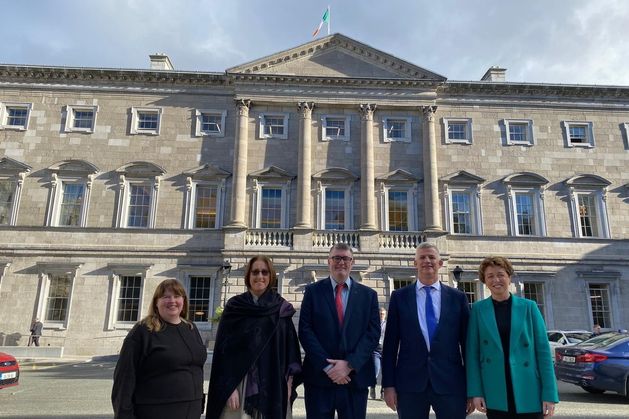
“Last week, representatives from our group joined the national biogas concern group (NBCG) at the Oireachtas Joint Committee on Agriculture and Food to highlight the national policy gaps surrounding biogas development,” said Mr Mooney.
“Ireland currently has no dedicated statutory framework to regulate siting, safety standards, or EPA enforcement for these facilities. As a result, we risk repeating the mistakes seen in parts of Europe: rapid, unregulated expansion that threatens food security, damages the environment, and undermines trust in renewable energy.”
Two members of the NBCG are from Tipperary, said spokesperson Alice Coman.
“The national biogas concern group would like to make one point clear from the outset: we are not against biogas, or anaerobic digestion technology,” she added.
“When developed and located appropriately, this technology has genuine potential to support Ireland’s transition to a low-carbon, circular economy.
“However, biogas is a complex sector. It sits at the crossroads of agriculture, energy, the environment, planning, and public health – yet it operates without a coherent, sector-specific legislative framework.”
At present, biogas development is governed in a fragmented way through planning law, waste management regulations, and environmental licensing, none of which were specifically designed for this emerging industry, said Ms Coman.
“The result is inconsistency, confusion, and a lack of clear safeguards, both for communities, and for developers who genuinely want to operate responsibly.”
Across the country, planners have refused permission for industrial-scale biogas plants for reasons including being “prejudicial to public health and seriously injurious to the residential and environmental amenity of the area”.
Other reasons include, generating traffic that would “render the road unsuitable to carry the increased loads arising from the development” and that they “would endanger public safety by reason of traffic hazard and obstruction of road users”.
Additionally, that “such developments where chemical processing involving flammable or toxic substances should be located 1,000m from an establishment”.
The NBCG was formed in 2024 as communities across Ireland began facing a wave of poorly sited industrial-scale biogas proposals, added Ms Coman.
“We are now a coalition of more than ten communities from as many counties and the same pattern repeats everywhere: a lack of open, transparent engagement.
“In many cases, developers have not held a single in-person public meeting. Communities have had to organise their own meetings and when they do, hundreds turn out.”
The groups’ shared concerns include the absence of clear, enforceable regulations on minimum setbacks from homes and waterways to mitigate environmental and health risks.
Also, industrial-scale plants proposed in the heart of rural communities without proper health, safety, or infrastructure assessments, increased HGV traffic on small local roads, limited enforcement powers for the EPA when plants breach conditions, and poor transparency and almost no engagement from developers.
There is a growing trend toward large, centralised plants that rely on feedstock hauled from long distances, undermining sustainability, instead of local, farm-scale systems that could genuinely reduce emissions by reducing carbon emissions from transport, added the NBCG.
“These challenges are not unique to Ireland. Through our partnership with FoodRise EU, we’ve seen how biogas development across Europe can harm rural communities and local environments when regulation fails to keep pace with expansion.
“The agricultural implications are also significant. In Germany, by 2011, for the first time in 25 years, domestic grain production could not meet national demand, partly due to land competition driven by biogas.
“In both Germany and the UK, long-term feedstock contracts left farmers financially exposed when markets shifted, subsidies changed, or plants went insolvent.
“Biogas in Ireland is still a fledgling industry. That gives us a valuable opportunity to learn from these lessons, before the mistakes are repeated here.
“To achieve Ireland’s biomethane targets sustainably, we need dedicated statutory instruments, built on existing parent acts like the Environmental Protection Agency Act, the Planning and Development Act, and the Waste Management Act.”
The NBCG say such instruments should clearly define biogas and biomethane as a distinct industrial-agricultural category, differentiate between industrial and farm-scale plants, and establish clear, science-based environmental and safety standards.
Additionally, NBCG believe that they should guarantee transparent public engagement and proper spatial planning, safeguard food and fodder security through sustainable feedstock sourcing, and provide“regulatory certainty that encourages responsible investment.
“Our goal is simple: to ensure biogas develops with oversight, with community trust, and with environmental balance, not in a fragmented or reactionary manner.
“In short, we are calling for biogas done right, through a statutory framework that supports innovation, protects rural Ireland, and delivers real climate benefits.”
The NBCG said it looked forward to working with the Oireachtas Joint Committee on Agriculture and Food on these issues.