
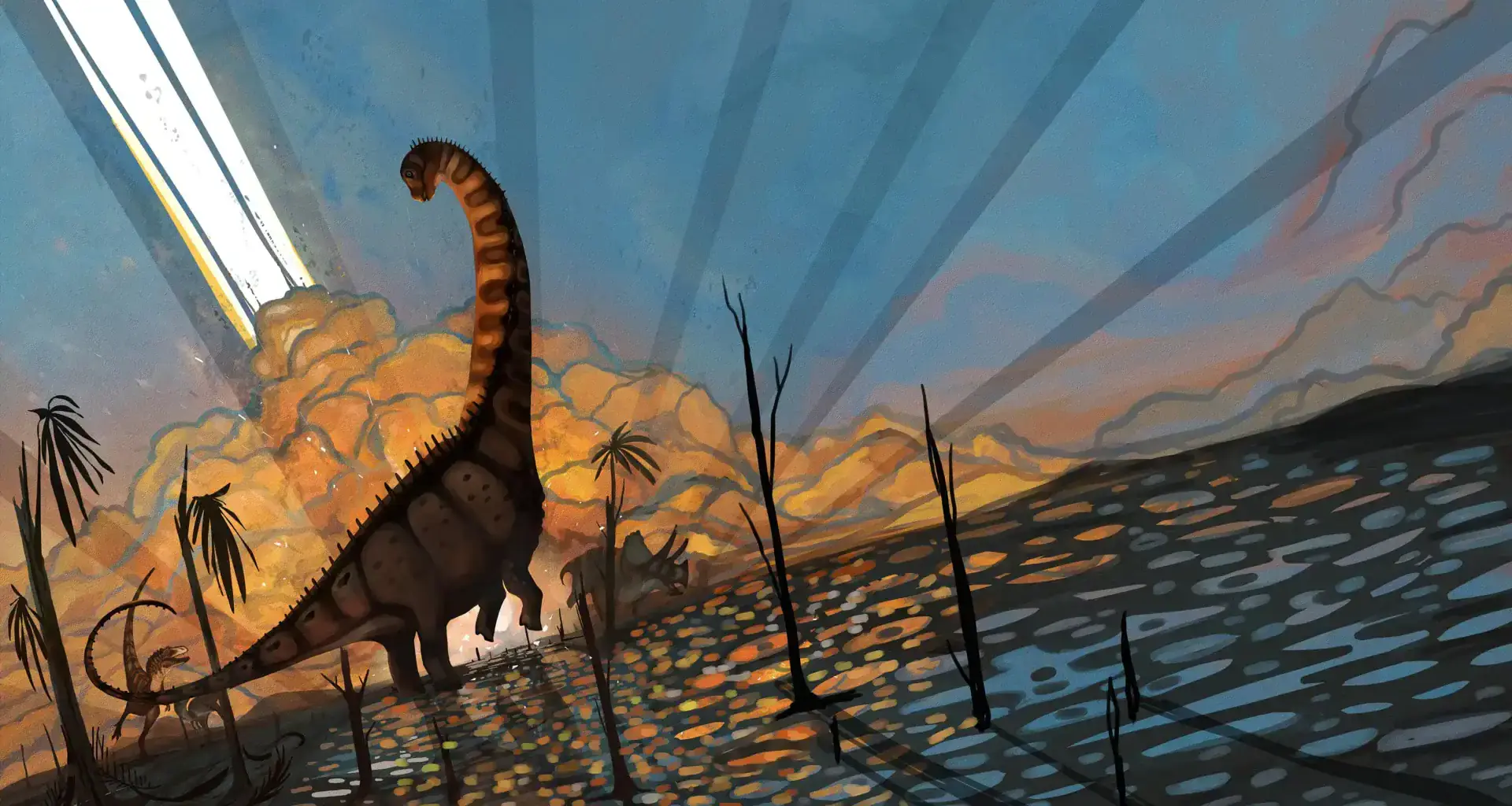
 Alamosaurus fossils show southern dinosaurs differed from same-age northern species in Montana and Wyoming. Credit: Natalia Jagielska
A new study is challenging a long-standing view of the final days of the dinosaurs. For decades, many palaeontologists believed that non-avian dinosaurs were already in decline before the asteroid impact 66 million years ago. The assumption was that dinosaurs were collapsing, and the space rock was merely the coup de grâce. But research recently published in Science suggests a very different story: these animals were still thriving when the catastrophe hit.
“They’re doing great, they’re thriving, and the asteroid impact seems to knock them out,” said Andrew Flynn, a geologist at New Mexico State University and lead author of the study.
This new evidence, discovered in the Naashoibito Member of the Kirtland Formation, paints a far more vibrant picture of the dinosaurs’ final days and complicates the long-standing narrative that they were already doomed.
The Right Time Placement
The story begins in the San Juan Basin of New Mexico. In it, there’s a geological formation called the Naashoibito Member. This formation has numerous interesting fossils, but its age is very uncertain. Earlier estimates placed it millions of years before the asteroid impact. But this new study says otherwise. Using two high-precision techniques (radioisotopic dating of volcanic crystals and magnetostratigraphy based on Earth’s shifting magnetic poles) Flynn and colleagues pinpointed its place in time.
They found that the dinosaur-bearing layers of the Naashoibito Member were deposited between 66.87 and 66.38 million years ago—no more than 400,000 years before the Chicxulub asteroid slammed into the planet.
 A restoration of the environment, featuring Dineobellator (center front), Ojoceratops (right), Tyrannosaurus (far left), and Alamosaurus (center back), taxa all known from the formation. Image via Wiki Commons.
This means the fossil assemblage in this region is nearly contemporaneous with the famous Hell Creek Formation (home to Triceratops and Edmontosaurus). But here in New Mexico the fauna includes a variety of other species, including crested lambeosaurids and large sauropods which could reach ~30 metres in length (comparable to a Boeing 737).
The dinosaur fauna is so varied that it suggests dinosaurs were doing just fine before the asteroid.
“There is no sign that these dinosaurs were in any trouble, or that anything unusual was happening to them, or that they were in any type of long-term decline,” Brusatte told The Guardian.
Regional Diversity
For years, paleontologists debated whether dinosaur ecosystems had become homogenous by the end of the Cretaceous, a possible sign of fragility before collapse. The idea was that biodiversity had thinned out, leaving species more vulnerable to environmental upheaval.
But this new research contradicts that view.
Flynn and his colleagues ran advanced ecological modeling on fossil communities from across western North America. What emerged were distinct “bioprovinces”—regional ecological zones defined not by simple geography, but by temperature gradients. Dinosaurs in the north lived in cooler, more temperate climates. Those in the south, like New Mexico, thrived in warmer habitats.
 Depiction of what a Lambeosaurus may have looked like. Image via Wikipedia.
“We recognize the final ~1 million years of dinosaur evolution as a time of biogeographic diversity and partitioning,” the authors wrote.
That diversity held true for early mammals as well. After the asteroid impact, mammals rapidly diversified. Within 300,000 years, mammals had developed new body sizes, diets, and ecological roles. Yet even in this rebound, the north and south bioprovinces remained intact.
“The surviving mammals still retain the same north and south bioprovinces,” Flynn said. “Which is different than other mass extinctions where it seems to be much more uniform.”
In other words, ecosystems didn’t become uniform after the extinction. They stayed regional and shaped by climate—similar to how they are today.
Lessons for Today
This finding doesn’t just help us understand dinosaurs better, it also helps us understand our current times because unfortunately, we’re also living in a time of extinctions.
 The impact. Credit: Donald E. Davis/Wikimedia Commons.
The question of how dinosaurs disappeared speaks to how life on Earth responds to sudden, massive change. As ecologist Lindsay Zanno puts it, “A view of life’s fragility that is limited to the present is myopic. It requires empirical insight derived from Earth’s deep-time fossil archive.”
The new findings come at a time when scientists are raising alarms about today’s rapid loss of biodiversity. Many species are struggling as habitats shrink and the climate shifts. Looking at how life recovered after past extinctions could help scientists understand what can be done today.
The asteroid impact was sudden and devastating. But the world it struck wasn’t already falling apart. Dinosaurs were still going strong—until, very abruptly, they weren’t.