
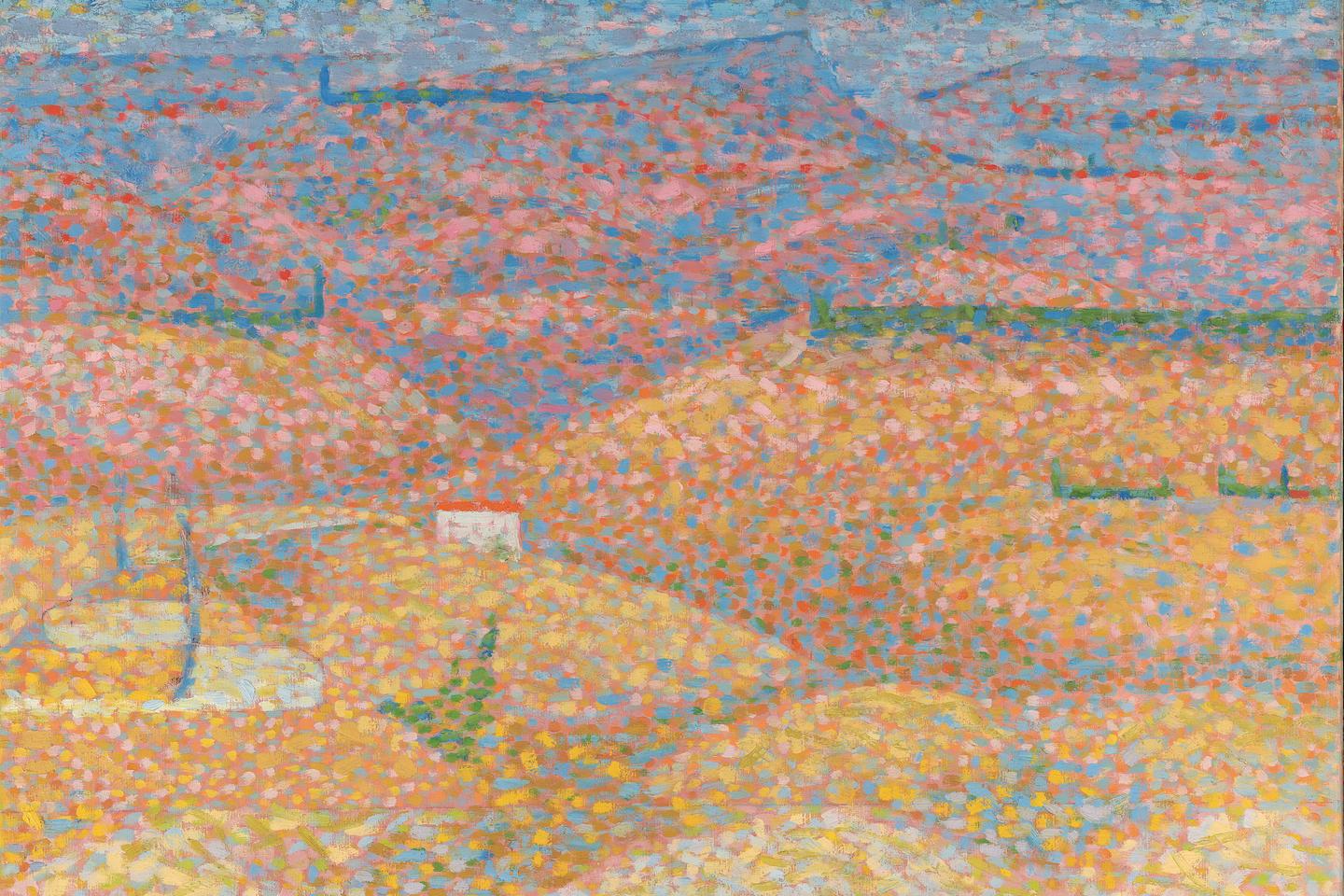
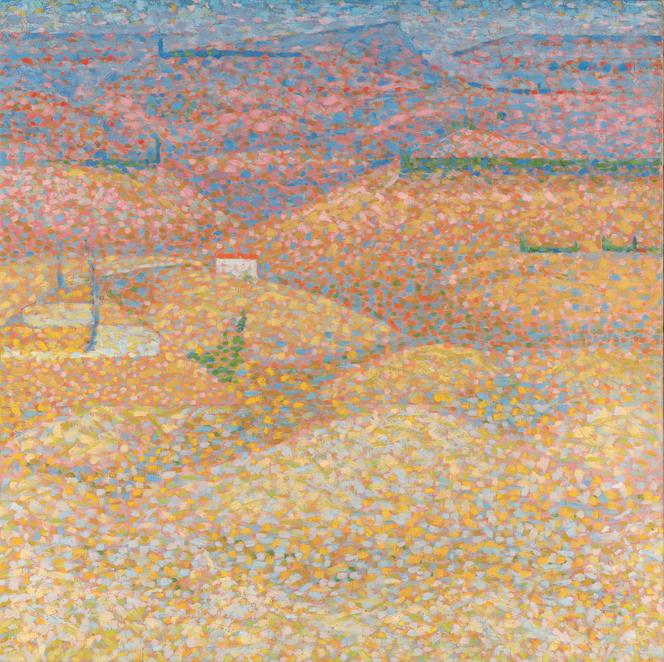
 “Pink Landscape” (1960) by Bridget Riley. PRUDENCE CUMING ASSOCIATES/BRIDGET RILEY 2025
British artist Bridget Riley, born in 1931, has long been associated with strictly geometric painting: parallel vertical bands of color, black and white grids and constructions based on the repetition of triangles or curves. In the 1960s, critics classified her work under Op Art, but she was also linked to Minimal Art. Riley is, in fact, included in the current exhibition devoted to minimalist aesthetics at the Collection Pinault, Bourse de Commerce in Paris. Such convenient categories, however, fail to capture the uniqueness, continuity and coherence of her visual experimentation. These qualities have made her one of the foremost creators of abstraction in the second half of the 20th century and beyond.
So why are four rooms dedicated to her at the Musée d’Orsay in Paris, a museum devoted to the 19th century? Because here, Riley pays tribute to the Neo-Impressionist painter Georges Seurat (1859-1891), whom she has described as her “mentor.” Their encounter – first the subject of an exhibition in London in 2015 – was initially a matter of circumstance. In 1949, then 18-year-old Riley visited the National Gallery in London, which was finally reopening after wartime, during which its collections had been scattered far from the capital. “For five years,” she recalled, “the war was everything.” At the time, Riley was living in Cornwall, away from the bombings.
You have 76.72% of this article left to read. The rest is for subscribers only.