
 Press enter or click to view image in full size
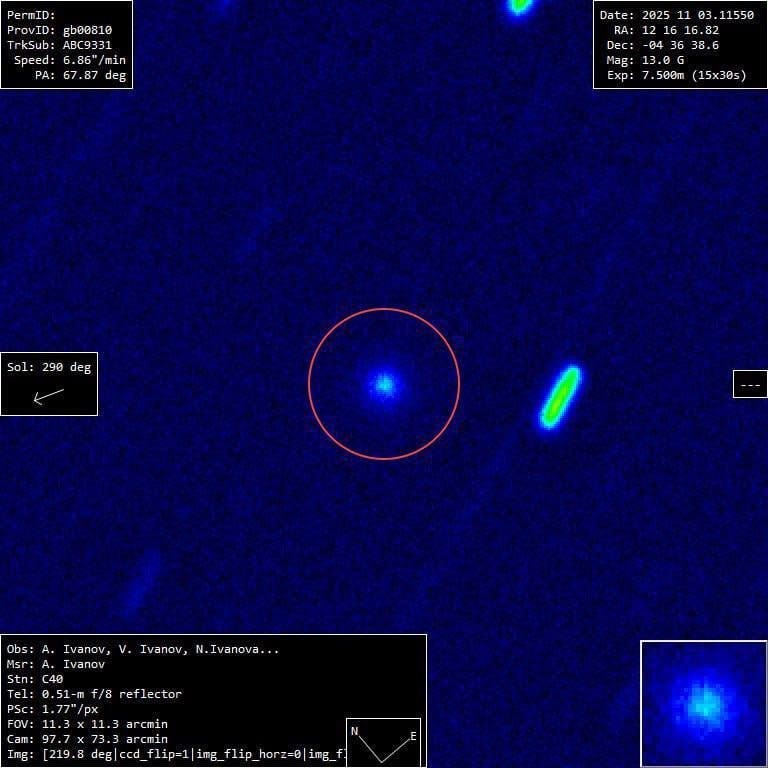
An image of a new object C/2025 V1, taken on November 3, 2025. No cometary tail is visible. The sunward direction is towards the upper right corner. (Credit: A. Ivanov et al.)
In a Newsmax interview this morning (available here), I was asked about a new “nearly interstellar” object that was just discovered in the inner solar system after the perihelion passage of the interstellar object 3I/ATLAS.
On the morning of November 2, 2025, the astronomer Gennady Borisov — discoverer of the interstellar comet 2I/Borisov in 2019, identified a new “nearly interstellar” object which is officially labeled as C/2025 V1 (Borisov). The object is by now catalogued by NASA’s JPL here and by the Minor Planet Center here.
The orbit of C/2025 V1 is inclined by 113 degrees relative to the ecliptic plane and follows an orbital plane that is nearly perpendicular to the orbit of 3I/ATLAS. Similarly to 3I/ATLAS, C/2025 V1 does not display a clear cometary tail.
The orbital eccentricity of C/2025 V1 is 1.0095 with an uncertainty of 0.0026. It would have been defined as unbound by gravity to the Sun, or equivalently a truly interstellar object, if its actual eccentricity was known to exceed 1 by a large margin. However, C/2025 V1 most likely originated from the Oort cloud at the outskirts of the Solar System.
The reason for this association is that if we integrate the motion of C/2025 V1 all the way back to a distance of 1,000 times the Earth-Sun separation (au) — where planets cannot affect it, and then recompute the orbit, a value of eccentricity so close to 1 will likely drop below 1. A small gravitational impulse from Jupiter near perihelion is sufficient to make a bound Oort Cloud object appear slightly hyperbolic in the heliocentric orbital fit of JPL. In addition, unmodeled outgassing can easily shift the apparent eccentricity to a value below 1.
One of the fundamental unknowns regarding 3I/ATLAS is whether it represents a technological mothership that released mini-probes into the inner solar system.
C/2025 V1 is not related to 3I/ATLAS if it did not employ non-gravitational propulsion. The closest separation of the two orbits is 75 million kilometers (0.5 au) and the objects were never closer than 225 million kilometers (1.5 au) from each other without propulsion. The measured non-gravitational acceleration of 3I/ATLAS is insufficient to bridge the gap with C/2025 V1.
The latest images of 3I/ATLAS show a complex structure of at least 7 jets (as discussed here). Given that a large number of jets appear in opposite directions, the reported non-gravitational acceleration of 3I/ATLAS (as discussed here) requires much more than 10–20% of its initial mass to have been ejected near perihelion. Only a fraction of the ejected mass carries an excess momentum in a preferred direction. Therefore, the cloud of debris around 3I/ATLAS must carry a substantial fraction of its initial mass in case it is a natural comet that disintegrated near perihelion. In that case, there would be no doubt about the composition of 3I/ATLAS since it lost a major fraction of its body mass to an unbound plume of gas. The composition of the debris gas cloud can be determined through spectroscopy by the Webb telescope as 3I/ATLAS gets closest to Earth on December 19, 2025. In contrast, technological thrusters could give the interstellar visitor a boost with much less mass jetted out. In a technological context, the required momentum is delivered at a higher gas speed. Chemical rockets are propelled by an exhaust speed of 3–5 kilometers per second, which is ten times larger than the maximum ejection speed of volatiles that are sublimated by sunlight from cometary surfaces. Ion thrusters reach an even higher ejection speed of 10–50 kilometers per second.
It would be easy to test whether 3I/ATLAS is natural or technological by measuring the outflow velocity, mass flux and composition of its jets during the coming month — leading to its perigee on December 19, 2025. As I mentioned in a new interview on NewsNation (here), let us hope 3I/ATLAS will not deliver any unwanted gifts to Earth during the holiday season.
ABOUT THE AUTHOR
Press enter or click to view image in full size(Image Credit: Chris Michel, National Academy of Sciences, 2023)
Avi Loeb is the head of the Galileo Project, founding director of Harvard University’s — Black Hole Initiative, director of the Institute for Theory and Computation at the Harvard-Smithsonian Center for Astrophysics, and the former chair of the astronomy department at Harvard University (2011–2020). He is a former member of the President’s Council of Advisors on Science and Technology and a former chair of the Board on Physics and Astronomy of the National Academies. He is the bestselling author of “Extraterrestrial: The First Sign of Intelligent Life Beyond Earth” and a co-author of the textbook “Life in the Cosmos”, both published in 2021. The paperback edition of his new book, titled “Interstellar”, was published in August 2024.