
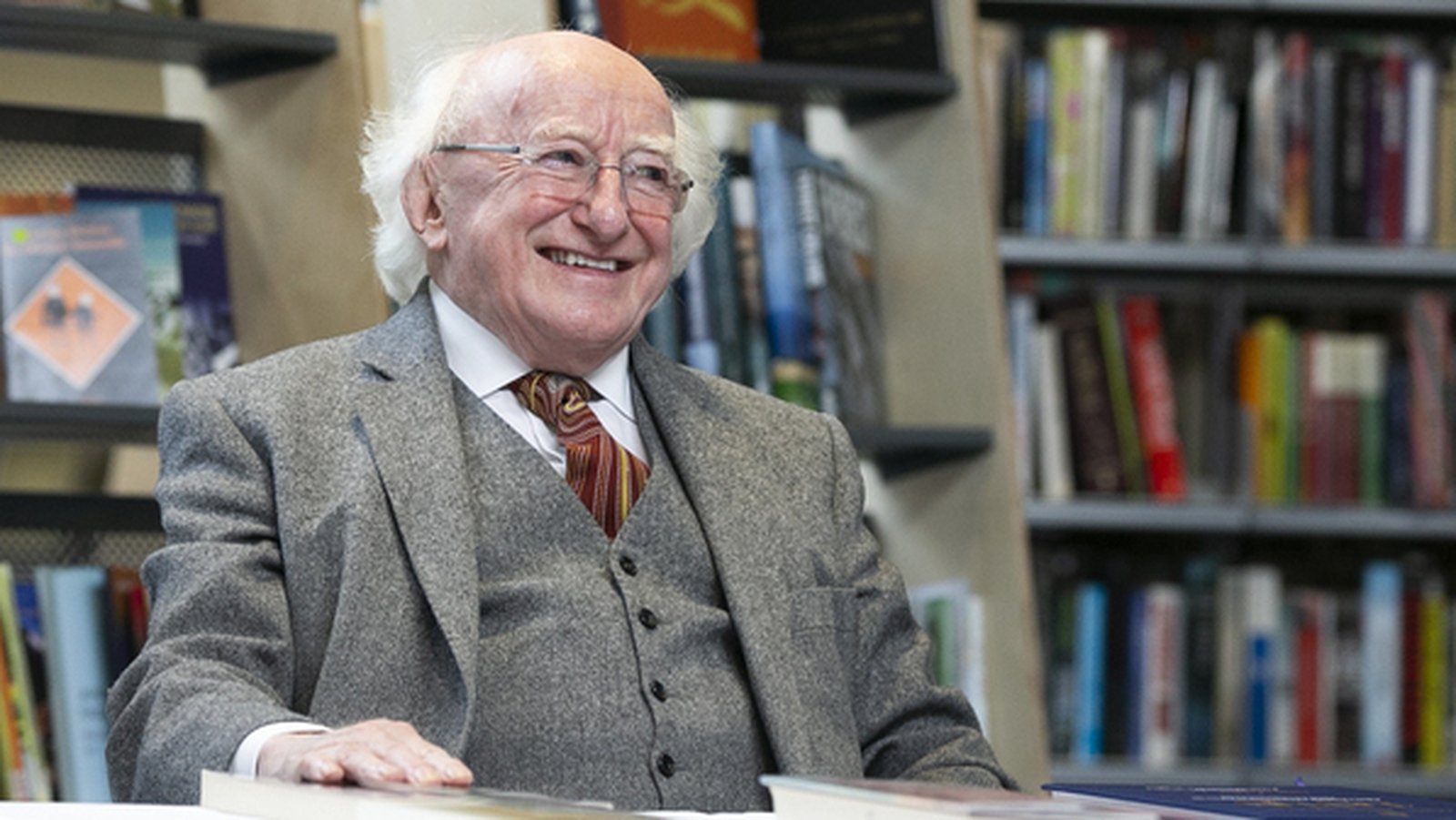
Sometimes controversial, strongly opinionated, but never dull, Michael D Higgins’ 14-year term as Uachtarán na hÉireann comes to an end this week after many historic moments that helped define modern-day Ireland.
His 14 years as Ireland’s ninth president have encompassed the centenary of the State’s foundation, the first official visit by Ireland’s president to the United Kingdom, and a meeting with the late Pope Francis in Ireland.
But they also included a global pandemic, national and international crises, and a number of significant stand-offs over what exactly the Constitution allows a president to say and do while in office.
A figure who is often seen as a contradiction, being one part ageing firebrand political activist and another part inspiration behind Michael ‘Tea’ Higgins tea cosies, knitted toys and children’s books, the now 84-year-old still divides opinion among supporters and detractors alike.
But after 14 years in office, it is difficult to disagree that his period in power has been significant, unique and ultimately central to how the Irish people have come to view the role of president – and what they may expect his successors to bring to the table.
Background and political beginnings
Given Michael D Higgins’ career in politics before becoming president and his childhood experiences of poverty, it should have been no surprise that his time in Áras an Uachtaráin would feature strongly expressed views and an emphasis on social matters.
While his father John had a solid and reliable job with a grocer in Co Cork, the aftermath of the War of Independence changed that reality, with John being interned in the Curragh and subsequently finding work difficult to obtain.
The family eventually moved to Co Limerick where John opened a bar, and like others waited for many years before being awarded a financially important military pension, a delay which contributed to a young Michael D and his brother being sent to live with relatives in Co Clare. His sisters eventually emigrated to England – neither scenario being an uncommon experience of the time.
Much of these earlier experiences played a role in shaping Michael D Higgins’ focus on social justice issues which, apart from a short dalliance as chair of Fianna Fáil’s Kevin Barry cumann while studying at the now University of Galway in the 1960s, have been key to his position as a central figure in the Labour party for more than half a century.
After two failed General Election campaigns, Michael D Higgins was appointed to the Seanad 52 years ago, in 1973, during which time he also met actress Sabina Coyne, who he has since described as his rock.
The couple married in 1974 and have four children: twins John and Michael; Daniel; and Alice Mary, the latter of whom has been a senator since 2016.
By 1981 Michael D Higgins had won the Galway West Dáil seat, before losing it during the tumultuous election of 1982, and regaining it in 1987 until he stepped down in 2011.
As part of the so-called Rainbow coalition in the early 1990s, Michael D Higgins was appointed Ireland’s first minister for Arts, Culture and the Gaeltacht.
This role meant he was central to the establishment of Irish language station TG4 and in promoting film sector tax incentives in Ireland which helped to rejuvenate the then struggling industry here.
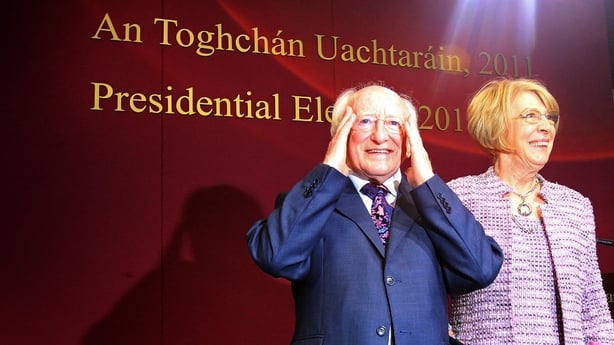
Michael D Higgins has described his wife Sabina as his rock
But it also occurred at the same time as the decision to repeal section 31 of the Broadcasting Act which had until then banned Sinn Féin from appearing on Irish broadcast media.
This 1993 decision was taken months before the 1994 Provisional IRA ceasefire and – the then government argued – was taken for civil liberty reasons as much as allowing the public to have greater scrutiny of the party’s practices.
Michael D Higgins’ pre-presidential years also saw him focus on international affairs, including his outspoken criticism of the Iraq war, his defence of Palestine and a two-state solution, his support for Latin American nations’ independence, and his backing of civil rights movements in the US and further afield.
By the 2004 presidential election the then TD had wanted to run as Labour’s candidate before the party decided that September that incumbent president Mary McAleese – who was ultimately re-elected uncontested – was in an unbeatable position.
However, by 2011 times had changed, with Michael D Higgins this time convincing his colleagues he would be able to swap his role as president of the Labour Party for a far more grandiose position.
Presidential elections and key events
That 2011 Presidential Election can politely be described as having a dramatic climax for its own already well-aired reasons.
But its outcome did result in Michael D Higgins (39.6% first count, 56.8% final count) entering office having won out against Independent Sean Gallagher (28.5%, 35.5%). The other five candidates eliminated on the first count included Sinn Féin’s Martin McGuinness (13.7%), Fine Gael’s Gay Mitchell (6.4%), Independent David Norris (6.2%), Independent Dana Rosemary Scallon (2.9%) and Mary Davis (2.7%).
That first term as president saw Mr Higgins oversee a number of key moments in modern Irish life, including in 2014 when he became the first head of State of Ireland to formally visit the United Kingdom and the British monarch, the late Queen Elizabeth II.
A year later came the marriage equality referendum landslide result, before the 2016 General Election saw the first tip-toeing towards Fine Gael and Fianna Fáil in office together as part of the confidence and supply deal and the centenary of the 1916 Rising that same year.
By 2018, two more significant events occurred under the President’s watch, including the Eighth Amendment referendum in May 2018 after the death of Savita Halappanavar five years earlier, and the visit of the late Pope Francis to Ireland three months later – events which needed a delicate hand in the Áras to represent all views on Irish society.
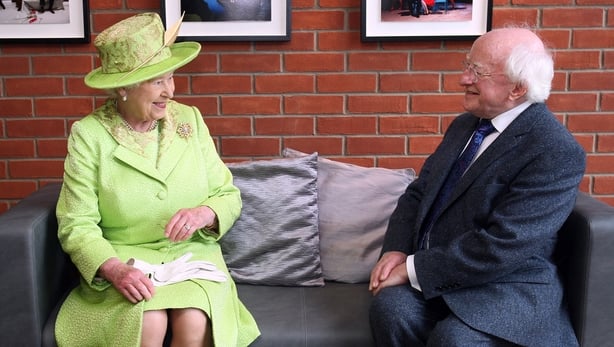
Britain’s Queen Elizabeth and President Higgins during the Queen’s visit to Ireland in 2012
It had initially been expected that Michael D Higgins’ tenure would end the following year.
But, despite initially promising to serve only one term, the President waved away that commitment in spring 2018, in the view of some people without ever fully explaining why.
While the sudden change raised some eyebrows, he was ultimately electorally vindicated, winning by a landslide, his 55.81% first count haul dwarfing those of Independent Peter Casey (23%), Independent Sean Gallagher (6%), Sinn Féin’s Liadh Ní Riada (6%), Independent Joan Freeman (5.96%) and Independent Gavin Duffy (2.18%).
The slaying of the dragons – two of his rivals in 2018 were entrepreneur panelists on TV programme Dragon’s Den – clearly stoked the flames within the returning President, as his second term in office saw him be more forceful in his public comments.
But he appeared to hold back on other occasions, such as meeting then US president Joe Biden. He always met his constitutional duties, formally appointing two governments and five taoisigh (Leo Varadkar twice, Micheál Martin twice and Simon Harris) in that time; and being a dignified and assured presence during ceremonies to mark the potentially divisive centenary events.
This period also saw the Covid-19 pandemic descend upon Ireland and the world, during which time the President’s broadcast messages and the occasional sight of him walking alone with his Bernese mountain dogs on the grounds of Áras an Uachtaráin were for some a symbol of how, regardless of position, the pandemic affected us all.
Controversies
There were controversial moments during his time in office – a number of which led to claims he over-stepped the constitutional limits to what a president can and cannot say. And, over his 14-year term in office, there has certainly been much discussion.
Perhaps given his own record as a left-wing firebrand Labour TD and senator it should have been no surprise, but the outgoing President first raised eyebrows within Government when he responded to the death of former Cuban leader and revolutionary Fidel Castro in November 2016 with a statement a number of ministers felt went too far.
In a fulsome statement at the time, President Higgins wrote of his “great sadness” at Fidel Castro’s death, describing him as “a giant among global leaders whose view was not only one of freedom for his people but for all of the oppressed and excluded peoples on the planet”.
Those remarks and similar references to the 100% literacy rate in Cuba and a health system “that is one of the most admired in the world”, without referencing the concerns of how internal dissenters have been treated, led to Government sources suggesting the President had gone too far.
They included then Fine Gael TD and foreign affairs minister Charlie Flanagan, who told RTÉ’s This Week programme that while he “did not agree” with much of Fidel Castro’s actions and “was not a fan”, he “respected” the right of the President to make his views known, and then Fianna Fáil TD and foreign affairs spokesperson Darragh O’Brien who said some of what Michael D Higgins said should be seen as “personal views”.
That underlying friction crackled far more loudly during the President’s second term in office from 2018 until today, with Government Buildings and Áras an Uachtaráin increasingly at odds over a number of issues at the centre of Irish social and political debate.
During a speech in 2022, President Higgins appeared to blur the widely implied but not explicitly stated constitutional line that Ireland’s head of state can discuss issues of national importance but not wade into direct discussions on Government policy, by raising the spectre of Ireland’s housing crisis.
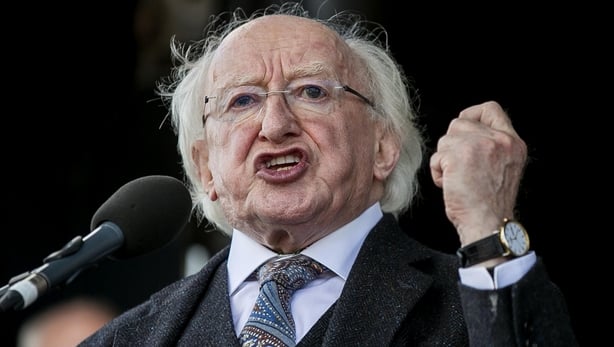
President Higgins said Ireland was ‘playing with fire’ with a consultative forum on international security
Deviating from a prepared speech in Naas, Co Kildare, the President said he has taken to “speaking ever more frankly in relation to housing because I think it is our great, great, great failure,” before adding: “It isn’t a crisis any more; it is a disaster and I think we have to really think about meeting the basic needs of people in a republic, be it about food and shelter and education.”
Those remarks led to public debate among constitutional experts over whether a sitting president is allowed to make such overt remarks about existing policies, a debate that was far from shut down by government ministers.
The following year, in 2023, the divergence between President Higgins’ views and those of the government returned to the airwaves, when the head of state was forced to apologise after he responded to questions about then-tánaiste and minister for foreign affairs Micheál Martin’s consultative forum on international security.
After initially saying Ireland is “playing with fire” due to the “drift” on foreign policy and raising concerns over “the formerly neutral countries who are now joining NATO,” President Higgins then referenced the chair of the forum Professor Louise Richardson and how she has “a very large DBE” – Dame of the British Empire.
After Mr Martin stressed the forum was balanced and Fine Gael TD Neale Richmond said the President’s comments were “disappointing” and went close to the constitutional line of what a head of state can say but did not cross it, Mr Higgins apologised, to an extent, with a spokesperson saying his comment about Prof Richardson was simply a “throwaway remark”.
And since that period there has been further friction between the Áras and Government Buildings, with the President expressing his strong views on what is happening in the Middle East and sparking criticism from Israel.
While President Higgins has repeatedly called out the violence in Gaza as a “genocide”, most recently at the Ploughing Championships in September when he suggested “we must look at exclusion from the United Nations itself” for Israel and countries supplying it with weapons, this was not a once-off clash.
Almost exactly a year earlier, President Higgins alleged that Israel was behind the leaking of his letter to Masoud Pezeshkian following his appointment as President of the Islamic Republic of Iran.
The claim was described by Israel as “baseless”, “highly inflammatory and potentially slanderous”. President Higgins did not retract his remarks.
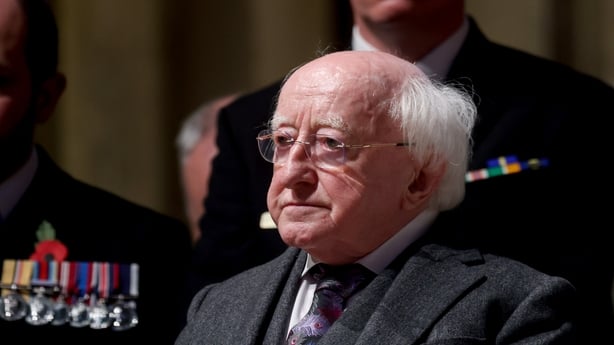
President Higgins attended his last official engagement at the National Service of Remembrance in St Patrick’s Cathedral in Dublin on 9 November 2025
Legacy
That rare mixture of presidential standing, activism, long-held staunch opinions and the unique position within the collective Irish mindset that comes from it are what the 14-year term of Ireland’s ninth head of state will most likely be remembered for.
And, alongside that legacy, a potential blueprint has been drawn up for his successors to follow, whether they choose to do so or not.
To his supporters, President Higgins’ tenure has again emphasised the position as head of state as being key to voicing the views of the wider public on social, national and international issues of the day without the need to be aligned with the Government.
And to his detractors, it is the voicing of those same views even if they make matters more difficult for the Government on the world stage that will mean there will be significant attention paid to how far or not his successors go to the boundaries of the presidential role.
Like other presidents before him, most recently Mary McAleese and Mary Robinson, President Higgins’ time in power has been often personalised, often profound. A president, ultimately, of his time. And one who, whether people liked it or not, spoke in flashes of political poetry as much as calm and pointed prose.