
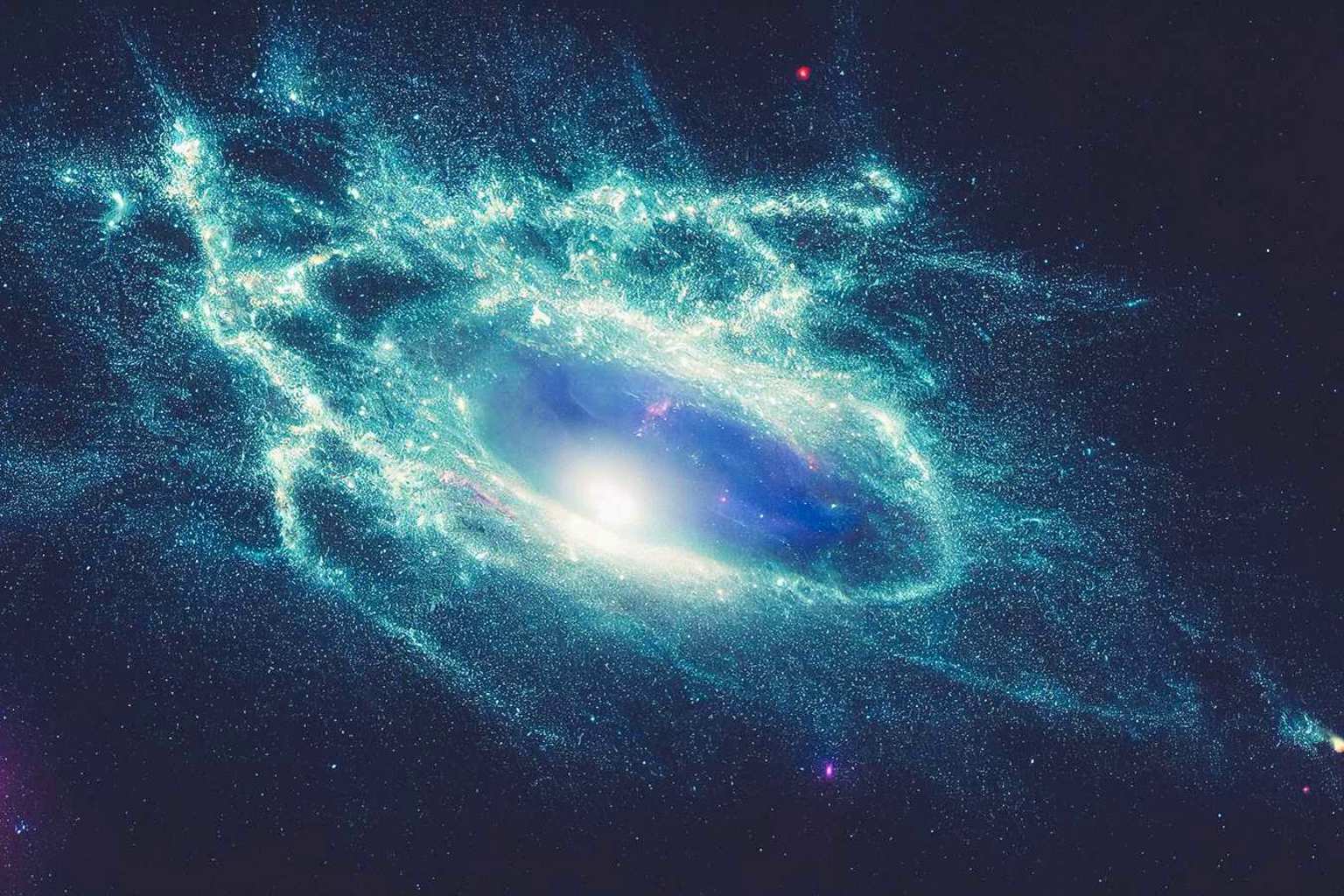
© Image credit: Record-breaking cosmic water reservoir discovered containing 140 trillion times the water on Earth
Water—one of the most familiar and essential substances on Earth—just got a cosmic upgrade. Imagine a colossal reservoir in the depths of space, holding an unimaginable amount: 140 trillion times more water than all the oceans on our planet combined. This discovery doesn’t just stretch the limits of size; it reshapes our understanding of water’s abundance across the universe.
Astronomers have pinpointed this gargantuan water reservoir around a distant quasar, a brilliant beacon powered by a supermassive black hole. Located some 12 billion light-years from Earth, this cosmic ocean lies near the heart of the universe and challenges everything we thought we knew about the distribution of water in space.
A quasar like no other
At the center of this astonishing find is the quasar known as APM 08279+5255. This celestial powerhouse hosts a supermassive black hole weighing an incredible 20 billion times the mass of our Sun and radiates energy equivalent to about a thousand trillion Suns. The sheer scale of this object alone is astounding—but surround it with a reservoir of water that dwarfs Earth’s oceans by 140 trillion times, and you have a cosmic wonder that defies imagination.
Matt Bradford, a scientist at NASA’s Jet Propulsion Laboratory involved in analyzing this quasar, emphasizes the uniqueness of this environment: “The area around this quasar is distinctive in its ability to produce this enormous mass of water.” His words, published in a study about the discovery, confirm that water is prevalent even in the farthest reaches and earliest epochs of the universe.
Matt Bradford (@MattBradfordNASA) tweeted: “Discovering the vast water reservoir around APM 08279+5255 reshapes how we think about water’s cosmic role. Water is everywhere, even on the grandest scales.”
A galactic oasis with extreme conditions
This vast water reservoir isn’t your typical cold, sparse molecular cloud. Instead, it defies common galactic conditions in several ways:
– The temperature of the reservoir is a surprisingly warm -81°F, approximately five times warmer than typical galactic clouds.
– Its density is about 100 times greater than average interstellar water clouds.
– It spans hundreds of light-years, making it a truly enormous cosmic body.
These unusual properties result from intense X-ray and infrared radiation streaming from the quasar itself. The radiation generates an environment dense and warm enough for water vapor to accumulate on a gargantuan scale. Researchers believe this cosmic ocean could even fuel the black hole’s growth, potentially increasing its mass sixfold.
Water’s cosmic ubiquity revealed
This discovery adds to a growing body of evidence showing that water is widespread in the universe, not just limited to planets like Earth. For decades, astronomers have found water in places ranging from:
– Interstellar clouds like the Orion Nebula, 1,344 light-years away, which contain both water vapor and ice.
– Protoplanetary disks, such as the region around star PDS 70, 370 light-years distant, where young planets are forming amidst water vapor.
– Comets and asteroids, including comet 67P/Churyumov-Gerasimenko, known for carrying frozen water.
– Exoplanet atmospheres, such as the super-Earth K2-18b, located 124 light-years away, where water vapor signatures have been confirmed.
These findings collectively affirm the omnipresence of water throughout space and support the idea that life’s essential ingredient is scattered throughout the cosmos. In fact, researchers suggest this widespread distribution of water raises important questions about the origin of Earth’s water and the potential for life beyond our planet.
This is supported by a 2023 report from NASA, which states that the detection of water in multiple cosmic environments “provides critical clues about the chemical pathways that lead to the formation of habitable worlds” (NASA report).
Unlocking new frontiers in cosmic water research
The immense water reservoir discovered near APM 08279+5255 is more than just a curiosity—it’s a springboard for profound scientific questions. How did such a vast quantity of water accumulate in this extreme environment? What role does this water play in cosmic evolution, including black hole growth and galaxy formation? Scientists will continue to investigate these questions with upcoming missions and next-generation telescopes.
Water, once considered unique to Earth, now emerges as a key player in the cosmic drama, inviting us to rethink our place in a universe that is surprisingly wet. This discovery from billions of light-years away reminds us that the building blocks of life are truly universal.
The science community and space enthusiasts alike are buzzing with excitement over this find, as it opens new windows into understanding the universe’s watery depths.
What do you think about this cosmic ocean? Share your thoughts, questions, or reactions in the comments below—and feel free to share this incredible discovery with fellow stargazers and curious minds!