
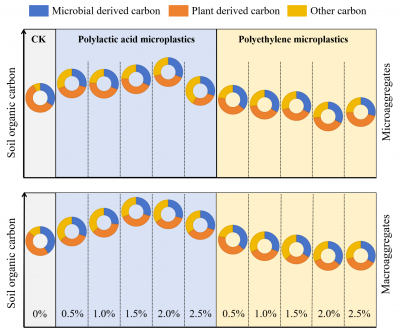
Researchers from the Chinese Research Academy of Environmental Sciences, et al. have conducted a study entitled “Differential effects of microplastics on soil organic carbon via lignin phenols and amino sugars in soil aggregates”. This study was published in Frontiers of Environmental Science & Engineering, Volume 19, Issue 7.
Soil organic carbon (SOC) stability depends on plant- and microbial-derived carbon, while microplastics (MPs) in agricultural soils affect SOC dynamics—yet their aggregate-specific impacts on carbon sources remain unclear. The study conducted a 140-day corn pot experiment with biodegradable polylactic acid (PLA) and conventional polyethylene (PE) MPs, analyzing their effects on macroaggregates (0.25–2 mm) and microaggregates (< 0.25 mm) via physicochemical and biomarker methods. Microbial biomass was higher in microaggregates, with PLA/PE impacts dependent on concentration. Both MPs reduced microbial necromass carbon and its SOC contribution in macroaggregates (divergent concentration effects in microaggregates), and PLA had higher microbial necromass carbon than PE due to better biodegradability. PE lowered plant-derived carbon (lignin phenols) across aggregates, while PLA had dosage-related effects. Notably, 87%–408% of extra SOC in PLA treatments came from microplastic-derived carbon (inflating estimates). Macroaggregates had higher SOC, with plant-derived carbon dominating their SOC accumulation and microbial-derived carbon dominating microaggregates; MPs also enhanced microaggregate SOC stability (no effect on macroaggregates). The study clarifies MPs’ aggregate-specific regulation of SOC, aiding ecological risk assessment and soil carbon management.
For more detailed information, the full paper is available at: https://doi.org/10.1007/s11783-025-2010-y.