
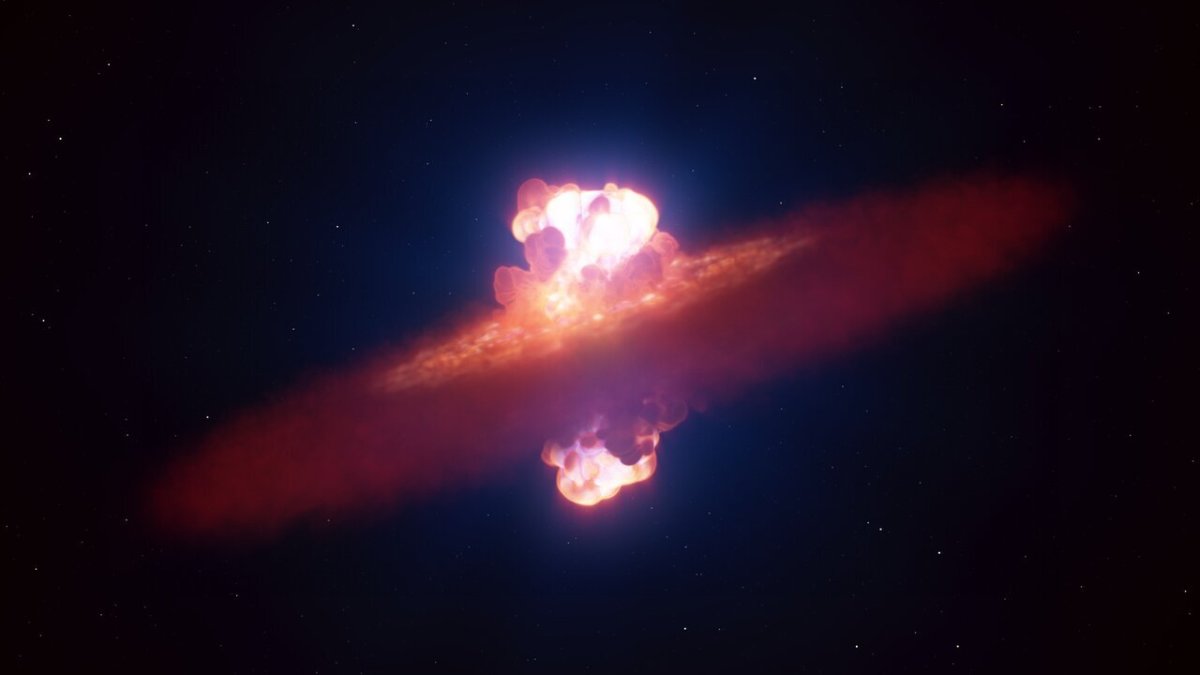
When a massive star dies, it does so with theatrical flair. A blast from its collapsing core rips through the surface, flinging matter and radiation across space.
Astronomers call this the “shock breakout” — the moment a supernova is born. It is as brief as it is violent, and until recently, it had been too fleeting to observe directly.
That has now changed. In a new study, researchers describe how they have, for the first time, caught one in the act.
On the night of April 10 last year, a new supernova — SN 2024ggi — erupted in a galaxy a mere 22 million light years away.
When the alert announcing its detection arrived, Yi Yang of Tsinghua University in Beijing had just stepped off a long-haul flight to San Francisco. He knew he had to act quickly. Within hours, he had sent an observing proposal to the European Southern Observatory (ESO), a research organisation made up of 16 member states, which swiftly approved it.
Barely a day after the discovery, the ESO’s Very Large Telescope (VLT) in Chile was watching the dying star.
• Some think 3I/Atlas is a comet. This scientist says it may be a UFO
“The first VLT observations captured the phase during which matter accelerated by the explosion near the centre of the star shot through the star’s surface,” said Dietrich Baade, an ESO astronomer and co-author of a new study published in Science Advances.

The Very Large Telescope (VLT) in Chile
PHOTO BY MARTIN BERNETTI/AFP VIA GETTY IMAGES
“For a few hours, the geometry of the star and its explosion were observed together.”
The team had seized a rare chance to see the shape of a stellar explosion during its opening act. To do so, they used spectropolarimetry, a technique that analyses the orientation of light waves to infer the geometry of the source.
In other words: though the exploding star appeared as a single point, the polarisation of its light carried clues about its form.
• Space junk smashing into the Outback may raise tensions with China
The parent star had been a red supergiant, 12 to 15 times the mass of the sun and 500 times its radius — a classical candidate for what is known as a core-collapse supernova. During its lifetime, gravity and the nuclear fusion from which it derived its energy had held the star in a delicate balance. When its nuclear furnace finally sputtered out, gravity won. The core imploded, then rebounded, driving a shockwave outward through the star’s outer layers.
The FORS2 instrument on the VLT, the only facility in the southern hemisphere capable of such measurements, recorded the scene.
What the team saw was striking. The explosion that ripped out through the surface of the star was stretched — “olive-shaped”, as the researchers put it — a sign of a shockwave surging faster along one axis than another. As the blast expanded, the shape flattened, but an axis of symmetry held steady.
That symmetry implies that something deep in the collapsing core was imposing order.
• Slender rings offer altered view of familiar Saturn
Competing theories of how a star’s heart implodes have revolved around two camps: one has emphasised the role of neutrinos, ghostly subatomic particles that stream from a dying core. The other suggests that magnetic forces channel the energy. The geometry of SN 2024ggi’s death suggests a combination of the two explanations — a neutrino-driven explosion with a magnetic backbone, which shapes the chaos.
“These findings suggest a common physical mechanism that drives the explosion of many massive stars,” said Yang.
Ferdinando Patat, an ESO astronomer and another co-author of the study, said: “This discovery not only reshapes our understanding of stellar explosions, but also demonstrates what can be achieved when science transcends borders. It’s a powerful reminder that curiosity, collaboration, and swift action can unlock profound insights into the physics shaping our universe.”