
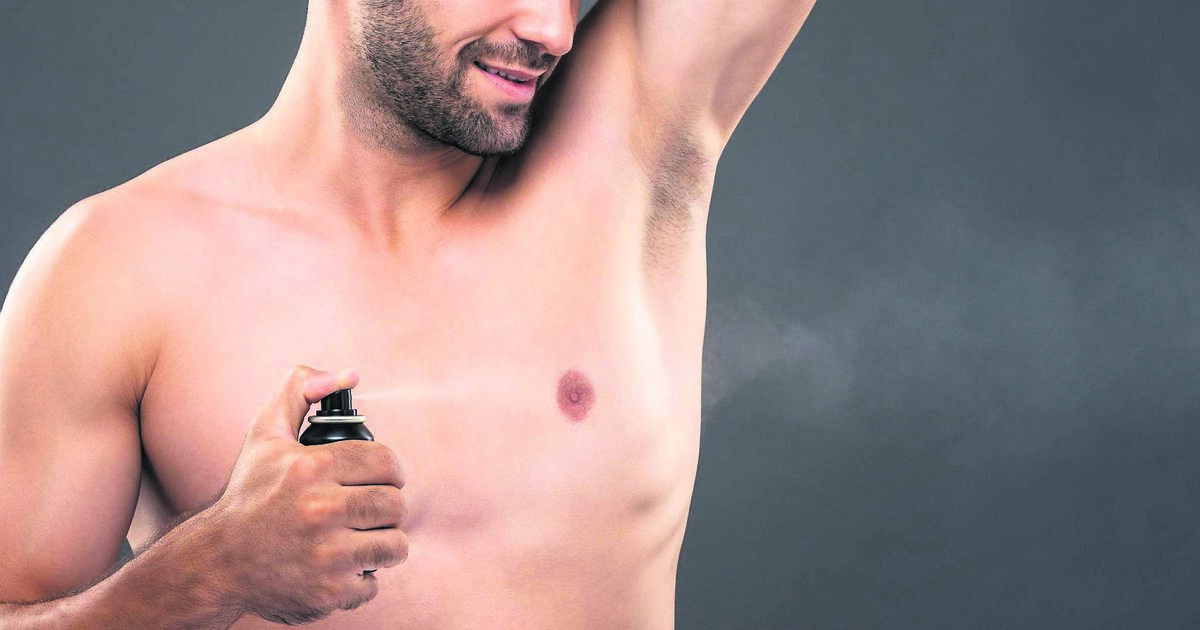
SINCE the arrival of the first underarm deodorant in the 1950s, the Irish market for fragrant sprays, roll-ons, and sweet-smelling sticks has exploded.
Readers of The Cork Examiner who saw the first adverts of a hand-drawn woman rolling Mum Rolette under her armpit in 1952 could hardly have expected that today they would witness television promos encouraging would-be buyers to spray body spray on their “butts”, “balls”, and “marbles”.
In recent months, there has been a proliferation of ads promoting products labelled as either all-over body sprays or whole-body deodorants. In one particular television ad, a young male basketball player is seen pulling out his trunks to spray what looks like a copious amount of body spray on his nether regions — an area that, up until now, had no need for fragrance.
“It’s a busy, crowded market and brands are always looking for something new,” says Stephen Ryan, the managing director of narration.ie and a lecturer at MTU.
“Getting attention is the hardest part, so they’ve gone for an edgy, raw campaign that tackles taboo topics with humour. It makes people laugh, but also introduces a genuinely new idea and product, an all-over body deodorant. They’ve created something original and paired it with bold, boundary-pushing marketing. That style fits perfectly with the TikTok generation, where content is more raw and authentic. Campaigns like this start conversations, and that’s exactly what they’re aiming for.”
While these colourful campaigns are no doubt amusing and edgy, a question mark remains over whether what they are promoting is, in fact, safe to use in the manner they suggest.
Spraying deodorant under the armpits and using body spray on the chest or back is usually fine, “balls” and “butts” — as Sure describes them in its campaign — are different matters altogether.
“There is no reason to apply deodorants or body sprays to the genital area,” says consultant dermatologist Caitriona Ryan.
“It has a very complex environment. The skin is delicate and naturally warm and moist, making it more vulnerable to irritation.
“Both men and women have a unique microbiome in this region, meaning a community of healthy bacteria that helps protect against infection and maintain the right pH balance.
“Deodorants and body sprays can disrupt this balance, leading to rashes, infections, or discomfort.
“Gentle washing with lukewarm water and mild cleansers is all that is required to maintain hygiene.”
As well as the possible physical consequences of using body spray on skin-sensitive areas, Dr Ryan is concerned about the mental health pressures that might accompany this new fad. Until recently, there had never been a problem with the usual smells emanating from the genital area.
As long as you shower regularly, smells from this area are simply not picked up. In other words, this is not a problem that needs to be solved.
“Marketing that suggests we should smell perfectly fresh everywhere can create unnecessary anxiety about completely normal body odours,” says Dr Ryan.
“This can lead to overuse of fragranced products, which in turn may cause allergic or irritant contact dermatitis and increased skin sensitivity. It is important to remember that healthy bodies have their own natural scent and do not require deodorants in intimate areas.”
 Prof Caitriona Ryan
Activating the female orgasm
Indeed, while marketing around deodorants and body sprays often suggests that they will give users more appeal to the opposite sex, science suggests otherwise, at least in part.
Robert King and his team at the department of applied psychology, UCC, have spent years researching the female orgasm and have discovered that smell plays a key role in its activation.
King and researchers identified two main types of orgasms — deep and surface-level. The deep ones were associated with higher oxytocin, known as the “bonding hormone”, and appeared more influenced by a partner’s scent.
The biggest predictor of a female orgasm is smell, says King. “The olfactory bulb in the brain, which is a piece of neural real estate that goes to processing smells, is 40% more dense in women than it is in men.”
He points to other research that suggests our noses may play a significant role in determining who we want to mate with. We’re often attracted to people whose genes complement our own, particularly a group of genes “called the major histocompatibility complex (MHC)”.
Having one or two MHC genes in common is OK, but having six that are different helps create healthier offspring, and that compatibility seems to be signalled through a partner’s scent.
“Scent is more important for women than for men from a sexual perspective,” says Rachel Herz, a neuroscientist and adjunct assistant professor at Brown Medical University in the US.
“Men pay more attention to visual cues. There’s a complicated immune system and evolutionary explanation for this. In simple terms, visual cues of attractiveness from the point of view of heterosexual males to females are signals of fertility — a waist-to-hip ratio, lustrous hair, bright eyes, and so on.
“For women, scent is the most important signal. Each of us has a unique immune system, which corresponds to our unique body odour; it’s as unique as your fingerprint. Your body odour is the external representation of the genes of your immune system. What immune system genes signal is how generally healthy you are and how compatible your immune system genes are with the person you may mate with, for example, the female doing the detecting who wants to maximise the likelihood of having a healthy offspring. So, going by body odour is very important for females in terms of determining the fitness of a male partner.”
Another really interesting evolutionary aspect of this is that women’s sense of smell is strongest during ovulation and weakest during menstruation, says Herz.
“If you think about it, it makes sense. At the time when a woman needs to be making the right biological choice, when she’s ovulating, her sense of smell is strongest.”
Signalling cleanliness
Given that our smell seems to be a way of attracting sexual partners, why would we want to cover it up with body sprays and deodorants?
“When we wear fragrance, firstly we are signalling that we’re clean and secondly we’re advertising with that fragrance and hoping that someone else will like it,” says Herz.
“If I put on a perfume that makes me feel attractive and confident that others might like it, if that’s how I perceive myself when I wear it, that’s going to make me feel good and change my behaviour.
“The conscious perception of scent happens in the part of the brain where emotion, emotional memories and associations are also being processed. No other sensory system co-opts the emotion centre of the brain. That’s how aromatherapy works.
“It’s not pharmacological; it works because it instantly activates emotions, and if those emotions are good, I’m going to feel good. If you wear a fragrance that you feel makes you smell good, you will present yourself more positively and confidently.”
There is a but.
“The modern world has potentially caused a problem for the natural biological signalling between males and females that body odour provides,” says Herz, the author of The Scent of Desire.
“Wearing fragrance masks natural body odour and can mess up the scent signal for determining a good biological match. Nowadays, I could really like the scent of the fragrance a guy is wearing and not be able to detect his natural body odour.
“Then, down the line, when we’re together, I know what he really smells like and wouldn’t have initially been attracted to his scent, but now that I have a [loving] relationship with him, it’s too late.
“It’s not very practical, but if a woman is on the hunt for the man who is going to be the father of her children, she should ask her dates not to wear a fragrance and to just get out of the shower and come meet her for a drink. That way she’ll be able to tell better if he’s [the longer term] guy for her.”
That particular dating strategy might take some time to catch on.
The story of body fragrance has ebbed and flowed over history.
While the Egyptians loved their perfume and clean clothes and the Romans came up with the concept of public baths where after cleaning themselves repeatedly they doused themselves in jasmine and lavender oils, the prudish and coy Christians of the Middle Ages were less inclined to get naked together and so covered their natural body odour with balls full of perfume, on chains suspended from their neck. That’s, of course, if they could afford it.
Today, most people in the Western world can, and the expectation now is that everyone wears at least some deodorant or body spray.
According to Statista, Irish shoppers spent €60m on deodorant last year. Its research also suggests that the use of natural and eco-friendly deodorants is on the rise as consumers prioritise sustainability and health-conscious choices.
Other research from Euromonitor International suggests that “as shoppers become more ingredient-aware, there is rising demand for alcohol-free, aluminium-free and sensitive-skin formulations”.
There is certainly more choice, and according to Dr Caitriona Ryan, consumers need to be judicious when choosing what to use on their bodies. “Fragrance-free products are usually better for sensitive skin. Alcohol can also dry the skin, and regular use of antibacterial agents may disturb the skin flora,” she says.
“Some people prefer more natural options with ingredients such as mineral salts or zinc, although these are not always as effective for everyone. The key is to choose a product that suits your own skin, avoid anything that causes stinging or redness, and remember that in most cases, less is more.”
And the advice when it comes to “balls” and “butts”, just leave it alone.