
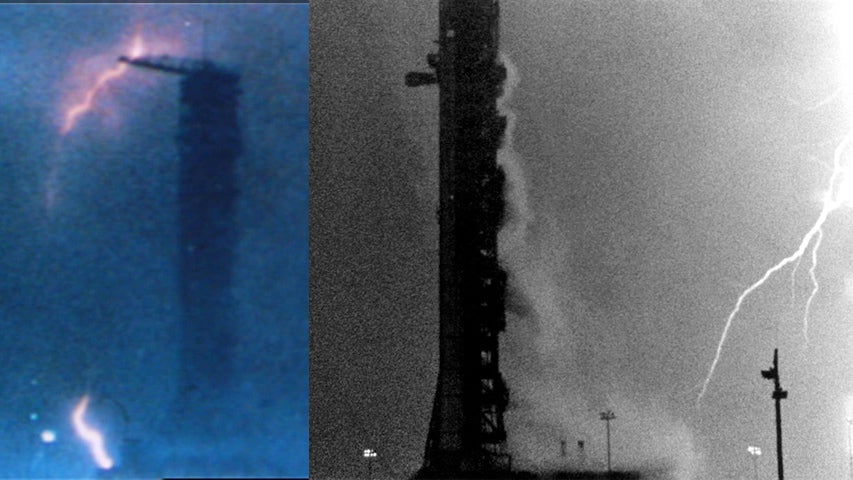

Imagine a rocket struck by lightning twice within a minute after launch, but the manned mission continued — to the moon, no less.
On Nov. 14, 1969, 56 years ago today, the Apollo 12 mission launched from Kennedy Space Center on its second manned mission to the moon, less than four months after Apollo 11 first brought humans to the lunar surface.
After scattered showers and thunderstorms popped up the previous day, overcast skies with no rain were deemed to be within the launch criteria on Nov. 14.

Weather in your inbox
By signing up you agree to the Terms & Privacy Policy. Unsubscribe at any time.
But just 36 seconds after liftoff, lightning struck the Saturn V rocket, triggering a flurry of alarms which appeared to the three-man crew of Charles Conrad, Alan Bean and Richard Gordon that their electrical power generation and distribution systems failed.
As the crew was reacting to this, a second lightning strike happened just 16 seconds later, knocking out the guidance systems. “OK, we just lost the platform, gang. I don’t know what happened here; we had everything in the world drop out,” Conrad said after the second strike. Apollo 12 lost its bearings regarding its position in space.
This unsettling situation was soon resolved thanks to John Aaron, a flight controller at Mission Control in Houston. Aaron noticed a similar incident during flight simulator training and advised flipping a switch of the signal condition equipment (SCE) to auxiliary power. Soon after, onboard instrumentation began to function normally.
Five days later, Conrad and Bean landed the lunar module on the moon, almost four months after man first stepped onto the surface.
According to NASA’s summary, launch rules were changed after Apollo 12 to ensure no future launch would be attempted in conditions where the formation of lightning was likely.
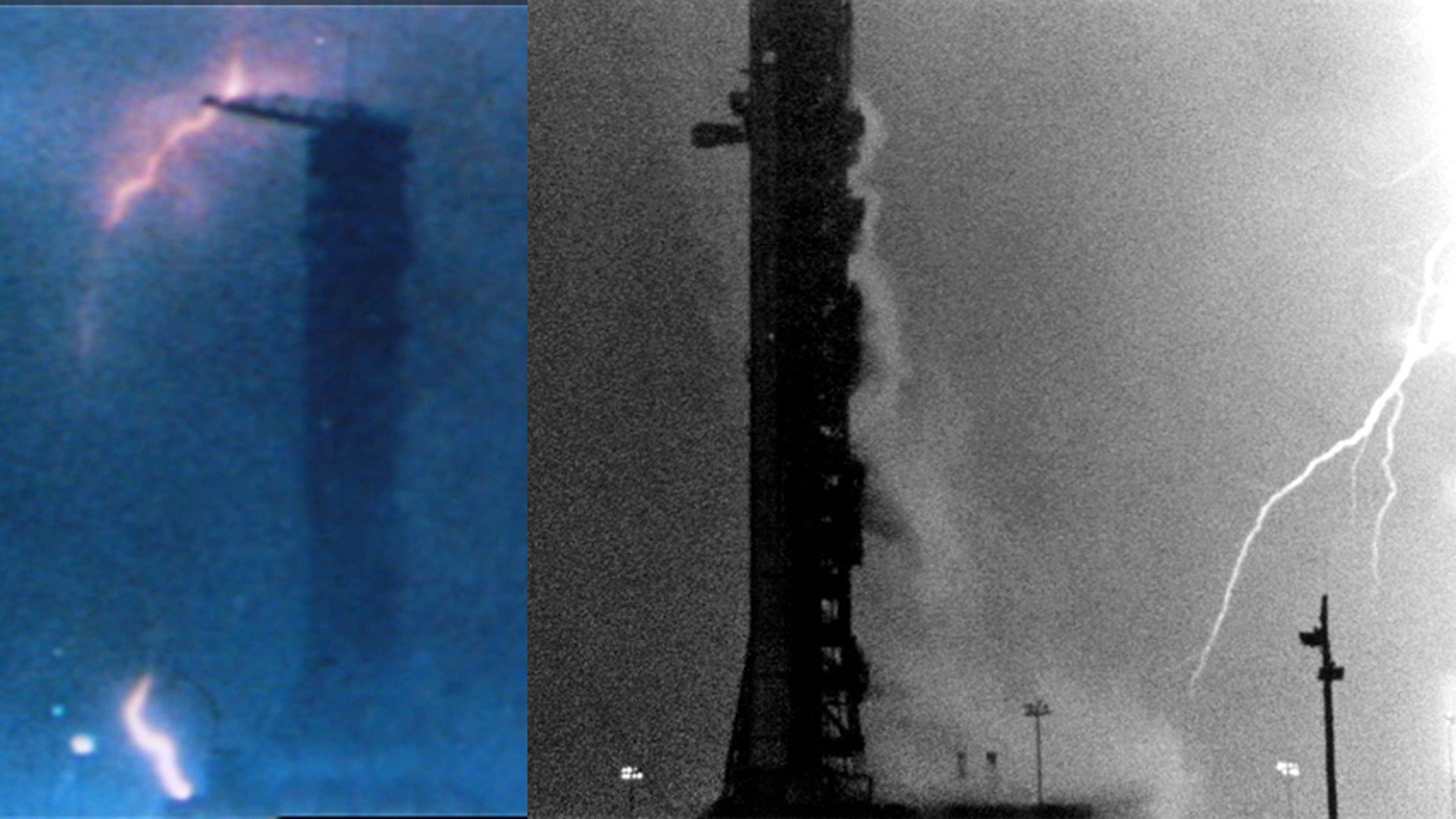
Two different views of a lightning strike 36 seconds after the launch of Apollo 12 at Kennedy Space Center, Florida, on Nov. 14, 1969.
(NASA)
Jonathan Erdman is a senior meteorologist at weather.com and has been covering national and international weather since 1996. Extreme and bizarre weather are his favorite topics. Reach out to him on Bluesky, X (formerly Twitter) and Facebook.